
Japan invites 1,000 Indian PhD scholars, researchers under LOTUS Programme 2026; apply by June 9
Major expansion in India-Japan science cooperation opens research exchange opportunities in AI, semiconductors, biotechnology, quantum science and other frontier fields

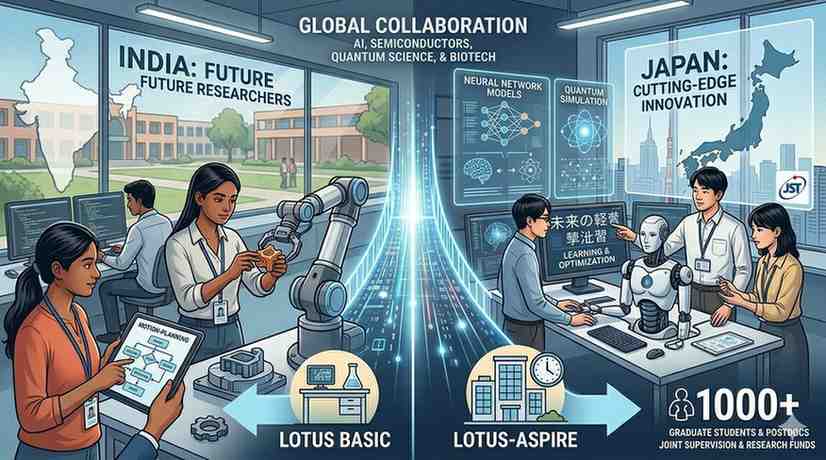
New Delhi: In a major push to deepen India-Japan scientific collaboration, Japan has invited around 1,000 participants under the LOTUS Programme 2026, a sharply expanded research exchange initiative for graduate students and postdoctoral researchers, with applications open till June 9, 2026. The programme is aimed at supporting Indian researchers to undertake joint research exchanges in Japan across cutting-edge fields, including AI, semiconductors, biotechnology, energy, and quantum science.
The LOTUS Programme — short for India-Japan Circulation of Talented Youths in Science Programme — is designed to enable young researchers from India to work on joint research projects in Japan under the guidance of principal investigators in both countries. The initiative reflects the growing strategic importance of science, technology and innovation in the broader India-Japan partnership.
Big-scale research exchange: The 2026 edition marks a significant expansion of the programme. While 55 participants from 22 institutions were selected in FY2024, the number rose to 300 participants from 78 institutions in FY2025. The upcoming round proposes expanding the programme dramatically to approximately 1,000 participants, underscoring the growing momentum in bilateral academic and research engagement.
The programme supports Master’s degree students, Doctoral degree students and postdoctoral researchers under 40 years of age. It is intended to promote the joint supervision of young researchers and strengthen the foundation for long-term Japan-India collaborative research.
Two schemes, longer support: The programme will operate through two tracks — LOTUS Basic and LOTUS-ASPIRE.
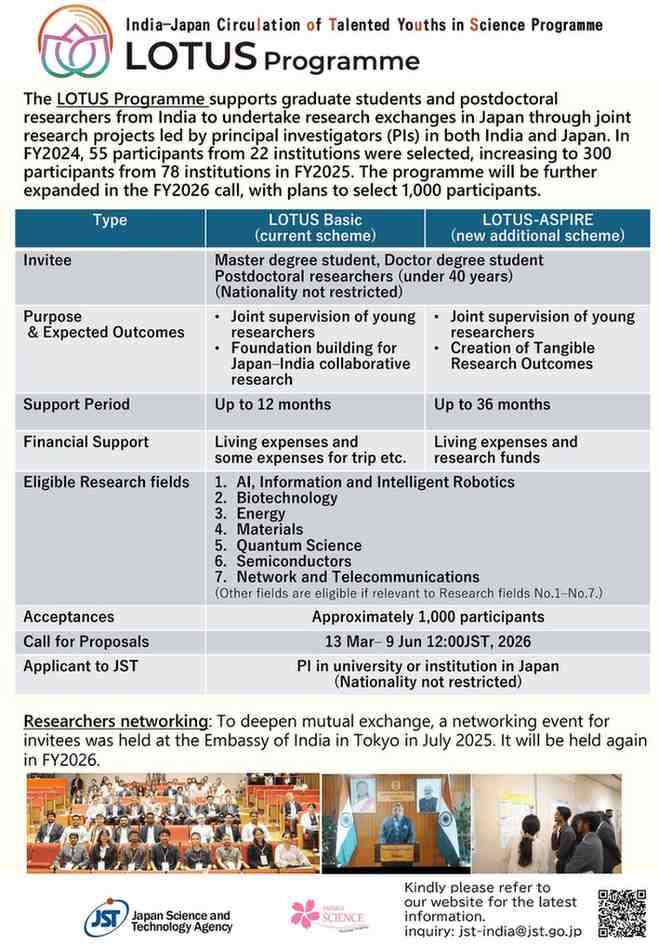 Under the current LOTUS Basic scheme, researchers can receive support for up to 12 months. The purpose is to encourage joint supervision of young researchers and to lay the foundation for deeper Japan-India collaborative research.
The newly added LOTUS-ASPIRE scheme significantly widens the scope, offering support for up to 36 months. Unlike the basic scheme, which provides living expenses and some travel-related support, the ASPIRE track includes living expenses and research funds, with the stated objective of creating more tangible research outcomes through sustained cooperation.
Focus on frontier technologies: The eligible research fields reflect the strategic priorities of both countries. These include AI, Information and Intelligent Robotics; Biotechnology; Energy; Materials; Quantum Science; Semiconductors; and Network and Telecommunications. The programme note adds that other fields may also be considered if they are relevant to these core areas.
Importantly, while the invitees include Indian graduate students and postdoctoral researchers, the formal application to the Japan Science and Technology Agency (JST) must be submitted by a principal investigator in a university or institution in Japan. The call for proposals runs from March 13 to June 9, 2026, till 12:00 JST.
The expansion of the LOTUS Programme signals a strong intent on both sides to create a more durable pipeline of young scientific talent, promote mobility in advanced research, and build institutional bridges across sectors likely to shape the future of technology and industry.
In an effort to deepen mutual exchange beyond laboratory collaboration, a networking event for invitees was held at the Embassy of India in Tokyo in July 2025 and is scheduled to be held again in FY2026. The organisers see this as a way to strengthen community-building among researchers and reinforce the human dimension of the India-Japan science partnership.