JCCII Report Highlights Rising Role of Japanese Women Professionals in India Through YKK India Experience
Digital report from the Japanese Chamber’s Women’s Advancement Committee highlights diversity, safety, challenge-driven work culture, and the changing reality of life for Japanese women professionals in India.

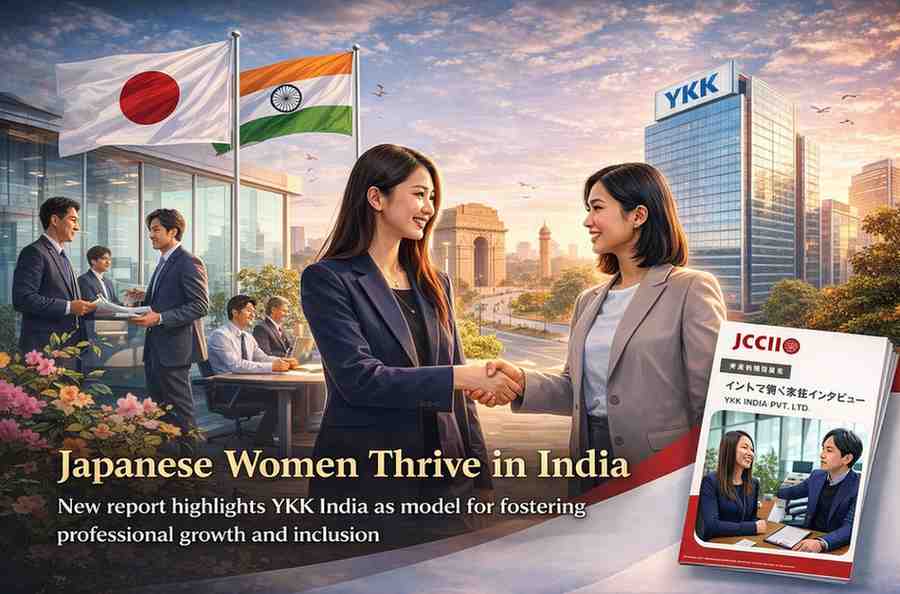
New Delhi, India – A new report issued under the Women’s Advancement Committee of the Japanese Chamber of Commerce and Industry in India (JCCII) has presented Japanese zip manufacturer company YKK India Pvt. Ltd. as an important example of how Japanese companies in India are gradually building more inclusive workplaces and creating greater professional opportunities for women, especially Japanese expatriates taking on overseas assignments.
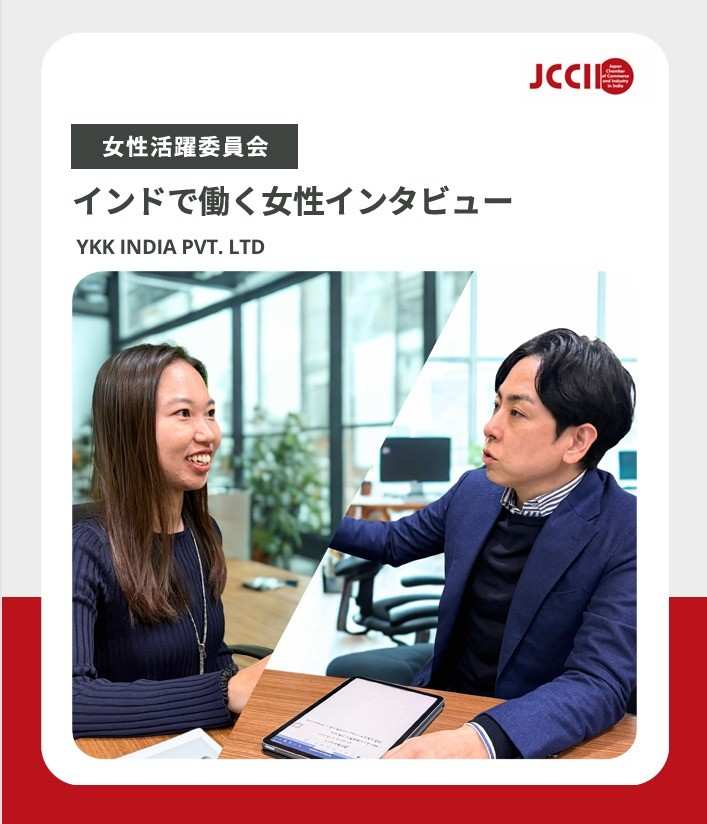
The report, titled “Interview with Women Working in India – YKK India Pvt. Ltd.”, combines management and employee perspectives to examine how workplace diversity, institutional support, and changing perceptions about India are shaping a new narrative around women’s careers in the country.
At the heart of the report are the views of Kenji Okuma, General Manager – Sales & Marketing, and Nodoka Shibahara, Senior Executive – ISAMEA, whose experiences together offer a picture of a company attempting to move beyond traditional staffing structures and toward a more multi-dimensional work culture. The report suggests that the growing presence of women in Japanese corporate operations in India is not merely a diversity exercise, but part of a wider effort to strengthen organisational adaptability, fresh thinking, and long-term competitiveness.
According to the report, YKK India had previously been a largely male-oriented organisation, partly due to practical concerns, including safety. However, the company now appears to be consciously widening its approach. Okuma is quoted as saying that YKK’s broader corporate philosophy promotes diversity and seeks to create workplaces where people with different values and perspectives can contribute. In the Indian context, he said, appointing Japanese women expatriates has become one way to achieve this broader diversity objective. He argued that while highly uniform organisations may achieve predictable, incremental growth, they are less likely to achieve the kind of breakthrough growth that comes from broader perspectives and different lived experiences.
The report places notable emphasis on safety and living conditions, an area often central to discussions about women taking up assignments in India. Okuma said the Delhi-Gurugram base offers a relatively comfortable environment for Japanese staff, with residences within a manageable travel distance of the office and access to Japanese food and other basic conveniences. He also noted that YKK India takes safety measures seriously, including travel-related precautions for expatriates and additional care for women employees. This aspect of the report appears designed to address long-standing anxieties among Japanese companies and families regarding overseas postings in India.
At the same time, the report does not present India through an overly simplified lens. Instead, it acknowledges both the opportunities and the practical challenges of working in the country. Shibahara’s account is particularly revealing in this regard. She joined YKK partly because she wanted overseas exposure within five years of starting her career and had heard that many younger employees at the company were already working internationally. After production training in Kurobe, Toyama, and about two years in Tokyo working on digitally enabled operational improvement, she moved to India. Initially, she handled order management and factory coordination on delivery schedules, and now works in a regional support function covering South Asia, the Middle East, and Africa. Her trajectory reflects not just a foreign posting but a significant career-building role tied to regional business operations.
One of the strongest themes emerging from the report is that India offers a challenge-rich environment that can accelerate growth. Shibahara said India is a growth market where individuals are given frequent opportunities to take initiative and where even younger staff can be entrusted with substantial responsibility. She indicated that this has strengthened both her confidence and motivation. The report portrays India not simply as a difficult overseas destination, but as a place where ambition, adaptability, and initiative can be tested and rewarded more quickly than in more structured or mature markets.
Yet the report is equally clear that growth comes with complexity. Shibahara described communication with Indian staff as one of the recurring challenges, pointing to differences not just in language but also in cultural background, expectations, and communication styles. She said such situations often require trial and error, including more careful face-to-face communication and deliberate efforts to convey messages by phone or email. Significantly, however, she also said that trust built over time with local colleagues often becomes the foundation for solving problems within deadlines. This makes the report valuable because it goes beyond cliché and points to the real mechanics of successful cross-cultural work: not perfection, but patience, effort, and trust-building.
The management side of the report complements this perspective by highlighting how YKK India tries to build a workplace where younger staff can take risks without fear. Okuma said the company has a core behavioural value that can be translated as “succeed even through failure,” reflecting a culture that encourages challenge rather than punishes mistakes. He also described structured support systems such as pre-departure conversations, preparatory efforts for management responsibilities, periodic check-ins after posting, and one-on-one conversations when motivation or performance dips. Such measures, he suggested, are part of creating psychological safety, especially in demanding overseas environments.
Another noteworthy aspect of the report is its rejection of simplistic gender essentialism. Asked whether there are roles in which women inherently add more value, Okuma reportedly responded that detailed, careful work should not be reduced to gender, but should be understood through individual aptitude. In Shibahara’s case, he said, her success in digitally enabled management work was less about being a woman and more about her personal strengths and digital-native capabilities. This framing is notable because it presents women’s advancement not as a symbolic representation, but as part of a merit-based, capability-led professional ecosystem.
The report also provides a more human, personal layer through Shibahara’s reflections on balance, role models, and the emotional dimensions of expatriate life. She said that alongside work, time with friends and her weekend yoga class helped her maintain psychological balance. Rather than seeing multiple commitments as a burden, she described them as a source of mental stability. She also said that while no single woman perfectly matches her ideal of a role model, seeing women who successfully balance work and private life while building international careers can broaden one’s sense of what is possible. These reflections add depth to the report by showing that women’s advancement is not only about corporate policy, but also about community, emotional resilience, and the visibility of diverse life paths.
Perhaps the most newsworthy message in the report is its call for more accurate information about India. Both the company and the employee perspective converge on the idea that outdated or one-sided perceptions may be discouraging more Japanese women from considering India assignments. Shibahara said what is needed is more “real information” that honestly explains both the rewards and the hardships of working in India, allowing women to decide with clarity rather than assumption. Okuma similarly suggested that too much information about India’s living and business environment remains frozen in a negative frame, whereas the actual experience can, in some ways, be more convenient than life in Japan. This is an important intervention, as it shifts the debate from whether India is “safe enough” or “difficult” to whether Japanese institutions are communicating the current reality clearly enough.
The broader institutional significance of the report lies in the work of the JCCII Women’s Advancement Committee, which was launched in September 2024 as a platform connecting women working in India. According to the committee’s three-year plan outlined in the report, the first phase focused on launch, membership rules, outreach, and setting goals; the second phase centres on awareness-building through networking events, digital reports, and online sessions; and the later phase aims to identify core issues and explore solutions in partnership with companies. The report notes that digital reports are planned every three months as part of this effort to raise the visibility of women working in India.
Taken together, the YKK India case study positions India as both a real challenge and a real possibility for Japanese women professionals. It suggests that the future of Japanese business in India may increasingly depend on how effectively companies combine workplace diversity, safety frameworks, managerial support, and honest communication about local realities. More than a company profile, the report reads as a sign of changing attitudes within the Japanese corporate ecosystem in India—one that sees women not on the margins of overseas business but central to its next phase of growth.
InfoBox 1: Key Takeaways from the YKK India Report
- Organisation featured: YKK India Pvt. Ltd.
- Published by: JCCII Women’s Advancement Committee
- Main focus: Women’s careers, workplace diversity, and expatriate life in India
- Voices featured: Kenji Okuma and Nodoka Shibahara
- Key themes:
- Diversity as a growth strategy
- Safety support for women expatriates
- India as a high-opportunity growth market
- Cross-cultural communication challenges
- Need for more accurate information on India
InfoBox 2: JCCII Women’s Advancement Committee at a Glance
- Launched: September 2024
- Purpose: To connect women working in India and raise recognition of their presence and achievements
- Publishing plan: Digital reports every three months
- Three-year roadmap:
- 2024: Committee launch, membership rules, recruitment, target-setting
- 2025: Awareness expansion, networking events, digital reports, online sessions
- 2026: Problem-solving phase, issue identification, possible corporate partnerships