27th World Korea Forum to Bring Global Opinion Leaders to New Delhi
Two-day programme at the University of Delhi will examine Korea-India relations, Indo-Pacific geopolitics, Korean Peninsula peace, economic security, diaspora engagement and cultural cooperation.

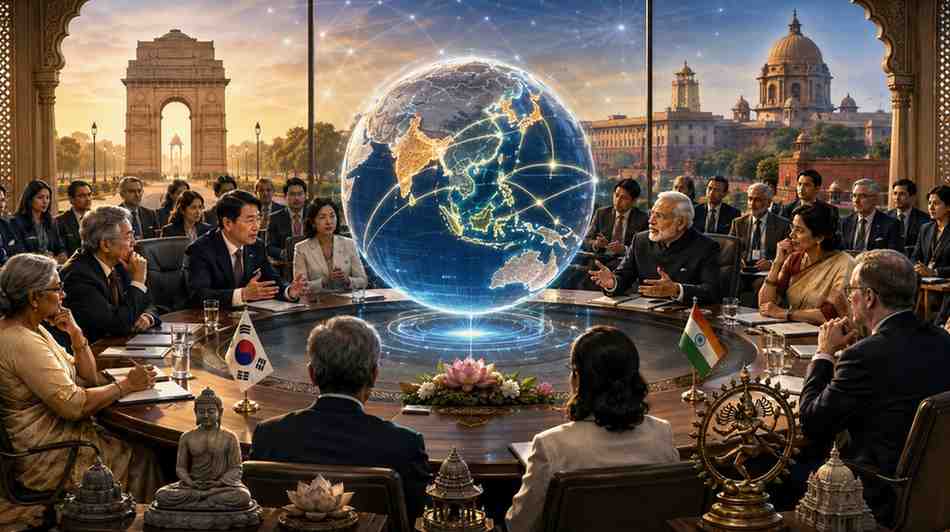
New Delhi/Seoul: Policy experts, diplomats, academics, business leaders and representatives of the Korean diaspora from several countries are scheduled to gather in New Delhi for the 27th World Korea Forum and Global Opinion Leaders Summit 2026, which will be held from August 19 to 20.
The main academic and policy sessions will take place at the University of Delhi’s North Campus, with programmes scheduled at the Vice Regal Lodge and Shankar Lal Auditorium on August 19 and 20. Korea Global Foundation (KGF), in association with the East Asian Studies, University of Delhi, and Southwest Asia Chapter Council of the Peaceful Unification Advisory Council (PUAC), is organising the event.
The forum will focus on the evolving strategic relationship between India and South Korea against the backdrop of geopolitical competition in the Indo-Pacific, changing global economic structures and continuing tensions on the Korean Peninsula.
Organised under the theme of building dialogue between the Korean Peninsula, India and the international community, the forum seeks to provide a platform for discussions on peace, security, diplomacy, trade, technology, culture and diaspora cooperation.
The programme describes India as an increasingly important economic, geopolitical and civilisational power positioned between East and West. It also highlights the role of the Indian diaspora and New Delhi’s expanding influence in the Indo-Pacific, BRICS, the Global South and other multilateral platforms.
The formal programme on August 19 will begin at the University of Delhi where the gathering will be introduced to the 27th New Delhi Global Opinion Leaders Summit, followed by a visual presentation tracing the 26-year history of the World Korea Forum.
The inaugural session, scheduled will open with remarks by Prof. Dr. Tshangchu Rhee, Executive Head of the Korea Global Foundation, on multilateral geopolitical changes and responses in an era of competition for hegemonic order.
The programme lists Prof. Dr. Yogesh Singh, Vice-Chancellor of the University of Delhi, for an address on the Indus civilisation, India’s modern history and the country’s future development.
Lee Seong-ho, Ambassador of the Republic of Korea to India, is scheduled to address more than half a century of Korea-India relations and the need for stronger strategic solidarity in the Indo-Pacific era.
A special address is also listed for Gae-ho Lee, a four-term member of South Korea’s National Assembly, former Minister of Agriculture, Food and Rural Affairs, and President’s Special Envoy to India. His address will focus on strengthening Korea-India diplomatic and economic cooperation in an increasingly multipolar world.
Sangman Shim, Forum Chair and a senior leader of the global Korean community, will speak on the growth of Korean associations and businesses overseas and the role of the diaspora in the contemporary era.
India’s Minister of Commerce and Industry Piyush Goyal is listed to deliver a keynote address on developing a strategic platform for the emergence of India and Korea as global hubs of exchange and cooperation.
Other inaugural speakers include Dr. Euy Don Park, President of the Southwest Asia Chapter Council of the Peaceful Unification Advisory Council; Dr. Vikas Gupta, Registrar of the University of Delhi; and Prof. Dr. Ranjana Mukhopadhyaya, Head of the university’s Department of East Asian Studies.
Korean Peninsula peace and security in focus: The second session, scheduled at Shankar Lal Auditorium from 1 pm to 3 pm on August 19, will focus on Korean Peninsula diplomacy and the prospects for coexistence between North and South Korea.
Dr. Seong-Chang Cheong, Vice-President of the Sejong Institute, will deliver the keynote address on South Korea’s nuclear security and the proposed MP6 framework for cooperation among strategic middle powers during a period of uncertainty over extended deterrence.
The session will include presentations on the South Korean government’s policy towards North Korea, India’s potential contribution to Korean Peninsula peace and security, and the implications of Pyongyang’s “hostile two states” position for inter-Korean reconciliation.
The listed speakers include Prof. Dr. Kevin Gray of the University of Sussex; Dr. Divakaran Padma Kumar Pillay, a retired Indian Army colonel and fellow at the Indian Institute of Defence Studies; Prof. Dr. Sudhakar Vaddi of Jawaharlal Nehru University; and Prof. Dr. Jojin V. John of Mahatma Gandhi University.
Further discussions will examine the Workers’ Party of Korea’s ninth congress and the future of US-North Korea negotiations. Speakers include Prof. Dr. Hyun-chul Yeo of Kookmin University and Jenny Town, Senior Fellow at the Stimson Center and Director of 38 North.
The panel will include representatives from the Indian and Korean academic and media communities and will be moderated by A-Young Moon, representative of PEACEMOMO.
India’s role in Korean reunification debate: A later session organised with the Southwest Asia Chapter of the Peaceful Unification Advisory Council will explore India’s expanding strategic role and its potential contribution to peace and reunification on the Korean Peninsula.
The programme includes discussions on India’s rise and South Korea’s Indo-Pacific diplomacy, the role of the Global South in building goodwill on the Korean Peninsula and the impact of changing Indo-Pacific conditions on Korean reunification.
Among those scheduled to participate are Prof. Dr. Wongi Choe of the Korea National Diplomatic Academy; former Indian Ambassador to South Korea Skand R. Tayal; Prof. Dr. Sandip Mishra of Jawaharlal Nehru University; geopolitical analyst Robinder Sachdev; Prof. Dr. Navnita Rehra of the University of Delhi; and Prof. Dr. Nansi Paulraj of Loyola College, Chennai.
The session will also feature an address by Dr. Euy Don Park on India’s rise and the possibilities for peaceful coexistence and shared prosperity on the Korean Peninsula.
Bun Do Choi, Vice-Chairman of the Peaceful Unification Advisory Council’s Asia-Pacific region, is scheduled to speak on public diplomacy and international solidarity for justice and peace during a period of global transformation.
The first full day will conclude with a gala dinner from 6.30 pm to 8 pm, with the programme listing a welcome dinner hosted by the Ambassador of the Republic of Korea to India.
International relations and changing world order: Proceedings on August 20 will begin with a session on international relations and the changing world order.
Prof. Dr. Tae-Hyung Kim of Soongsil University will deliver a keynote address on North Korea’s strategy towards South Korea and the United States amid closer political and strategic coordination among North Korea, China and Russia.
Other presentations will examine reform of the United Nations Security Council, the Korean doctrine of peace, Buddhist perspectives on international order, the political division of the Korean Peninsula and the influence of Japan’s new right and post-war nationalism on peace and conflict in East Asia.
The speakers include scholars from Russia, India, South Korea and Italy, including Prof. Dr. Dmitry N. Baryshnikov of Saint Petersburg University, Sangmo Chung of the Korean Peace Culture Institute, Prof. Dr. Narender Kumar of Jawaharlal Nehru University, Prof. Dr. Antonio Fiori of the University of Bologna and Dr. Juhee Seok of the Northeast Asian History Foundation.
The session will also include academic presentations on Korean cultural values, the translation of Korean literature into Hindi and the teaching of Korean language and culture in India.
Former British Ambassador to North Korea John Everard is listed as the moderator.
Economic security and Korea-India cooperation: A major geoeconomic session from 11.20 am to 1.20 pm will consider economic security, fair trade and the changing role of major and middle powers.
Prof. Dr. Youcheer Kim of Duksung Women’s University will deliver the keynote address on economic-security structures and minilateral cooperation for restoring fair trade.
The programme lists presentations on the foreign economic policies of India, Russia and China; the political economy of BRICS and the Global South; relations between great powers and middle powers in the Indo-Pacific; and the European Union’s strategic engagement with India and other emerging powers.
A dedicated presentation on trends and prospects in Korea-India economic cooperation will be delivered by Apurv Kumar Mishra, Consultant to the Economic Advisory Council to the Prime Minister of India.
Other participants include Antara Ghosal Singh of the Observer Research Foundation, Prof. Dr. Rahul Mishra of Jawaharlal Nehru University and Dr. Amaia Sanchez-Cacicedo of the London School of Economics and Political Science.
Panel discussions will further examine new development models involving China and India and the economic-security strategies of South Korea and Japan in Central Asia.
Diaspora and public diplomacy: The afternoon session will turn to the Korean diaspora and its growing role in public diplomacy and international cooperation.
Sangman Shim will deliver a lecture on the growth of the Korean community in India and the future of diaspora public diplomacy.
Former KAIST Vice-Rector Prof. Dr. Byoung Kyu Choi will speak on family-integrated social education for multicultural students and Korea’s NGO-based educational models.
Presentations will also cover memory and identity in Korean-American literature, the global Korean diaspora as a strategic bridge, and the experience of Korean communities in the five Central Asian countries.
The programme includes speakers from South Korea, New Zealand, Kazakhstan, India, Japan, China and Uzbekistan, reflecting the international character of the forum’s diaspora discussions.
Tagore, Indian civilisation and academic cooperation: The final thematic session will focus on the humanities, literature, philosophy and cultural interaction in a diverse world.
Dr. Eunjoo Choi, General Director of the Seoul Museum of Art, will deliver a keynote address on Rabindranath Tagore and the continuing relevance of his contributions to Indian literature, art, education and philosophy.
Other presentations will examine migration and South-South cooperation, Indian philosophy and civilisation, the global identity of K-culture and K-philosophy, the Gandhi-Nehru framework of governance and the future of Korea-India academic collaboration.
Speakers include Prof. Dr. Amba Pande of Jawaharlal Nehru University, Prof. Dr. Ananda Mishra of Banaras Hindu University, Prof. Dr. Youn Gyeong Kim of Incheon National University, Prof. Dr. Manas Kandi of the Sri Sathya Sai Institute of Higher Learning and Prof. Dr. Shyam Kumar Anand of KL University.
The forum will conclude with an audience interaction followed by a farewell dinner from 7 pm to 8.30 pm on August 20.
Through its wide-ranging programme, the 27th World Korea Forum is expected to position New Delhi as a platform for international dialogue on the Korean Peninsula while highlighting India’s expanding role in Indo-Pacific geopolitics, global economic cooperation, peace-building and diaspora diplomacy.