

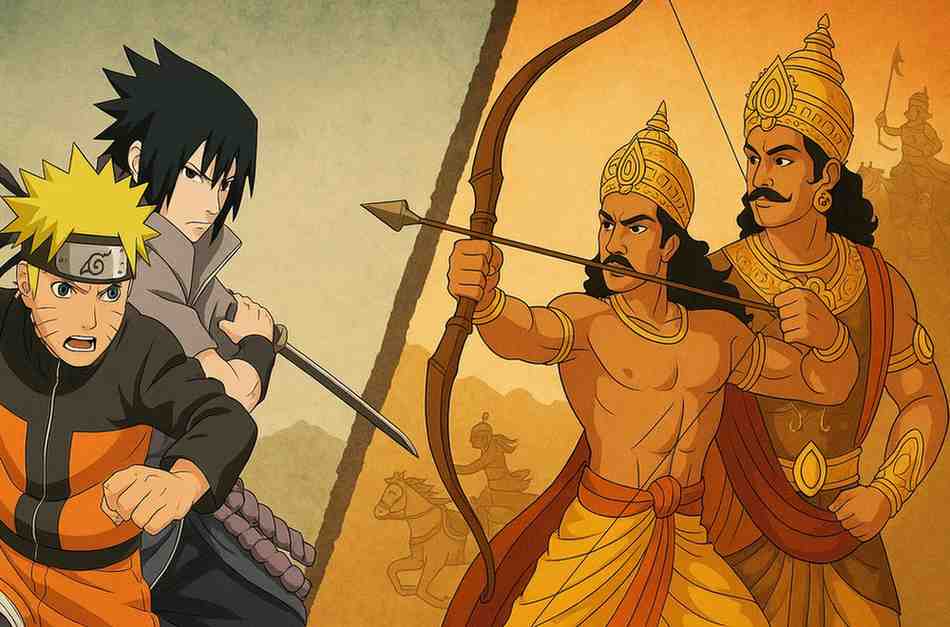
New Delhi, India, August 8, 2025 — When we place the world of Japanese anime beside Indian mythology, few comparisons are as fascinating as that of Naruto and the Mahabharat. On the surface, they seem worlds apart—one a fictional tale of ninjas set in a mystical version of Japan, the other an ancient Indian epic chronicling divine wars and dharma. But a deeper look reveals rich thematic overlaps that resonate universally—ideas of destiny, rivalry, sacrifice, and inner conflict.
At the heart of both narratives lies a war that defines the fate of nations. In Naruto, the Fourth Great Ninja War mirrors the epic battle of Kurukshetra in the Mahabharat. Both conflicts are not just physical but deeply philosophical, exploring the consequences of hatred, revenge, and the need for peace. While Naruto Uzumaki fights to end the cycle of hatred among shinobi, Krishna in the Mahabharat becomes the divine guide urging Arjuna to fight for righteousness, even against his kin.
The central characters also show intriguing parallels. Naruto himself is much like Karna—ostracized by society, driven by the need for acceptance, and possessing great inner strength. Yet, he also mirrors Arjuna in his role as a chosen one, a prodigy burdened with fate and moral decisions. Similarly, Sasuke Uchiha’s path of vengeance, pride, and redemption finds echoes in the character of Ashwatthama, who too is a fallen warrior driven by loss and anger, eventually punished for his blind rage.
The concept of friendship and rivalry is pivotal in both tales. The bond between Naruto and Sasuke is strikingly similar to that between Krishna and Arjuna, but with the added layer of conflict. While Arjuna and Krishna remain allies through the battle, Naruto must win Sasuke over from the darkness. Their dynamic explores the fine line between love and rivalry, a duality also found among the Kauravas and Pandavas, especially in the relationship between Duryodhana and his cousins.
Themes of reincarnation and destiny are also dominant in both stories. Naruto delves into the cycle of rebirth through the legends of Indra and Asura, whose descendants continue their ideological battle through Sasuke and Naruto. The Mahabharat too, is full of karmic loops and spiritual rebirths, where characters are born to fulfill cosmic roles. The eternal return of conflict and the hope of spiritual resolution bind the two narratives together in surprising harmony.
Mentorship is another strong parallel. Just as Naruto grows under the guidance of Jiraiya, Kakashi, and ultimately his own life experiences, Arjuna evolves through his lessons from Krishna. These mentors are not just teachers of technique but moral compasses, guiding their pupils through ethical and emotional turmoil. The role of the mentor in both stories reflects the ancient teacher-disciple tradition rooted in Asian cultures.
Female characters in both stories often represent strength through suffering. Hinata’s quiet resilience and devotion echo Draupadi’s dignity and fire. Sakura’s evolution into a formidable warrior and healer also reflects the strength of women like Kunti or Subhadra, who, though not in the battlefield, influence events through wisdom and support. While anime has been critiqued for its portrayal of women, Naruto does offer moments of depth that resonate with the layered portrayal of women in the Mahabharat.
Even the villains in both tales are complex rather than purely evil. Madara Uchiha, with his idealistic yet destructive vision for peace, can be likened to figures like Duryodhana or even Bhishma—those who pursue flawed righteousness. These characters challenge the binary of good and evil, forcing protagonists to confront uncomfortable truths.
Ultimately, both Naruto and the Mahabharat serve as epic journeys of self-discovery, spiritual evolution, and social commentary. Their mythological scale is balanced by intimate emotional struggles. Though separated by centuries and cultures, they tap into the universal archetypes of heroism, fallibility, and redemption.