Haryana to Roll Out ‘Make in Haryana’ Policy to Boost Manufacturing
The policy launch in Gurugram is expected to position Haryana as a stronger manufacturing and investment destination for Japanese, Korean, Taiwanese and other global companies looking at India as a production base.

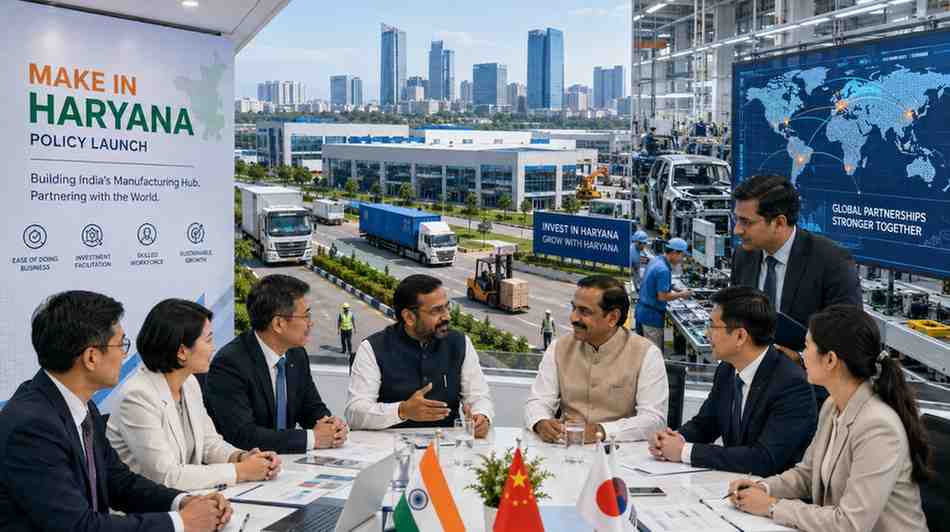
New Delhi/Gurugram: In a major move to attract fresh industrial investment, especially from East Asian manufacturing powerhouses such as Japan, South Korea and Taiwan, the Haryana government is set to launch the “Make in Haryana Policy” on Monday, June 1, 2026, in Gurugram.
The policy rollout, to be chaired by Haryana Chief Minister Nayab Singh Saini, is expected to mark a renewed push by the state to strengthen its position as one of India’s most preferred destinations for manufacturing, supply-chain expansion, electronics, automotive, components, logistics, warehousing and export-oriented industrial activity.
The launch event, organised by the Department of Industries & Commerce, Government of Haryana, will take place in Gurugram near New Delhi on Monday. It will also see the unveiling of other sectoral policies aimed at creating a more focused and investment-friendly industrial ecosystem in the state.
The programme will be held in the presence of Rao Narbir Singh, Haryana’s Minister of Industries & Commerce, Environment, Forests and Wildlife, Foreign Cooperation, and Sainik & Ardh Sainik Welfare. Senior officials from the state government, industry bodies, investors, corporate representatives and other stakeholders are expected to attend the launch.
Haryana already occupies a strategic position in India’s industrial map. Gurugram, Manesar, Bawal, Dharuhera, Faridabad, Sonipat and other industrial belts have attracted a wide range of domestic and foreign companies over the years. The state is particularly important for Japanese and Korean companies because of its strong presence in automobile manufacturing, auto components, electronics, logistics, engineering, food processing and services.
The new policy is likely to build on Haryana’s existing advantages — proximity to Delhi, access to the National Capital Region market, industrial infrastructure, expressway connectivity, skilled manpower, airport access and the presence of global companies. For East Asian investors, these factors are particularly important as many companies are now looking to diversify supply chains, reduce overdependence on single-country production bases and expand manufacturing footprints in India.
The timing of the policy is also significant. Japanese, Korean and Taiwanese companies have been increasingly evaluating India not only as a consumer market but also as a production and export hub. The global “China Plus One” strategy, India’s growing domestic demand, the expansion of production-linked incentive schemes and the rise of industrial corridors have created a favourable environment for states such as Haryana to compete aggressively for foreign investment.
The agenda of the launch suggests that the government intends to present the policy as a serious industrial roadmap rather than a routine announcement. According to the event schedule, the programme will begin with registration and welcome tea from 10:30 am, followed by guest seating, reception and welcoming of guests on the dais.
Dr. Amit K. Agrawal, IAS, Commissioner and Secretary, Department of Industries & Commerce, will deliver the welcome address. The policies will then be unveiled by the Chief Minister, followed by a presentation on policy highlights by Dr. Yash Garg, IAS, Director General, Industries & Commerce and Director General, MSME.
The event will also include key launches and announcements, remarks by Arun Kumar Gupta, IAS, Principal Secretary to the Chief Minister, and an MoU exchange ceremony. Rao Narbir Singh will deliver a special address, while Chief Minister Nayab Singh Saini will give the keynote address. The formal programme will conclude with a vote of thanks by Sushil Sarwan, IAS, Managing Director, HSIIDC, followed by press and media interactions and an experience centre walkthrough.
For Haryana, the policy carries both economic and strategic importance. The state faces strong competition from Gujarat, Maharashtra, Tamil Nadu, Karnataka, Uttar Pradesh and Telangana, all of which are aggressively courting global manufacturers. A clear and investor-friendly “Make in Haryana” framework could help the state sharpen its pitch before foreign companies, particularly those from East Asia with long-term manufacturing plans in India.
The presence of institutions such as HSIIDC and HEPC in the launch communication also indicates that industrial infrastructure and investment facilitation will remain central to the policy approach. Investors will closely watch whether the policy offers stronger incentives, faster approvals, land support, MSME integration, export promotion measures, sector-specific clusters and a simplified business environment.
For Japanese companies, Haryana has long been an important base because of the Maruti Suzuki ecosystem, auto-component suppliers and the Delhi-Mumbai Industrial Corridor-linked industrial belt. Korean companies have also shown interest in Gurugram and Manesar because of electronics, automobiles, trading, logistics and consumer-sector linkages. Taiwanese companies, particularly in electronics, ICT hardware and precision manufacturing, may see Haryana as a potential destination if the state can offer competitive infrastructure, skilled manpower and policy certainty.
The proposed launch of “Make in Haryana” also comes at a time when India is trying to move from being a large market to becoming a global manufacturing hub. Haryana’s success in attracting East Asian investment will depend not only on policy announcements but also on execution, speed of clearances, cost competitiveness and aftercare support for investors.
If implemented effectively, the policy could help Haryana move beyond its traditional industrial strengths and enter newer areas such as electronics manufacturing, EV components, semiconductors-linked supply chains, green technologies, medical devices, robotics, logistics and advanced engineering.
With the formal rollout scheduled for Monday, the state government is expected to send a clear message to investors: Haryana wants to be seen not just as a business-friendly NCR state, but as a frontline manufacturing destination in India’s next industrial growth story.