

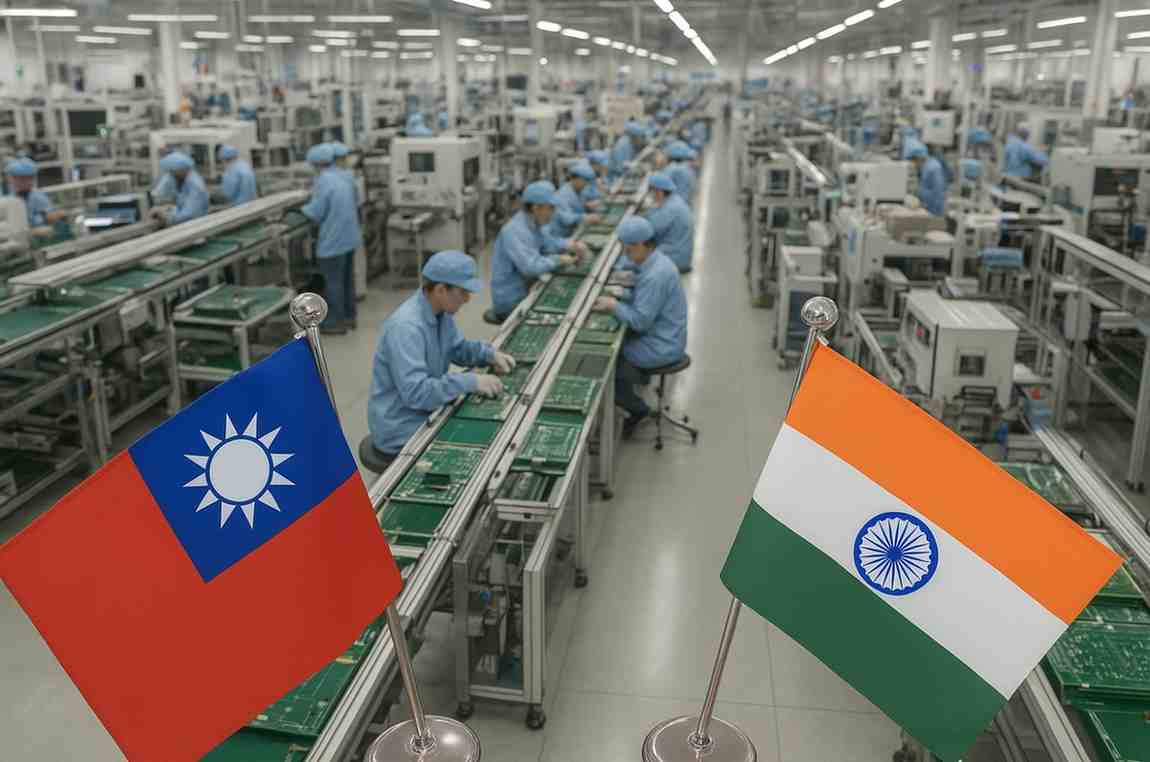
New Delhi, India, August 23, 2025 — Over the past decade, India has been steadily climbing the ladder in the global electronics manufacturing sector, and one of the biggest catalysts behind this growth has been Taiwanese investment. Known for their technological expertise, precision manufacturing, and innovation-driven approach, Taiwanese companies are increasingly viewing India as a natural extension of their global production base. This trend is transforming India’s electronics hubs, from Bengaluru and Chennai to Noida and Hyderabad, into vibrant ecosystems that not only assemble products but also create jobs, supply chains, and technical knowledge.
Taiwan, home to global giants in semiconductors and electronics such as Foxconn, Wistron, and Pegatron, has long been recognized as the backbone of the world’s electronics supply chain. As production costs rise in China and geopolitical uncertainties intensify, India has emerged as a reliable alternative. Taiwanese firms see India’s large consumer market, skilled workforce, and government incentives under initiatives like “Make in India” and “Production Linked Incentives (PLI)” as an attractive combination. By channeling billions of dollars into factories and assembly units, these companies are helping India reduce its dependency on imports while boosting its export potential.
One of the most visible changes has occurred in southern India, particularly around Chennai, which is often referred to as the “Detroit of Asia” due to its strong industrial base. Taiwanese firms have established large-scale factories here to manufacture smartphones, laptops, and other consumer electronics. Foxconn, in particular, has set up major plants that assemble iPhones, directly linking India into the global supply chain of high-end electronics. This has elevated the region’s status as a global manufacturing hub while creating thousands of direct and indirect employment opportunities.
The story is similar in other parts of India, such as Noida and Greater Noida in Uttar Pradesh, which have emerged as significant electronics clusters. Taiwanese investments have fueled the rapid expansion of mobile phone manufacturing in the region, turning it into a powerhouse for both domestic and export markets. With local suppliers and ancillary units mushrooming around these hubs, an ecosystem of innovation and entrepreneurship has started to take shape. This ripple effect ensures that the benefits of Taiwanese investments extend far beyond the immediate factories, touching small businesses and local service providers.
Hyderabad, known for its thriving IT sector, is also witnessing a surge in Taiwanese interest. Here, the focus has been not just on assembly lines but also on research and development. Taiwanese firms are collaborating with Indian talent to explore next-generation technologies such as 5G, IoT devices, and semiconductor packaging. This is a crucial step in moving beyond assembly to higher-value manufacturing and design, positioning India as a player in the knowledge-intensive side of electronics production.
A major benefit of Taiwanese investments is the transfer of technical expertise. Taiwanese companies bring decades of experience in precision manufacturing, quality control, and lean production techniques. By training Indian engineers and workers, they are raising the overall standards of the industry. Over time, this knowledge transfer is expected to strengthen India’s domestic capabilities, allowing local firms to climb the value chain and compete internationally.
Government support has also played a crucial role in attracting Taiwanese capital. The Indian government has provided policy stability, tax benefits, and infrastructure development to make these hubs investor-friendly. Special economic zones, streamlined approval processes, and initiatives to improve logistics have further enhanced India’s attractiveness. Taiwanese firms, in turn, are taking advantage of these reforms to deepen their commitments and scale up operations.
The impact on employment cannot be overstated. From skilled engineers to factory floor workers, Taiwanese investments have created opportunities across multiple levels of the workforce. In addition to direct jobs, there are countless indirect opportunities for suppliers, transporters, service providers, and local communities. This has contributed to regional economic development, reducing unemployment, and creating more balanced growth across states.
Looking ahead, Taiwanese investments are poised to push India toward its goal of becoming a global electronics powerhouse. As the demand for electronics continues to surge worldwide, India is well-positioned to capture a larger share of the market with Taiwan’s help. The partnership is not just transactional—it is a strategic collaboration that leverages Taiwan’s technological leadership and India’s vast potential. Together, they are reshaping the future of electronics manufacturing in Asia and beyond.