JNU and Korean Embassy Launch Eight Scholarly Volumes Advancing Korean Studies in South Asia

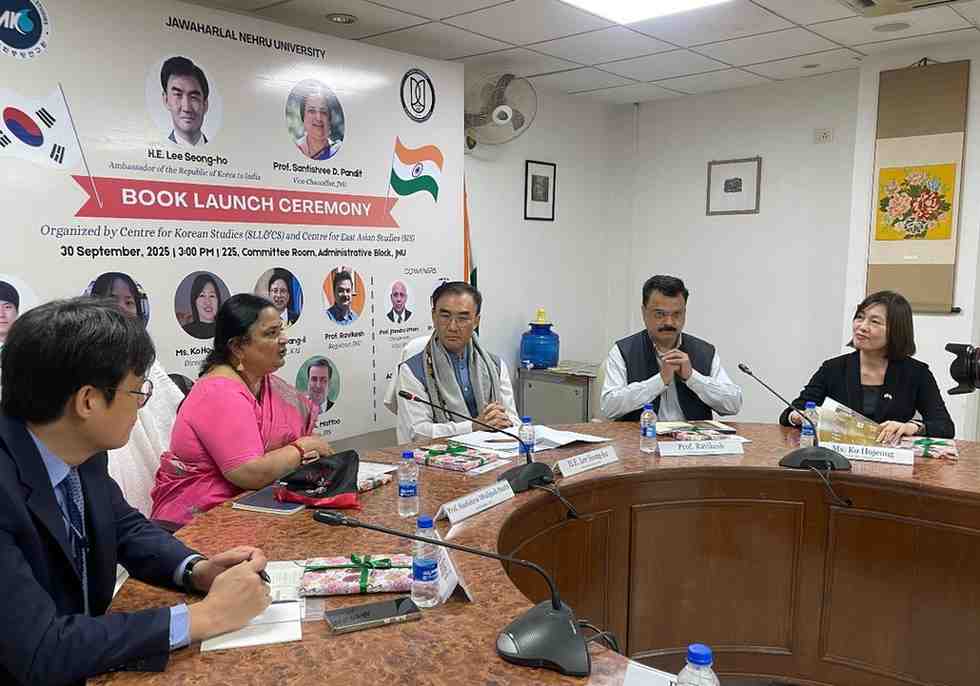
New Delhi: Jawaharlal Nehru University (JNU) hosted a landmark academic and cultural event with the visit of His Excellency Lee Seong-Ho, Ambassador of the Republic of Korea to India. Organised jointly by the Centre for Korean Studies (CKS), SLL&CS, and the Centre for East Asian Studies (CEAS), SIS, the event marked the successful completion of a five-year project of the Academy of Korean Studies. Prof. Ravikesh, who currently holds the position of Registrar at the University, was the project director of the project.
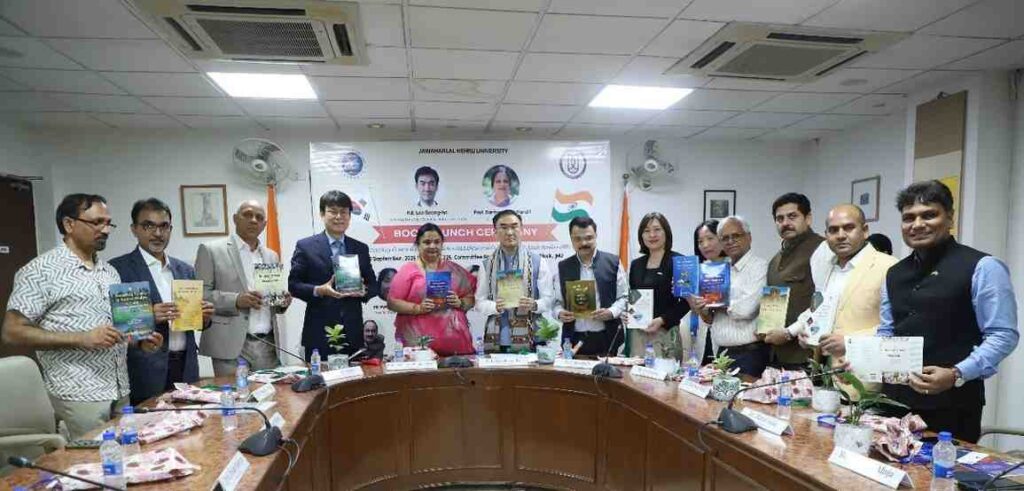 Despite a one-year extension due to the COVID-19 pandemic, the project concluded with remarkable success, publishing 23 scholarly books, of which eight volumes were formally launched at this event. The contributions of faculty members and scholars of the Korean language and culture across South Asia, including India, Nepal, Bangladesh, and Sri Lanka, enriched the project.
The ceremony was graced by Prof. Santishree D. Pandit, Vice Chancellor of JNU, and Lee Seong-Ho, who also held a brief personal meeting with the Vice Chancellor before the program. Distinguished guests included Park Sung-il, Minister Counsellor, Embassy of the ROK; Ms Jung Hye Won, First Secretary, Embassy of the ROK; and Ms Ko Ho-jeong, Director, Korea Education Centre (KEC), who were also present to boost the morale of Korean studies scholars in South Asia. The event was convened by Prof. Jitendra Uttam, Chairperson, CEAS, SIS and Dr Kaushal Kumar, Chairperson, CKS, SLL&CS.
Prof. Ravikesh, the Project Director, introduced the Academy of Korean Studies project and its initiative, highlighting its outcomes and emphasising how the program has strengthened Korean Studies in South Asia and fostered academic collaboration beyond borders.
 The highlight of the program was the launch of eight volumes of books on Korean studies, each representing a significant contribution to the growth of Korean Studies in South Asia. Among them were the Nativized Textbook on Korean Literature, written by Prof. Kim Do Young, Prof. Ravikesh, and Dr Satyanshu Srivastava. A foundational resource introducing modern Korean fiction and poetry, this book addresses themes such as national division, sociopolitical transformation, feminist writing, and North Korean literature, offering comparative insights into Indian literature.
Nativized Textbook on Korean Culture, authors Prof. Kim Young Soon, Dr Neerja Samajdar, and Dr Kaushal Kumar. This book is designed for Indian learners, presenting Korean culture through festivals, customs, K-pop, language, food, and multiculturalism, while also providing comparative references to Indian traditions.
Korean Studies in India and South Asia, edited by Prof. Ravikesh, is a collaborative volume that explores cultural, social, and historical connections, featuring chapters on gender, religion, media, ancient linkages, and the growing influence of Korean soft power in the region. Emerging Trends in Korean Studies in South Asia: An Inter-Cultural Perspective Vol. II, edited by Dr Satyanshu Srivastava and Sanjay Kumar Jha, is a collection of interdisciplinary essays based on regional research and conferences, covering literature, comparative constitutionalism, Gandhian thought, foreign policy, women’s participation, and Korean language education in South Asia.
 Korean Studies in India & South Asia: Literature & Education, edited by Prof. Ravikesh, is another collection of chapters that explore the intersections of Korean literature with culture and society, ranging from folklore and diaspora to translation and digital storytelling. Comparative perspectives linking Korea and India underscore the literature’s role in memory, identity, and cross-cultural dialogue. Emerging Trends in Korean Studies in India: An Interdisciplinary Perspective, Vol. II book is edited by Dr Neerja Samajdar and Dr Kaushal Kumar. This volume examines Korea’s cultural, social, and economic connections with India through studies on folklore, cinema, gender, Hallyu, and corporate soft power, reflecting the evolving relationship between Korea and India. Korean Studies in India & South Asia: An Inter-Cultural Perspective, edited by Dr. Kaushal Kumar focused on Korea–South Asia ties, this book covers soft power, diplomacy, youth culture, and economic relations. It highlights cultural and strategic exchanges, from K-pop to trade, which shape regional cooperation.
Dwaar k Bahar Murgi (The Hen Who Dreamed She Could Fly), written by Hwang Seon-m, is a celebrated Korean children’s classic novel that has touched readers worldwide with its simple yet profound storytelling. It has been translated into 27 languages, and a recent addition was a Hindi translation, making it more accessible to Indian readers. A very popular book in South Korea. Prof. Ravikesh and Naushad Aalam have translated this book into Hindi.
Collectively, these works reflect the depth and diversity of Korean Studies research emerging from the project and are expected to serve as lasting academic resources and milestones in the indigenisation of Korean Studies within South Asia.
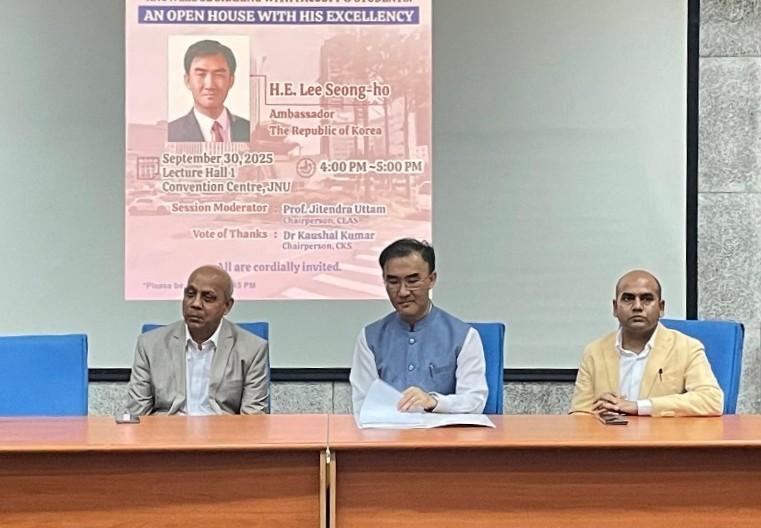
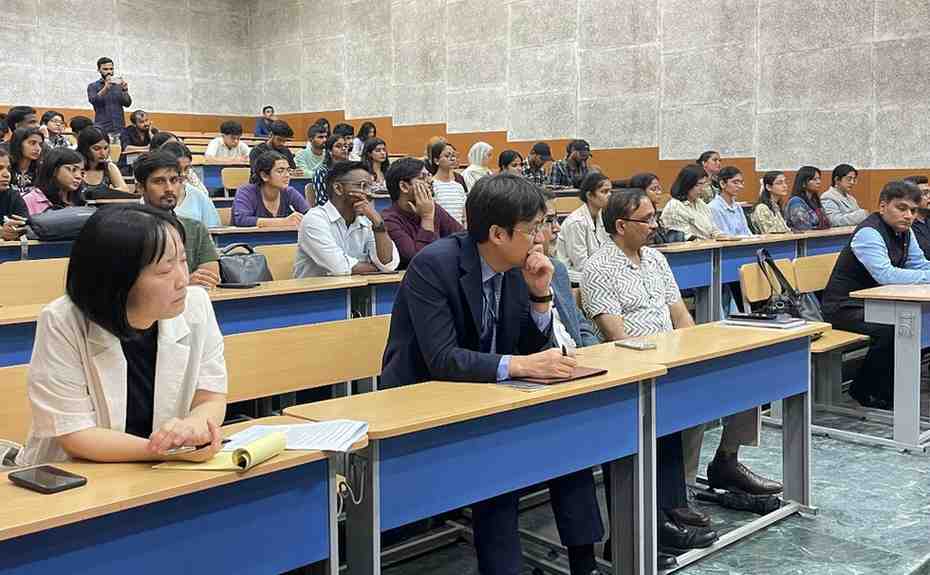
The second part of the event featured an Open House with his excellency Lee Seong-Ho, where faculty and students from CKS and CEAS shared their ongoing work and future plans. The Ambassador warmly engaged with the participants, assured institutional and academic support from the Embassy of Korea, and emphasised the importance of bilateral cooperation in education and research.
Students asked thought-provoking questions on cultural exchange, foreign policy, and opportunities for study in Korea, all of which were answered insightfully by the Ambassador. He also expressed hope for high-level delegate visits between India and Korea in the near future.
The session concluded with honorary remarks by Prof. Jitendra Uttam and a vote of thanks by Dr Kaushal Kumar. In his vote of thanks, Dr Kaushal Kumar warmly acknowledged the Ambassador, dignitaries, and colleagues’ gratitude for their encouragement and support. He highlighted the Ambassador’s inspiring words on strengthening academic collaboration and reaffirmed JNU’s commitment to advancing Korean Studies. Extending thanks to faculty, students, and volunteers, he concluded with the hope of many more such dialogues and partnerships in the future.