
From Factory Worker to President: Lee Jae Myung’s Tough Journey to Korea’s Highest Office
Born into poverty, marked for life by a factory injury and lifted by grit, study and law, Lee Jae Myung’s rise to South Korea’s presidency and Blue House has stood as one of the country’s most emotionally resonant stories of endurance and social mobility.

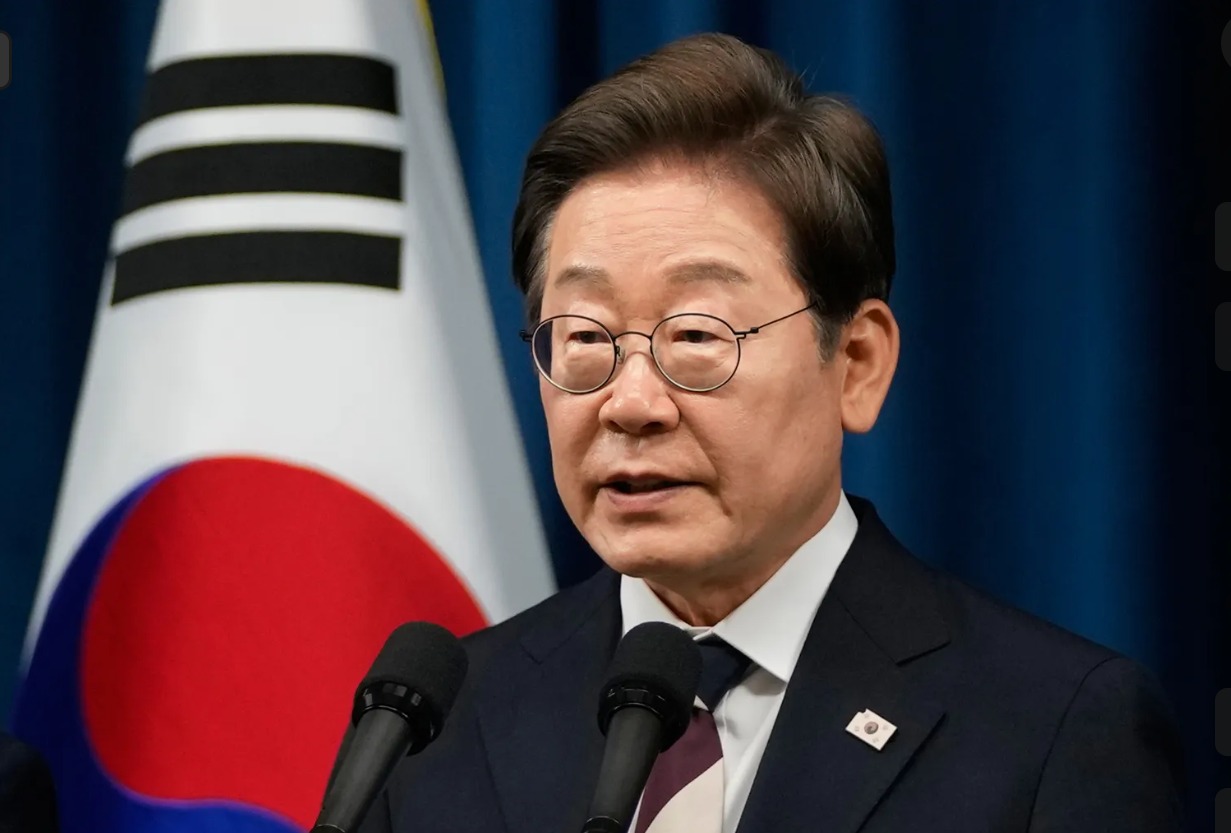
New Delhi, India – The sound of machines came into Lee Jae Myung’s life long before the language of power did. Before official residences, motorcades and state ceremonies, there was the factory floor, the weight of hardship, and a childhood shaped less by comfort than by endurance. Lee, whose official profile lists his birth date as December 22, 1964, rose from severe poverty to become president in June 2025, a journey that has carried unusual emotional force in South Korea because it was forged not in privilege, but in deprivation.
His early life has long been central to his public image. As a boy from a poor family, he worked in factories rather than following a normal school routine, and those years left a permanent mark on his body and his politics. The injury to his arm became more than a personal scar.
It came to symbolize the harshness of an era in which children from struggling families were often pushed into work too early and protected too little. For many supporters, that wound has remained a reminder that Lee did not study inequality from a distance; he lived inside it.
Yet the darker part of the story never became the whole story. What gave Lee’s rise its emotional pull was the stubborn belief that education could still open a door. His official biography says he passed the High School Equivalency Examination in August 1978 and the College Entrance Equivalency Examination in April 1980, before earning a law degree from Chung-Ang University in February 1986. In the same year, he passed the 28th National Judicial Examination, an achievement that transformed the image of a factory boy into that of a future lawyer and public figure.
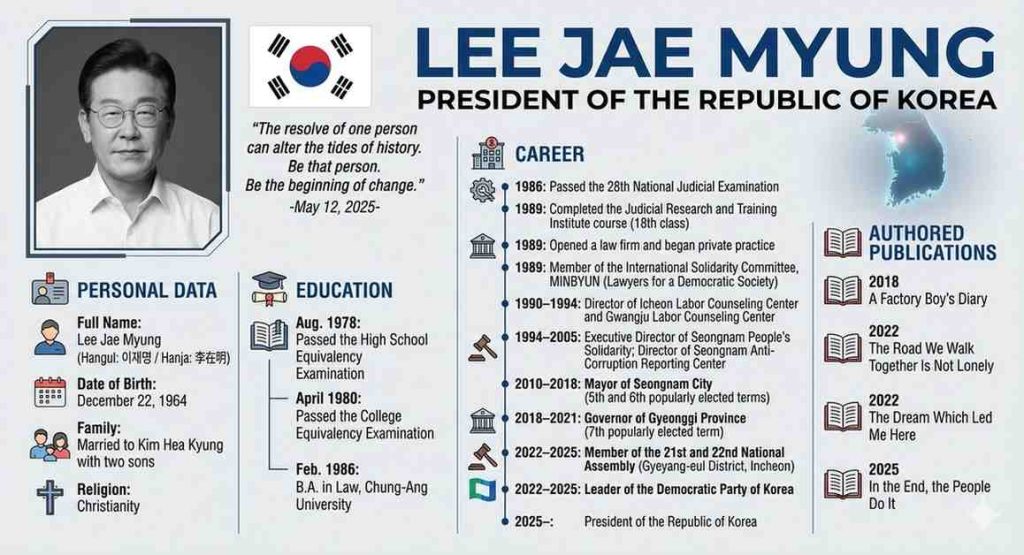 That transformation did not carry him away from ordinary people. Instead of turning his legal credentials into a purely commercial career, Lee moved into work tied to labour, rights and civic activism. His official profile shows that after opening a law firm and beginning private practice in 1989, he also served with MINBYUN’s International Solidarity Committee and later worked with labour counselling centres and civic organisations in Seongnam.
Those years helped build the political identity that would define him later: a leader who spoke in the language of struggle because he had known struggle first-hand.
His political rise was gradual, but it carried the same narrative thread. He served as mayor of Seongnam from 2010 to 2018, governor of Gyeonggi Province from 2018 to 2021, then as a National Assembly member and leader of the Democratic Party before winning the presidency in 2025. Each phase added to the sense that Lee’s career was not simply a ladder climbed upward, but a long argument that public office should answer to those who had once been left behind by the system.
When he was sworn in on June 4, 2025, the symbolism was impossible to miss. The man taking the oath of office was someone whose youth had been spent under economic strain and physical hardship, not one groomed from childhood for the state’s highest platform. Reuters reported just days ago that Lee’s term runs through 2030, underscoring that his presidency is no longer just a political upset from a turbulent year, but an ongoing chapter in South Korea’s national story.
Lee’s own words have helped explain why his biography continues to resonate. His official profile carries a line dated May 12, 2025: “The resolve of one person can alter the tides of history. Be that person. Be the beginning of change.” Read against the facts of his life, the sentence feels less like rhetoric than memory. It is the voice of someone who knew what it meant to stand at the edge of exclusion and still insist on movement.
That is why Lee Jae Myung’s story has endured as more than a tale of political success. It has been read, especially by many ordinary Koreans, as a story of stubborn ascent: from grease-stained labor to legal study, from injury to advocacy, from the margins to the center of power. In that sense, the emotional force of his rise has not lain only in the office he reached, but in the life he had to cross before he got there.