JNU hosts 10th Int’l Conference Commemorating Hangeul Day
Scholars and students from universities across India gather to discuss language, culture and the future of Korean studies

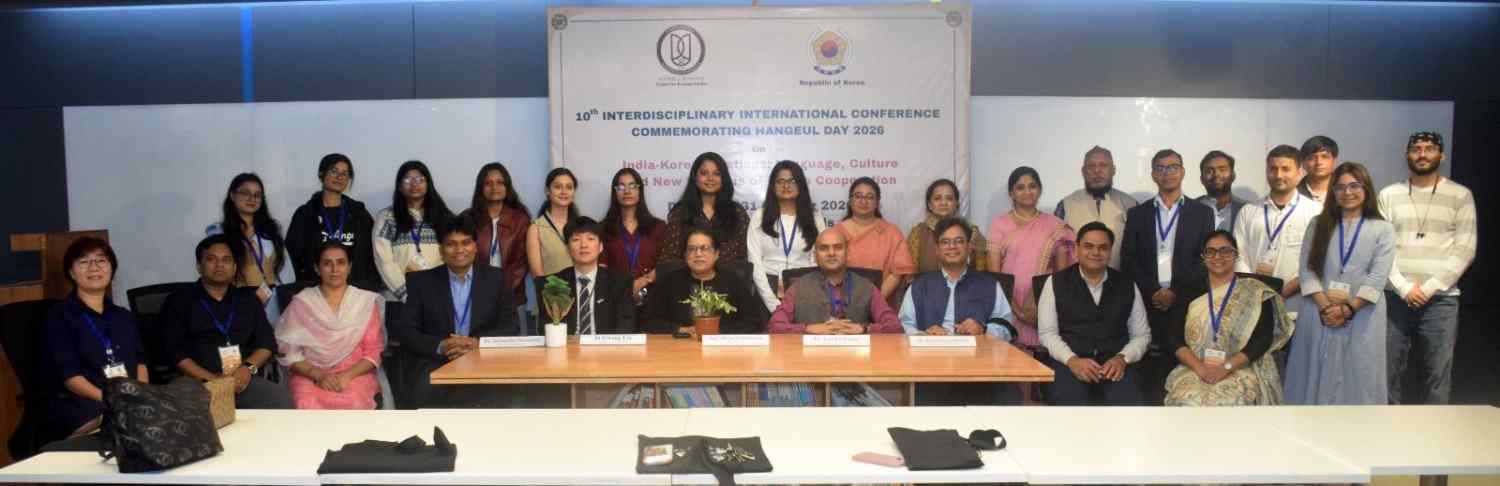
New Delhi: The Centre for Korean Studies (CKS) at Jawaharlal Nehru University held the 10th Interdisciplinary International Conference commemorating Hangeul Day on 30 and 31 October 2026. It was organised in association with the Embassy of the Republic of Korea in New Delhi, under the theme “India–Korea Relations: Language, Culture and New Horizons of Future Cooperation.”
The programme had 11 paper sessions with 57 presentations, a networking meeting and a valedictory session. Most sessions were held in person at the Korea Corner in SLL&CS-II, with parallel sessions in Room 228 and several others online over Google Meet.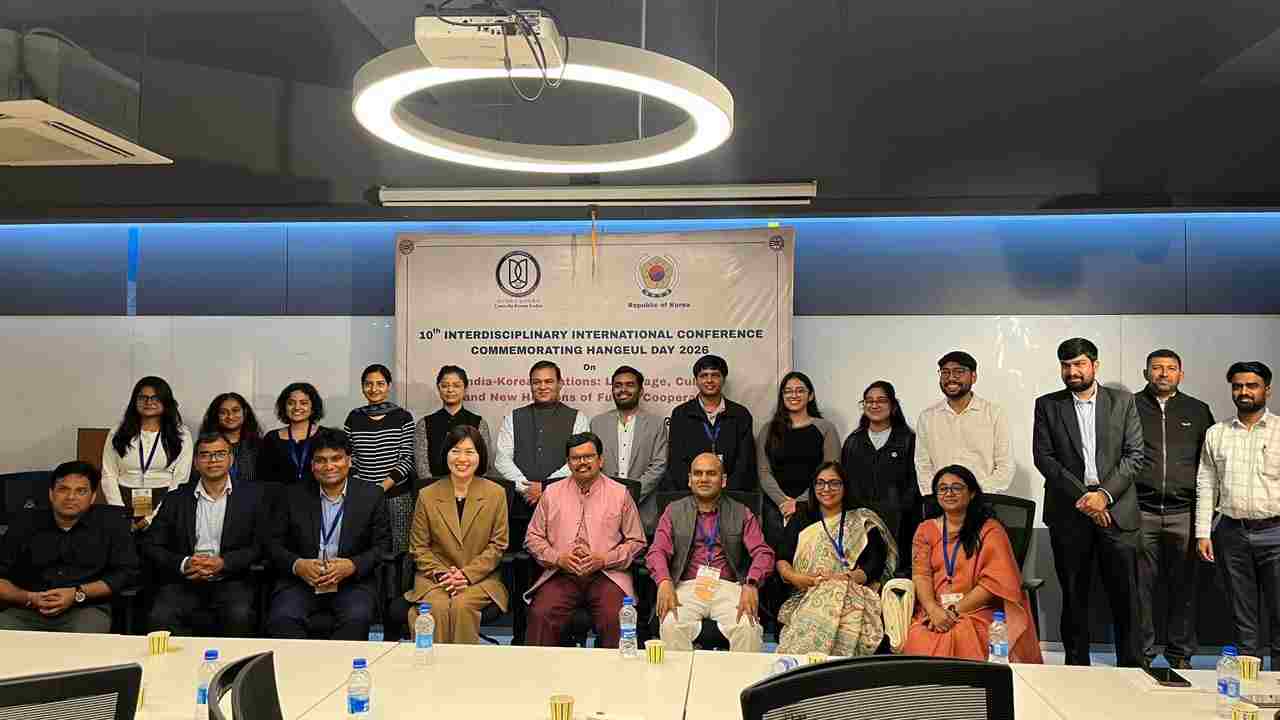
The conference drew a large number of students from other universities. The wide spread of topics attracted not only those working in language, literature and cultural studies but also researchers from international studies and other disciplines. Established professors presented alongside PhD and master’s scholars, which gave the two days a mix of experience and perspective. Organisers and participants described the event as a success, noting the variety of knowledge on display across the sessions.
The conference opened on Friday, 30 October. Dr. Kaushal Kumar, Chairperson of CKS, gave the introductory address, and Prof. Shoba Sivasankaran, Dean of the School of Language, Literature & Culture Studies, delivered the welcome address. Mr. Ju Gwang Lee, Second Secretary at the Embassy of the Republic of Korea offered congratulatory remarks. Dr. Manish Kumar Barnwal proposed the vote of thanks, and Dr. Satyanshu Srivastava served as master of ceremonies. Mr. Ju Gwang Lee promised to provide all the possible support to the development of Korean language program in India.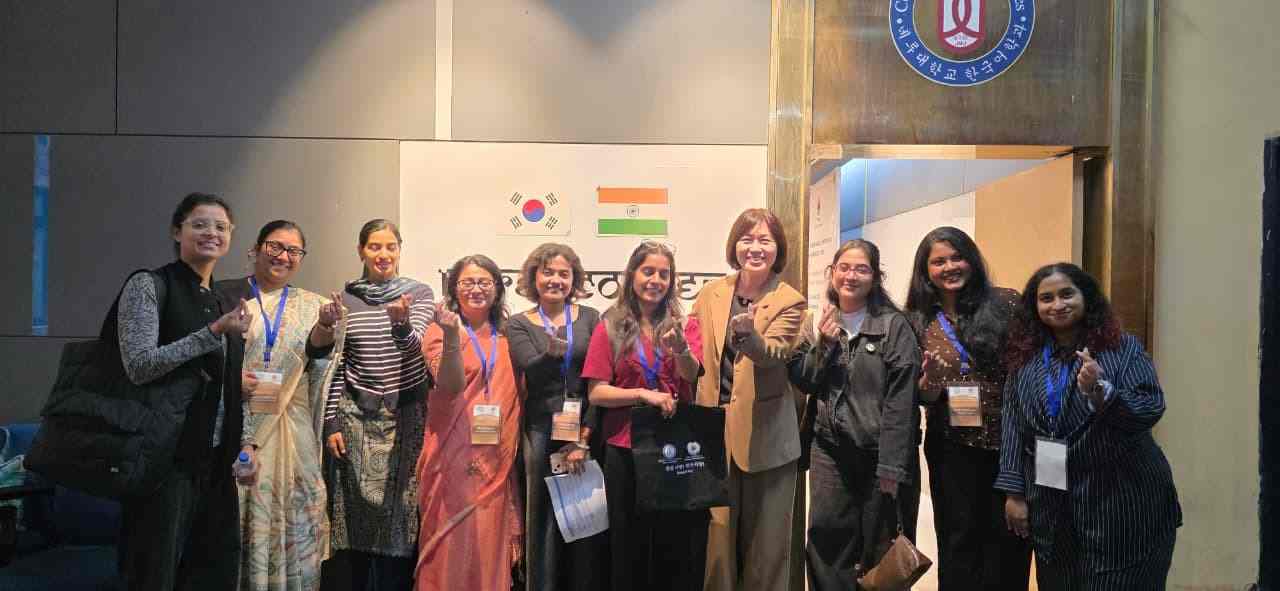
Why this theme
The concept note describes the India–Korea relationship as one that extends beyond diplomacy and trade, rooted in historical, cultural and intellectual exchange. The organisers framed the event as an interdisciplinary platform for scholars, language experts, cultural practitioners and students to explore how language and people-to-people exchange can support deeper academic, economic and strategic partnerships.
The call for papers invited submissions in seven areas:
Language, literature and translation
Shared heritage, history and civilisational connections
Contemporary and popular culture
Education, youth and people-to-people exchange
Technology, economy and emerging partnerships
India–Korea relations and the Indo-Pacific
Korean language skills and industry demand
Language and literature
Korean language education and literary studies made up a large share of the programme. Papers addressed teaching Han Kang’s The Vegetarian in translation, the pedagogical use of AI-translated manhwa, and role-play methods for building speaking skills among Indian learners. Others examined the Korean batchim (final consonant) for Hindi speakers and Korean language education in Indian middle schools.
Comparative work connected the two literary worlds. Presentations explored the Korean translation of Arundhati Roy’s The God of Small Things, Han Yong-un’s poetry alongside Maithili Sharan Gupt’s Saket, and Rabindranath Tagore’s influence on modern Korean poetry. One session was conducted in Korean, with papers on Hindi–Korean semantic correspondence and a comparison of Korean and Tamil traditional culture.
Hallyu and popular culture
The Korean Wave was another major theme. Presenters examined why Indian learners study Korean, how audiences have moved from consuming Hallyu to participating in it, Korean retro dramas and nostalgia, the “glass skin” phenomenon in K-beauty, and Korean webtoons. Other papers looked at bootlegged Korean media from the 2000s and everyday cultural exchange around Korean companies in India.
Strategy, technology and the Indo-Pacific
Scholars also took up the strategic side of the relationship. Papers compared South Korea’s Indo-Pacific strategy with India’s SAGAR vision and examined middle-power agency and minilateralism. One presentation assessed India–ROK semiconductor cooperation after the April 2026 summit, while another drew lessons from South Korea’s industrial policy for India’s semiconductor ambitions. Further papers covered the Korean Armistice Agreement and the limits of peacebuilding on the peninsula, and deterrence and regional stability.
Heritage, history and arts
Other sessions covered Buddhist diplomacy and folklore, Indic epics as soft power, Neo-Confucian thought and Korean foreign policy, museum pedagogy, and festivals and tourism along the Ganga and the Han. Further presentations looked at Mithila painting and Korean Minhwa, and at the “New Hanok” movement in architecture.
Networking: new horizons and ground realities
The Networking Meeting, chaired by Dr. Kaushal Kumar and graced by the esteemed presence of Ms. Hojeong Ko, Director, Korean Education Centre (KEC), was organised with the primary objective of fostering academic collaboration between Jawaharlal Nehru University (JNU), KEC, and various institutions and universities across India where Korean language programmes are currently being offered or are in the process of being introduced.
The meeting brought together distinguished academicians and representatives from several prestigious institutions, including Prof. R. P. Mahapatra, Dean, SRM Institute of Science and Technology (SRM IST), Delhi-NCR Campus; Dr. Manish Ranjan, Associate Professor, Banasthali Vidyapith; Ms. Salna Sunny, English and Foreign Languages University (EFLU), Hyderabad; Mr. Harshit Agarwal, Deputy Director, KIIT University; and Dr. Shyam Kumar Anand, KL University, Andhra Pradesh. Faculty members from the Centre for Korean Studies (CKS), JNU, and Jamia Millia Islamia (JMI) also actively participated in the meeting.
The deliberations extended beyond exploring new avenues in Korean language education and Korean Studies to address the practical challenges, institutional requirements, and future prospects of promoting Korean language learning in India. The discussions highlighted the importance of inter-institutional networking, academic cooperation, and collective efforts to strengthen the foundation of Korean Studies in India.
The conference concluded on Saturday afternoon with an engaging concluding discussion, followed by the distribution of certificates to the participants, marking a meaningful step towards building stronger academic networks and advancing Korean language education in India.