JNU Prof Launches AI-Based Korean Learning Tools to Support Students Beyond the Classroom
KoreanFix and K-GrammarPro aim to help learners tackle grammar confusion and receive instant sentence-level feedback, reflecting a new effort to integrate AI into Korean language education in India.

New Delhi, India – Seeking to address some of the most persistent challenges faced by Korean language learners, Dr. Satyanshu (사티안슈) Srivastava, Professor of Korean at Jawaharlal Nehru University (JNU), has introduced two GPT-based learning agents designed to provide students with deeper grammatical clarity and more consistent learning support beyond the classroom.
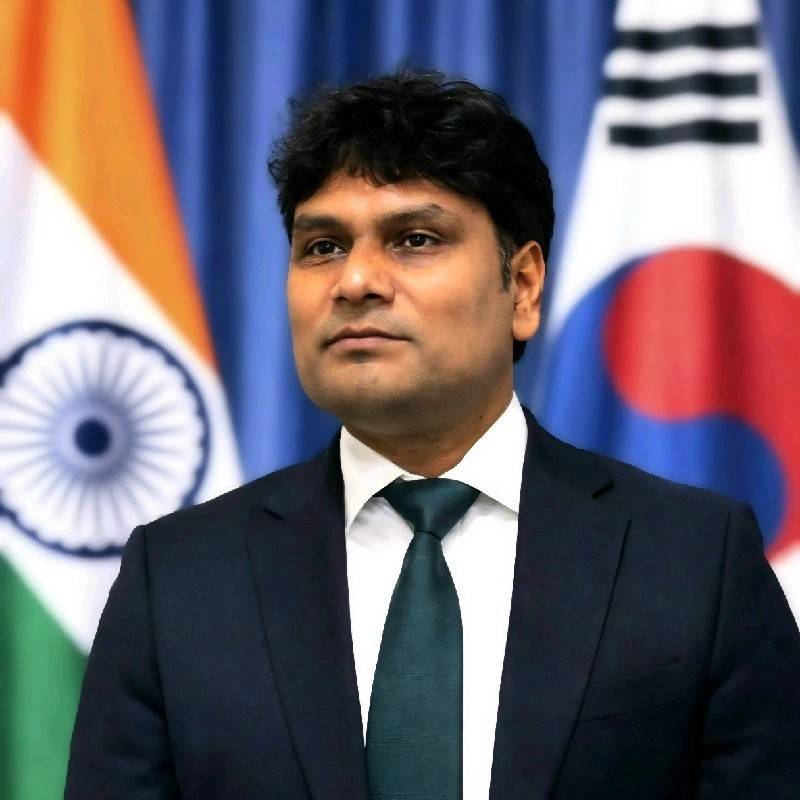
Dr.Srivastava, who is also President of the GKS India Alumni Association and an alumnus of Seoul National University (SNU), Kyung Hee University (KHU), and Chung-Ang University (CAU), Korea, said the initiative grew out of years of reflection on how technology can be used meaningfully in language education.
Explaining the rationale behind the initiative, Dr. Srivastava said that, as a Korean language teacher, he had repeatedly observed two key issues among learners. One, he noted, was the difficulty students often face in understanding Korean grammar, particularly when trying to distinguish between grammatical structures that appear similar on the surface but differ subtly in usage, context, and nuance.
The second challenge, he said, was the lack of regular, individualised feedback, especially in an academic environment where growing class sizes and limited time make it increasingly difficult to provide sentence-level correction and one-on-one guidance to every student.
To help bridge these gaps, Srivastava has launched KoreanFix, a GPT-based agent that provides instant sentence-level corrections with clear explanations, enabling learners to identify and understand their mistakes in real time. The tool is expected to be particularly useful for students seeking support in writing practice, self-correction, and language refinement outside class hours.
Alongside this, he has also introduced K-GrammarPro, a second learning agent focused specifically on explaining and differentiating complex or similar Korean grammar structures in what he described as a simple, structured, and learner-friendly format. The aim, according to Srivastava, is to make grammar instruction more accessible and less intimidating for learners across different proficiency levels.
He stressed that the tools are not intended to replace teachers, but rather to extend the learning process beyond the classroom and provide learners with a free supplementary resource that offers continuous support, practice, and conceptual clarity. In his view, such tools can serve as a practical academic companion for students who need help revising grammar, checking sentences, and reinforcing their understanding at their own pace.
Dr. Srivastava also framed the initiative within the broader rise of artificial intelligence in education. At a time when AI is becoming increasingly powerful and accessible, he said, it would be neither practical nor productive for educators to resist or dismiss the technology outright. Instead, he argued, teachers have a responsibility to integrate such tools thoughtfully and responsibly in ways that strengthen learning outcomes and empower students.
The JNU professor described the launch of the two agents as a modest but meaningful step toward building better language-learning ecosystems, especially for the wider Korean-learning community in India and beyond. He expressed hope that the tools would prove useful to students at all proficiency levels and invited feedback, suggestions, and insights from users on how the agents could be further improved.
He also encouraged educators, learners, and members of the Korean language community to share the tools widely so that more students can benefit from free, AI-enabled academic support. With Korean language learning continuing to grow in popularity in India amid rising cultural, educational, and economic engagement with South Korea, the initiative is likely to resonate with a broad community of students seeking practical and flexible ways to strengthen their proficiency.
Through KoreanFix and K-GrammarPro, Srivastava’s initiative adds to the emerging conversation around how AI can be used constructively in language classrooms—not as a substitute for teachers, but as an extension of their pedagogical reach.