World Korea Forum to Place India at Centre of Indo-Pacific and Korean Peninsula Debate
New Delhi summit will examine India’s rise, great-power rivalry and the Global South’s potential role in advancing peace and cooperation in Northeast Asia.

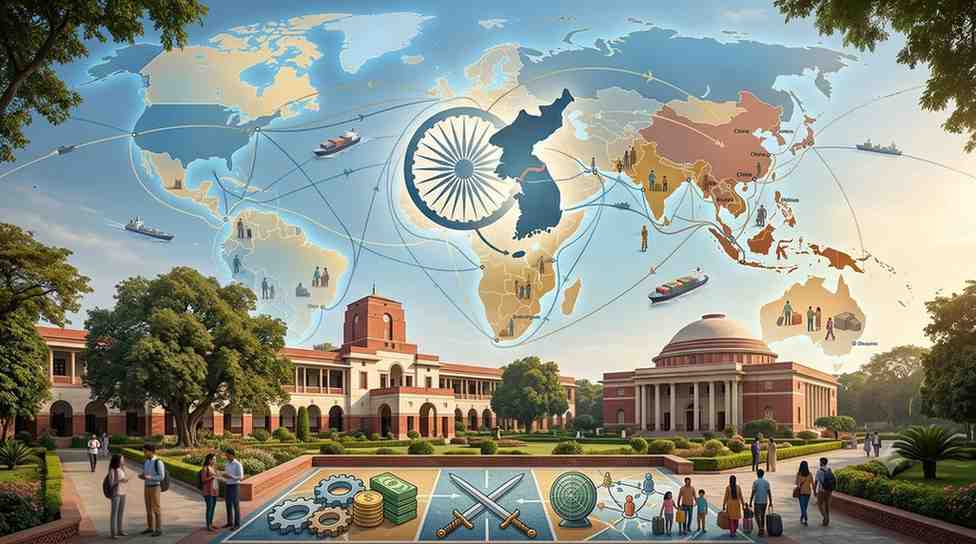
New Delhi: India’s growing strategic influence in the Indo-Pacific will form the central backdrop of the 27th World Korea Forum and Global Opinion Leaders Summit, scheduled to be held in New Delhi from August 18 to 20, 2026.
The international gathering will explore how intensifying competition among major powers, the rise of strategic middle powers, the growing influence of the Global South and changes in the international economic order are reshaping the Korean Peninsula and the wider Indo-Pacific region.
The principal sessions will be held at the University of Delhi’s North Campus, including the Vice Regal Lodge and Shankar Lal Auditorium. The programme presents India as an emerging economic, political and civilisational power capable of connecting different regions and contributing to international dialogue.
India’s distinctive strategic position: The forum is being organised at a time when the Indo-Pacific has become a major arena of geopolitical and economic competition.
Rivalry between the United States and China, closer cooperation among North Korea, China and Russia, changing defence partnerships and the increasing involvement of European and regional powers have complicated the strategic environment.
Against this background, the forum will examine how India manages its relationships with the United States, Russia and China while participating in BRICS, the Shanghai Cooperation Organisation and Global South platforms.
India’s policy of strategic autonomy gives it a distinctive position in discussions on the Korean Peninsula. Unlike countries directly aligned with competing Northeast Asian security blocs, India maintains diplomatic engagement across different political camps.
The summit will consider whether New Delhi can contribute as a dialogue partner, strategic bridge and supporter of peaceful coexistence in a region increasingly shaped by bloc politics.
Korean Peninsula viewed through wider global shifts: The programme will move beyond viewing tensions on the Korean Peninsula as an exclusively inter-Korean or Northeast Asian issue.
Discussions will place Korean security within the broader context of nuclear deterrence, global power competition, changing alliances, economic security and the weakening of traditional multilateral institutions.
Sessions are expected to examine North Korea’s closer alignment with China and Russia, its policies towards South Korea and the United States, uncertainty surrounding extended deterrence and the future of US-North Korea negotiations.
The implications of North Korea’s “hostile two states” position for reconciliation and inter-Korean relations will also be discussed. Another session will assess the proposed MP6 framework for cooperation among strategic middle powers.
By holding these discussions in New Delhi, the organisers seek to widen international engagement on Korean Peninsula peace beyond the countries that have traditionally dominated the issue.
India and the Global South: India’s relevance to the forum arises from its economic rise, strategic autonomy, military capacity, large population and expanding diplomatic influence.
The programme will specifically examine India’s potential contribution to peace and security on the Korean Peninsula, India-North Korea relations and the future of India-South Korea strategic cooperation in the Indo-Pacific.
India maintains relations with both South Korea and North Korea while following an independent foreign-policy approach. Although the forum does not suggest that India can resolve Korean tensions on its own, it will consider whether New Delhi can help widen dialogue and mobilise greater support for peaceful coexistence.
A major theme will be the demand for the Global South to have a stronger voice in international political and security discussions.
Sessions will examine whether countries outside traditional power centres can contribute fresh diplomatic ideas to Korean peace and reconciliation. The issue will be presented not only as a regional security challenge but also as a test of whether a more representative international order can develop effective mechanisms for dialogue.
Economic security and multilateral reform: The forum will also address concerns over the ability of existing international institutions to respond effectively to wars, nuclear tensions and geopolitical confrontations.
Discussions will cover United Nations Security Council reform, the role of BRICS and the search for alternative peace frameworks at a time when established multilateral institutions are under pressure.
Economic security will form another key component. Trade, technology, investment, supply chains, energy security and industrial policy are increasingly being used as instruments of strategic competition.
A dedicated session will examine fair trade, the economic policies of India, China and Russia, the political economy of BRICS and cooperation between major and middle powers. India-Korea economic relations will be considered within the broader context of supply-chain restructuring and technological competition.
Diaspora and people-to-people diplomacy: The summit will also highlight the role of diaspora communities, academic institutions, businesses and civil-society organisations in strengthening international understanding.
Sessions will discuss the Korean community in India, diaspora public diplomacy and the role of overseas Korean networks as strategic bridges. Such networks can support academic exchanges, cultural familiarity, business partnerships and sustained people-to-people engagement.
The forum is expected to bring together specialists and opinion leaders from India, South Korea, the United States, the United Kingdom, Russia, Italy, Spain, New Zealand, Kazakhstan, Uzbekistan, Japan, China and Vietnam.
Its wider significance lies in connecting Korean Peninsula peace with India’s rise, Indo-Pacific strategy, Global South diplomacy, economic security and diaspora engagement.
By hosting the event, New Delhi will send a clear geopolitical message: India is increasingly being viewed not merely as an observer of Northeast Asian affairs, but as an important participant in debates over the future of the Indo-Pacific and the evolving international order.