
‘Discovery of Lanka’ Yatra to Link Nepal, India and Sri Lanka; Sita Utsav Planned at Ashoka Vatika
Sanatani Ganga Foundation’s 11-day civilizational journey will connect Janakpur, Ayodhya and Nuwara Eliya, with over 200 delegates expected to join cultural, spiritual, sporting and heritage programmes.

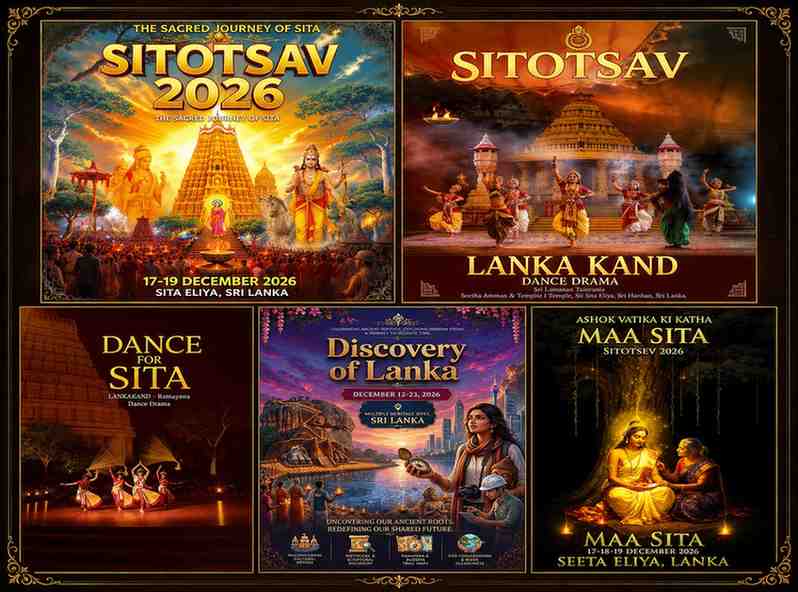
New Delhi, India: An ambitious cross-border cultural initiative tracing the civilizational journey associated with Maa Sita and the Ramayana will bring Nepal, India and Sri Lanka together this December, with the 11-day “Discovery of Lanka” international yatra scheduled from December 13 to 23, 2026.
At the centre of the initiative will be Sita Utsav, a three-day cultural celebration planned from December 17 to 19 at the Seetha Amman Temple, associated with Ashoka Vatika, in Nuwara Eliya, Sri Lanka. Organised by the Sanatani Ganga Foundation (SGF), the initiative has been conceived as a convergence of civilizational heritage, cultural diplomacy, performing arts, youth participation, sports and spiritual tourism.
Captain Praveen Kumar, Founder of the Sanatani Ganga Foundation, said the initiative sought to transform the shared Ramayana heritage of South Asia into a contemporary platform for regional connectivity.
“The journey of Maa Sita is not confined by modern national boundaries. It connects Nepal, India and Sri Lanka through a civilizational memory that has survived for generations. Through Discovery of Lanka and Sita Utsav, we want to bring that shared heritage alive and use it to strengthen friendship and people-to-people relations across the region,” Kumar said.
The broader journey has been conceptualised around a trilateral cultural axis connecting Janakpur in Nepal, Ayodhya in India and Nuwara Eliya in Sri Lanka. SGF describes the route as part of an ancient Vedic-Buddha Corridor, highlighting the deep cultural and spiritual links among the three South Asian countries.
More than 200 delegates, including dignitaries, Union and State Ministers, cultural personalities, Bollywood representatives, Vedic scholars and university students, are expected to participate. The initiative aims to strengthen people-to-people ties, encourage regional harmony and bring heritage conservation onto a wider international platform.
Sita Utsav to become cultural heart of the journey: The principal cultural programmes will unfold in Nuwara Eliya, focusing on the qualities traditionally associated with Maa Sita—courage, dignity, compassion, devotion, resilience, patience and inner strength.
One of the flagship programmes, “Dance for Maa Sita,” will invite classical and folk dancers, choreographers, theatre practitioners, musicians, cultural institutions, university groups and emerging artists from India, Sri Lanka, Nepal and other countries connected with the Ramayana tradition.
The programme envisages Indian classical traditions including Bharatanatyam, Kathak, Odissi, Kuchipudi, Mohiniyattam and Manipuri, alongside Sri Lankan traditional dance and other folk and devotional forms.
Importantly, collaborative productions between Indian and Sri Lankan artists are being encouraged, turning the programme into a cultural dialogue rather than simply a series of performances.
Kumar said art could communicate civilizational connections in a way conventional conferences often could not.
“We want artists from different traditions to interpret Maa Sita in their own cultural languages. When Indian, Sri Lankan, Nepali and international artists share the same platform, the Ramayana becomes not simply a story of the past but a living dialogue among cultures,” he said.
Ramayana narrative through theatre: Another major component, Natya Rūpāntaran, will use theatre, dance-drama, music, narration, costumes and visual storytelling to recreate episodes associated with Sita and Lanka.
The presentations will focus particularly on the Sundara Kanda, Lanka Kanda and Lanka Katha, combining traditional performance techniques with contemporary stagecraft. The intention is to present the Ramayana as a living cultural tradition rather than solely as a literary or historical narrative.
‘Run for Maa Sita’ to engage youth through sport: Adding a modern dimension to the heritage initiative will be “Run for Maa Sita,” envisioned as the sporting and youth-engagement pillar of Sita Utsav.
Professional athletes, marathon runners, para-athletes, sportspersons, fitness personalities, running clubs, university teams, school students and ordinary citizens are proposed to participate.
The concept seeks to connect the spirit of the Ramayana journey with contemporary ideas of fitness, discipline, endurance and unity. Participants from India, Sri Lanka, Nepal and other countries will be encouraged to run together in a symbolic expression of friendship rather than participate solely as competitors.
“Culture cannot remain confined to auditoriums and religious spaces. Young people have to experience heritage through activities they relate to. Run for Maa Sita is about bringing together heritage, sport and youth and conveying the message that cultural bonds can transcend borders,” Kumar said.
Ramayana Trail as a tourism and heritage network: Beyond the December events, SGF plans to use the initiative to strengthen the wider Ramayana Trail as an international cultural and spiritual tourism circuit.
Cultural institutions, tourism boards, historians, heritage custodians, international tourism partners and spiritual travellers have been invited to participate. Greater global visibility for such sacred circuits, the Foundation believes, could help local economies while encouraging responsible conservation of heritage and ecological assets, including Sri Lanka’s Hakgala biosphere.
Youth participation through eco-conscious treks, academic interactions and artistic showcases will form another pillar of the programme.
For SGF, the larger objective is to build a continuing cultural network rather than organise a one-time pilgrimage.
As Kumar put it, “Discovery of Lanka is ultimately about rediscovering what already connects us. If heritage can bring communities, artists, young people, policymakers and travellers together, it can become a powerful instrument of cultural diplomacy, tourism and regional harmony.”
Through its combination of pilgrimage, performing arts, theatre, sport and heritage tourism, Discovery of Lanka and Sita Utsav 2026 are thus being positioned as an effort to transform a shared ancient narrative into a contemporary bridge linking Nepal, India and Sri Lanka.