Park Tae-sang: The Korean Coach Shaping India’s Next Badminton Dream
After guiding PV Sindhu to Olympic glory, the South Korean mentor is now helping 17-year-old Tanvi Sharma rise rapidly on the world stage — from a historic Taipei Open triumph to qualification for the Korea Open

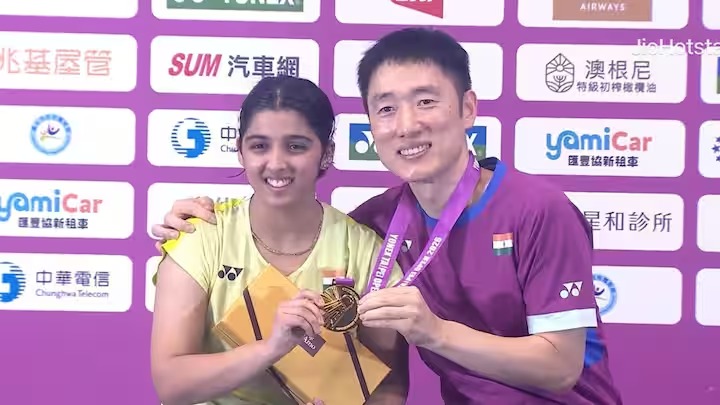
New Delhi: When 17-year-old Tanvi Sharma stood on top of the podium at the Taipei Open, she did something revealing even before the celebrations had properly begun. She removed the gold medal from around her own neck and placed it around the neck of her coach, Park Tae-sang.
It was a spontaneous gesture, but one that perhaps captured better than words the role the South Korean coach has played in the emergence of one of Indian badminton’s brightest young prospects.
Tanvi defeated Vietnam’s sixth-seeded Nguyen Thuy Linh 21-16, 21-16 in just 36 minutes on August 2 to win the Taipei Open Super 300, her first BWF World Tour title. The victory made her the first Indian woman to win the tournament’s singles title since Saina Nehwal in 2008. At 17 years and 222 days, she also became the youngest finalist in Taipei Open history.
Yet behind the teenager’s increasingly powerful smashes, improved movement and greater confidence stands a familiar Korean figure who has already left a significant imprint on Indian badminton.
Park is the same coach who stood courtside when PV Sindhu won bronze at the Tokyo Olympics, helping the Indian superstar recover mentally from her semifinal defeat and return to win the medal playoff. Sindhu later credited Park’s encouragement for helping her regroup.
Now he is attempting something different—and perhaps even more challenging: helping build a champion almost from the beginning.
From Sindhu to Tanvi — a new chapter: Park began working closely with Sindhu towards the end of 2019 and remained associated with her until 2023. Under his coaching, Sindhu won the Tokyo Olympic bronze, women’s singles gold at the 2022 Commonwealth Games, and three BWF World Tour titles in 2022—the Syed Modi International, Swiss Open and Singapore Open.
The relationship went well beyond technical coaching. Years later, Sindhu described Park as having become like a “big brother” during the four years he coached her.
After the Sindhu chapter ended, Park did not sever his association with Indian badminton. Instead, he turned his attention towards younger players.
That decision brought him to the Badminton Association of India’s National Centre of Excellence in Guwahati, where Tanvi moved in October 2024 to train under him. She had earlier spent five years at the Pullela Gopichand Badminton Academy before returning to Punjab during the Covid period.
What Park saw in the teenager immediately excited him: He famously declared: “I will make Tanvi Sharma the next Sindhu.”
That comparison carried considerable weight. Park knew Sindhu’s game intimately—her aggression, explosive attack and ability to finish rallies. In Tanvi, despite her smaller frame, he saw some of the same attacking instincts.
He has worked on transforming a player who earlier relied more heavily on retrieving and defence into a far more aggressive shuttler. Tanvi herself has credited Park with sharpening her smashes, movement, deception, net play and attacking mentality.
Taipei vindicated the belief: The transformation was clearly visible in Taipei.
Against Nguyen Thuy Linh, Tanvi mixed powerful attacks with deceptive drops and soft net shots. She raced to a 10-2 advantage in the opening game, absorbed a brief Vietnamese comeback and then regained control.
In the second, after falling 0-3 behind, she responded quickly and gradually opened a commanding advantage before closing out the match in straight games.
It was precisely the combination Park has been trying to cultivate: aggression without recklessness, power supplemented by deception, and the composure to respond when momentum shifts.
The medal ceremony then delivered the tournament’s defining image: Tanvi placing her gold medal around Park’s neck.
For the Korean coach, it was another milestone in a remarkable Indian journey: For Tanvi, the title represented the conversion of promise into senior-level success.
The Taipei triumph followed an impressive sequence of performances. She had already reached the 2025 US Open Super 300 final, won silver in girls’ singles and bronze in the mixed-team event at the World Junior Championships, and had been junior world No.1.
In June 2026, she also stunned world No.11 Chiu Pin-Chian at the Australian Open Super 500 before reaching the quarterfinals.
The Taipei result has now been followed by another important step in her upward journey—qualification for the Korea Open, taking Park’s young Indian ward towards another major international test, this time in his home country.
Park understands the transition Indian badminton needs: What makes the Park-Tanvi partnership especially interesting is its timing.
Indian women’s badminton has lived through an extraordinary era shaped first by Saina Nehwal and then by PV Sindhu. Finding the next player capable of consistently challenging the world’s best has therefore become one of the sport’s biggest priorities.
Park has never been shy about the scale of his ambition for Tanvi. He has described her as possessing characteristics of both Saina and Sindhu and has spoken openly about building her towards the highest level of international competition.
His long-term target is even bigger than World Tour titles: “Our dream and aim is the 2028 Los Angeles Olympic Games,” Park said while discussing Tanvi’s development in 2025. His stated ambition is to pursue an Olympic women’s singles gold for India—a medal the country has never won in the discipline.
The challenge remains enormous. Tanvi is still only 17. Her net game, consistency, physical development and ability to repeatedly handle the world’s elite will continue to require refinement. Park himself has previously identified areas that need substantial work.
But the early evidence is encouraging. Even Sindhu, after training with Tanvi earlier this year, said the youngster had the potential to emerge after her and specifically noted that with Park continuously supporting her, “she is in good hands.”
A Korean coach becoming part of India’s badminton story: Park’s contribution also represents an engaging chapter in India-Korea sporting relations.
He arrived in Indian badminton as a Korean specialist bringing the discipline, movement patterns and defensive traditions associated with his country’s formidable badminton system. He gradually adapted those methods to Indian players and, in the process, became deeply invested in their success.
As a player, Park represented South Korea internationally, including at the 2004 Athens Olympics, and was part of the Korean team that won Asian Games gold in 2002. He later moved into coaching. India then gave him the defining achievements of his coaching career.
First came Sindhu and an Olympic medal: Now comes Tanvi—a teenager whom Park is not merely coaching for the next tournament, but developing with Los Angeles 2028 in mind.
The Taipei Open trophy may eventually be remembered as one of the early milestones in that journey. And the sight of the young Indian champion placing her medal around the neck of her Korean mentor carried an unmistakable message: Tanvi Sharma won the title on court, but Park Tae-sang’s fingerprints were all over the victory.