New Delhi to host World Korea Peace Forum in Aug 2026
Three-day global summit in New Delhi to bring together opinion leaders, diplomats, scholars and diaspora voices to discuss Korea, India, the Indo-Pacific and the Global South in an era of great transition.

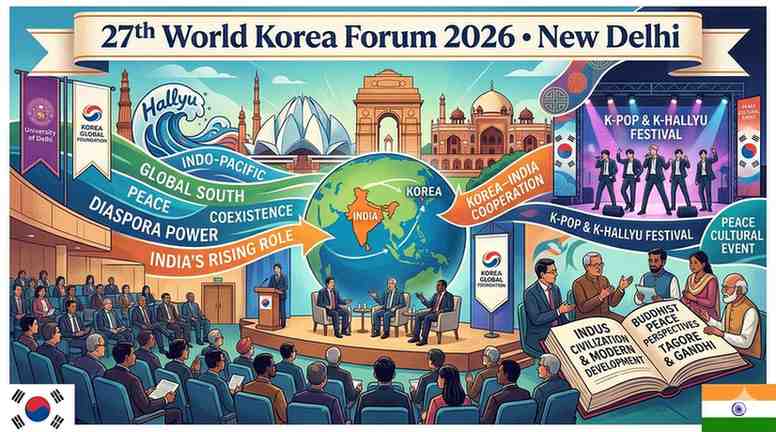
New Delhi, India – The 27th World Korea Forum 2026, being organised in New Delhi from August 18 to 20, will bring together international opinion leaders, diplomats, academics and diaspora representatives for a three-day dialogue on Korea, India and the changing global order. To be co-organised by Peaceful Unification Advisory Council (PUAC), International Korea Foundation, and hosted at the Delhi University, the event is being presented as the “Key Opinion Leaders New Delhi, India Summit” and will focus on themes including the Indo-Pacific, the Global South, emerging world order, coexistence, peace and diaspora power.
It is vital to mention here that through this global forum, the PUAC is planning to promote Korean Policy and extend the idea of peaceful coexistence and prosperity in the Korean peninsula.
The forum will open on August 18 with participants’ check-in at The Lalit, New Delhi, followed in the evening by the New Delhi Korean Festival, which will feature a K-pop concert, a K-Hallyu programme, and a Korean cultural event for peace at Shankar Lal Auditorium, University of Delhi North Campus. The opening-day cultural segment appears designed to blend policy discourse with people-to-people and cultural engagement.
The formal conference sessions will begin on August 19 at the Shankar Lal Auditorium, with an opening session on multilateral geopolitical changes and responses in an era of hegemonic competition. The programme lists Prof. Dr Tshangchu Rhee, Executive Head of the Korea Global Foundation, for the opening remarks, while Prof. Dr Yogesh Singh, Vice Chancellor of the University of Delhi, is scheduled to deliver the welcome address on the theme of the Indus Civilisation and India’s future development.
The organisers have also lined up senior diplomatic and policy voices for the opening session. Lee Seong-ho, Ambassador of the Republic of Korea to India, is listed to speak on strengthening new strategic solidarity in the Indo-Pacific era, while Gae-ho Lee, Member of Parliament of the Republic of Korea and former Minister of Agriculture, Food and Rural Affairs, is scheduled to address the theme of Korea–India diplomatic and economic cooperation in a multipolar world. Dr Euy Don Park, CEO of Seela Infratech and former President of the Federation of Korean Associations in India, is listed to deliver the chair’s address on the role and contribution of the global Korean community and Korean business in the current era.
The event is being organised to seek a new three-dimensional analysis of the global turning point, while encouraging exchange, cooperation, future-oriented coexistence and vision through a global meeting of opinion leaders. The concept note also places strong emphasis on India’s rising global role, describing the country as a major force in economics, geopolitics, culture and diaspora influence, and positioning New Delhi as an important venue for conversations connecting East and West.
The sessions on August 19 will cover a wide range of Korea- and Asia-related strategic issues. Among the listed themes are the international political landscape of the Korean Peninsula, US-DPRK negotiations, North Korea’s “hostile two states” declaration, India-DPRK diplomatic shifts, and the implications of the ROK-US-Japan versus DPRK-China-Russia alignment. Speakers named in the programme include Jenny Town of the Stimson Centre and 38 North, Prof. Dr Sudhakar Vaddi of Jawaharlal Nehru University, Prof. Dr Jojin V. John of Mahatma Gandhi University, and Prof. Dr Seong-Chang Cheong of the Sejong Institute, among others.
Another major segment on the second day will focus on Southwest and Central Asia, including public diplomacy, the discourse on Korean Peninsula peace, multicultural and multiethnic regional dynamics, and cultural-economic connections with Korea. The programme lists Dr Euy Don Park, Chairman of the Southwest Asia Council of the Peaceful Unification Advisory Council, for a representative address on public diplomacy and consensus-building for peace on the Korean Peninsula in Southwest Asia.
A further Asia Session scheduled for the afternoon of August 19 will examine North Korea-China-Russia solidarity, Buddhist peace perspectives, the paradox of political division on the Korean Peninsula, Indian and Chinese views of the evolving international order, and historical conflict and nationalism in East Asia. The session will include speakers from India, South Korea, Italy, China and Russia, underlining the organisers’ attempt to frame Korea-related issues within a wider Asian and global context.
The forum will continue on August 20 with sessions on international relations, geoeconomics, diaspora, migration, mobility, literature, philosophy, culture and humanities. Themes listed in the programme include the relationship between great powers and middle powers in the Indo-Pacific, the EU’s strategic relations with India and BRICS, global governance reform, foreign economic policies of India, Russia and China, Korea–India economic cooperation in the Indo-Pacific era, the role of the Indian diaspora, and the meaning and influence of the Korean diaspora in a multicultural world. The day’s presenters include scholars and experts from India, South Korea, the United Kingdom, Spain, Russia, China, Laos, Kazakhstan, New Zealand and other countries.
The programme also indicates a strong humanities and civilisational dimension. The final sessions are set to cover subjects such as Indian philosophy, culture and civilisation, Rabindranath Tagore’s continuing intellectual relevance, K-culture and K-philosophy as a global platform, and the Gandhi-Nehru political philosophy framework. This broad thematic spread suggests that the organisers are seeking to combine policy, strategy, economy, diaspora and culture within a single high-level international platform.
The forum’s promotional material says the event aims to contribute to a shared future vision for peace, stability and prosperity across politics, diplomacy, military affairs, economy, technology, culture and diaspora affairs, while helping establish a public diplomacy and diaspora bridge in an era of great transition. A poster on the opening page highlights the event under the banner of “India’s Diplomacy to North and South Korea,” while the closing page of the file also points ahead to the 28th World Korea Forum in Bologna, Italy, in June 2027.
With Delhi University set to host the 2026 edition, the 27th World Korea Forum is shaping up as a significant international gathering in the capital, bringing Korea-related discourse into conversation with India’s growing profile in the Indo-Pacific, the Global South and the wider emerging world order.