
Taiwan postpones President Lai’s Eswatini visit amid airspace row, accuses China of coercion
MOFA denounces “politicization of flight routes” and says last-minute overflight denials by African nations reflect Beijing’s growing pressure tactics

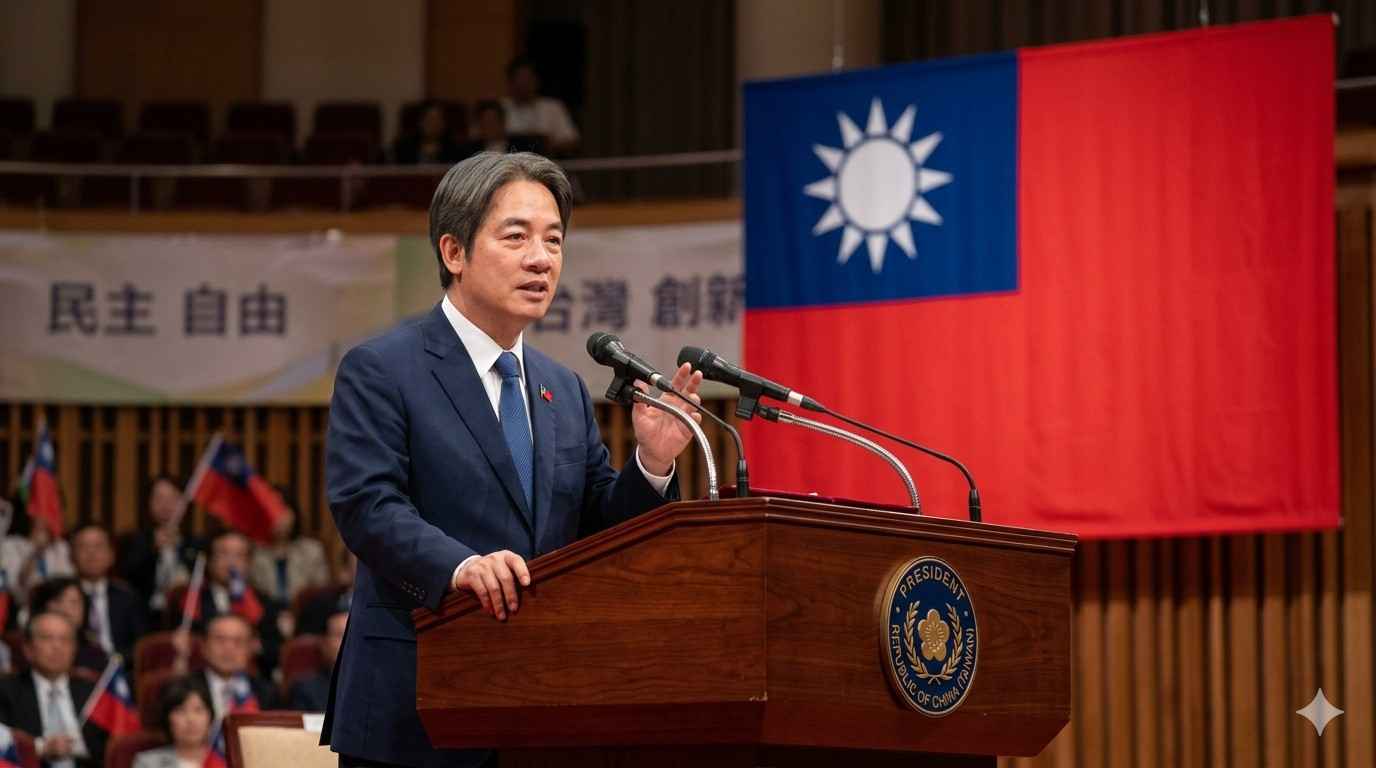
Taipei/New Delhi (23 April, 2026): Taiwan President Lai Ching-te has postponed his planned state visit to the Kingdom of Eswatini after multiple countries revoked overflight permissions at the last minute, triggering a sharp diplomatic response from Taiwan’s Ministry of Foreign Affairs (MOFA), which accused China of political and economic coercion.
The visit, which was to be undertaken at the invitation of King Mswati III of Eswatini—Taiwan’s only diplomatic ally in Africa—was called off after Seychelles, Mauritius and Madagascar withdrew previously granted flight clearances “without warning” just before departure.
In a strongly worded statement, Taiwan’s MOFA said it “strongly condemns PRC political and economic coercion enacted to pressurize other countries into changing their sovereign decisions, revoking overflight clearances and parroting PRC talking points.” The ministry described the development as a serious escalation, alleging that Beijing had influenced the decision-making of the countries involved.
Calling the move unprecedented, Taiwanese officials indicated that this was the first publicly known instance in which the island’s leader had to cancel an overseas trip due to the sudden denial of transit airspace.
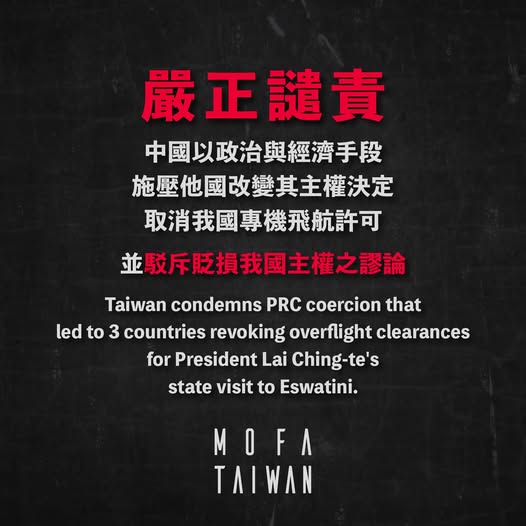
MOFA further criticized what it termed the “politicization and weaponization of flight information regions,” stating that such actions interfere with sovereign decisions of nations and “seriously impact the routine functioning of global civil aviation networks.” It also specifically protested against Seychelles and Madagascar for “parroting PRC talking points that challenge international norms and flight safety.”
China, however, denied allegations of coercion. Beijing reiterated its adherence to the “One China” principle, under which it claims Taiwan as part of its territory, and praised the Indian Ocean nations for their stance, saying it held them in “high appreciation.”
According to international reports, Seychelles and Madagascar maintained that their decisions were based on their non-recognition of Taiwan as a sovereign state. Taiwanese officials, however, termed the revocation of flight permissions as “unexpected and without prior notice,” underscoring what they described as external pressure.
In its statement, MOFA called on the global community to take note of what it described as China’s “flagrant interference” in the internal affairs of other countries. “This behavior is not solely directed at Taiwan, but also poses a threat to the democratic world order and international law,” the ministry said, framing the issue as one with broader geopolitical implications.
Reiterating Taiwan’s position, MOFA asserted that “the Republic of China (Taiwan) is a sovereign democratic nation, and neither side of the Taiwan Strait is subordinate to the other.” It emphasized that Taiwan has the right to engage internationally and warned that “no country should stand in our way.”
The ministry also dismissed any attempts to undermine Taiwan’s sovereignty, stating that such claims “have no bearing on the global consensus and the objective reality of the Taiwan Strait status quo.”
Despite the setback, Taiwan expressed gratitude to Eswatini and other allies. “MOFA offers sincere thanks to the Kingdom of Eswatini and other allies and like-minded countries that have attempted to mediate on our behalf,” the statement said, adding that Taiwan would continue to pursue a “pragmatic and steady approach” to expanding its international engagement.
The episode highlights the intensifying diplomatic contest around Taiwan’s global outreach, with Beijing continuing to assert its claims over the self-governed island while Taipei seeks to maintain and expand its limited but strategic diplomatic partnerships.
The USA shows its concern too:
The US has criticised China’s pressure on African countries to block the Taiwan president’s trip, saying the overflight was blocked at China’s behest. The U.S. official said that the incident marked China’s abuse of international civil aviation. In a statement, the State Department said it was concerned that several African countries revoked overflight clearances for Taiwan’s president at China’s behest, calling the incident an abuse of the international civil aviation system.