U.S. Pressure on Digital Trade and South Korea’s Strategic Response
Written by Chi Bum, Shin, Professor of Military Science, Konyang University, Republic of Korea

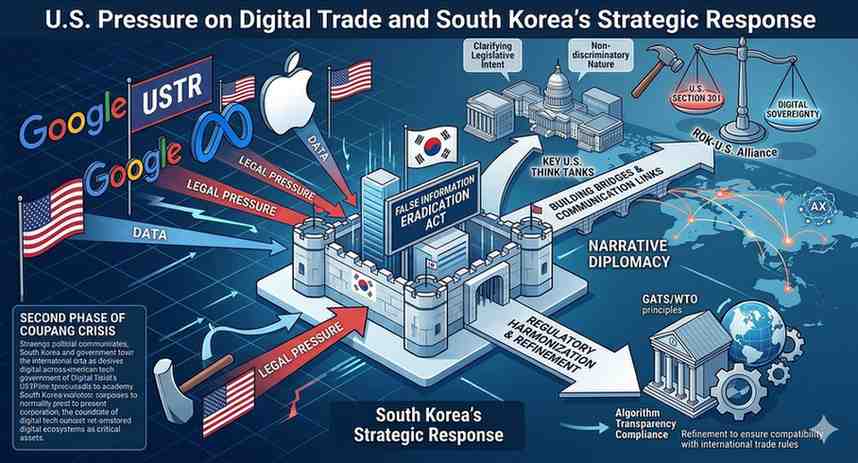
 The 2025 Coupang crisis is not over. More precisely, “Act II” is now underway. Recently, the U.S. State Department formally expressed concerns regarding South Korea’s Act on the Eradication of False Information, while major technology firms such as Google have voiced parallel objections, intensifying tensions across the digital trade landscape.
The company has argued that South Korea’s digital trade barriers and the amendment to the Information and Communications Network Act (hereinafter the “False Information Eradication Act”), which is scheduled to take effect in July, constitute regulations that disproportionately target U.S. firms.
Meanwhile, the Office of the United States Trade Representative (USTR) and officials in Washington have framed the Coupang crisis fundamentally as a digital regulatory issue and have formally raised the possibility of invoking Section 301 of the Trade Act. This is not merely a diplomatic expression of dissatisfaction. Rather, it is a strategic signal that the United States intends to intensify pressure even on its allies in the digital trade domain.
Military strategists tend to focus less on the “first shot” than on the “second move.” If the Coupang incident represented the first shot, what we are now witnessing is a more deliberately calibrated second move. If South Korea fails to accurately interpret the significance of this move, it may once again find itself confined to a reactive posture at the negotiating table.
The Misinformation Eradication Act: Tensions Between Regulatory Legitimacy and Trade Risk
The Misinformation Eradication Act currently being advanced by South Korea serves the legitimate public objective of strengthening the integrity of the information ecosystem. At the same time, however, the law contains provisions that directly intersect with the core business models of major U.S. technology companies—namely, algorithm-driven content distribution and advertising-based revenue structures. The characterization by Google and Meta of this law as a “digital trade barrier” is not merely rhetorical exaggeration, but rather a deliberate legal framing that seeks to exploit ambiguities within evolving WTO digital trade norms.
This is the central issue. It is the sovereign prerogative of any state to enact regulations to protect its citizens from misinformation. However, when such regulations are applied in a manner that disproportionately affects firms of a particular nationality, or that structurally disadvantages foreign companies relative to domestic platforms, they become a source of trade friction. This reflects the underlying logic of contemporary trade disputes, in which digital sovereignty and free trade norms come into direct tension. The United States is arguably the most adept actor operating within this framework.
Section 301 of the Trade Act is a potent instrument. This provision establishes a legal mechanism through which the U.S. Trade Representative (USTR) may independently investigate unfair trade practices by foreign governments and impose retaliatory tariffs; it has been widely employed in efforts to counter China’s technological rise. If this mechanism is directed at South Korea, a treaty ally, the issue extends beyond a conventional trade dispute and risks undermining the foundation of trust within the ROK–U.S. alliance. This point should not be underestimated.
Digital Sovereignty as Strategic High Ground in the AX Era
From a military perspective, “strategic high ground” refers to terrain that decisively shapes the outcome of a conflict. If steel and energy constituted the strategic high ground of the industrial era, data and platform ecosystems represent the strategic high ground of the AX era. Accordingly, the digital regulatory framework that South Korea seeks to establish is not merely a matter of domestic policy, but part of a broader structural contest over control of this strategic high ground.
The position held by U.S. Big Tech firms in the South Korean market corresponds, in military terms, to an asymmetric advantage. Google maintains a dominant position in search and digital advertising, while Apple and Google exercise comparable influence within the app ecosystem. When the South Korean government seeks to intervene in this ecosystem through regulatory measures such as the Misinformation Eradication Act, the U.S. response—translating these actions into trade pressure—reflects a strategic effort to preserve that asymmetric advantage.
Particularly noteworthy is the timing of this pressure. Since the onset of the second Trump administration, the United States has reinforced a transactional conception of alliances that explicitly seeks economic gains even from close partners. In this context, the actions of the U.S. Embassy in Seoul should be interpreted not simply as diplomatic signaling, but as evidence that Washington’s trade strategy is increasingly embedded within alliance management. Dismissing this signal as routine diplomatic friction risks a significant strategic misreading.
Communication Breakdown with the United States: The Absence of a Strategic Narrative
Since the 2010 Cheonan sinking incident, South Korea has learned—at considerable cost—that information asymmetry can produce diplomatic asymmetry. Regardless of how clear the underlying facts may be, without a compelling narrative through which to communicate them, one risks losing the contest in the domain of international public opinion. This lesson applies equally to the digital trade arena.
South Korea’s current communication framework with the United States remains highly vulnerable. It remains unclear whether Washington is receiving a coherent strategic narrative explaining why the Misinformation Eradication Act does not target specific firms or why its characterization as a “digital trade barrier” constitutes a misrepresentation.
While relevant South Korean agencies—including the Ministry of Foreign Affairs, the Ministry of Science and ICT, and the Fair Trade Commission—communicate through their respective channels and institutional logics, the U.S. side—comprising the USTR, the State Department, and major technology firms—has effectively coordinated a unified message of pressure.
This is not merely an issue of public relations. As Carl von Clausewitz observed, the essence of conflict lies in compelling the adversary’s will; this logic applies equally to digital trade negotiations. If the opposing side successfully establishes the narrative that “Korea’s digital regulations = discrimination against U.S. companies,” South Korea will be forced to negotiate from a structurally defensive position. Once the narrative has been ceded, half the contest has, in effect, already been lost.
Strategic Recommendations: Balancing Shield and Spear
I propose three strategic adjustments.
First, digital regulatory diplomacy should be elevated into an independent strategic domain. This requires a whole-of-government coordination mechanism capable of integrating trade negotiations, technology policy, and security cooperation.
Just as the United States effectively aligns the USTR, the State Department, and major technology firms along a common strategic axis, South Korea’s Ministry of Foreign Affairs, Ministry of Science and ICT, and Ministry of Trade, Industry and Energy must be brought under a unified strategic framework. This is, in essence, strategic synchronization for the digital age.
Second, South Korea must pursue proactive narrative diplomacy. A sustained public diplomacy effort is needed to clearly articulate the legislative intent, scope, and principle of non-discriminatory application of the Misinformation Eradication Act to Washington-based think tanks and congressional networks. Adequate expertise and resources should be allocated to ensure that South Korea’s position is accurately conveyed to institutions such as CSIS, the Brookings Institution, and the Heritage Foundation.
Third, the design of the Misinformation Eradication Act warrants careful recalibration. Both the statutory provisions and the implementing regulations should be refined to preserve regulatory legitimacy while minimizing exposure to trade disputes.
In particular, a rigorous legal review is necessary to ensure that requirements related to algorithmic transparency or mandatory content moderation remain consistent with South Korea’s obligations under the WTO General Agreement on Trade in Services (GATS). Achieving both regulatory effectiveness and trade compatibility represents the essence of sophisticated digital sovereignty.
Alliances at the Intersection of Interests
The ROK–U.S. alliance is both a blood-forged alliance and a values-based partnership. However, realist perspectives in international politics remind us that alliances are not sustained by shared values alone; they ultimately rest at the intersection of interests. U.S. digital trade pressure on South Korea should therefore be understood as part of an ongoing process of recalibrating that intersection.
South Korea must position itself as an active agent rather than a passive object in this process. Before the second phase of the Coupang crisis relegates Seoul once again to a defensive role, it must proactively define the negotiating framework and articulate its own terms. Just as control of the high ground confers an advantage in military operations, the ability to set the agenda shapes outcomes in digital trade negotiations.
In the spring of 2026, tensions are once again rising along the digital front lines of the AX era. What is required is not merely a defensive shield, but also a strategic spear capable of contesting adversarial narratives and projecting legitimacy. The combined deployment of shield and spear constitutes the appropriate strategic posture for a digitally sovereign state in the AX era.