South Korea’ Resilience: Here is Why South Korea’s Economic Fortress Stands Firm Amidst Middle East Storm
SUNDAY SPECIAL FROM EDITOR's DESK: Amid worldwide volatility, South Korea’s disciplined fiscal management, export muscle and technology dominance are emerging as a strategic lesson for India and the Global South.

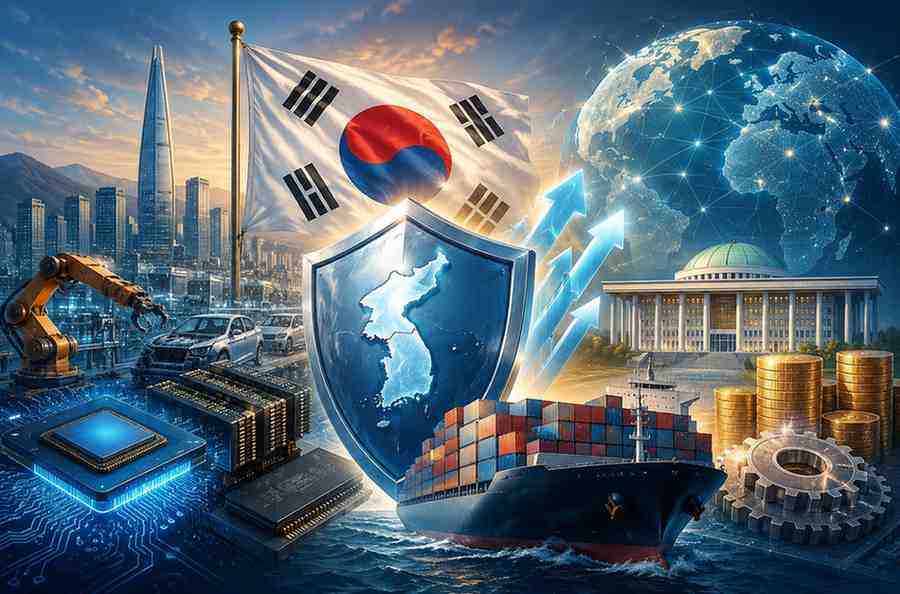
New Delhi, India – The global economic architecture in 2026 is navigating a tempest of profound proportions. As geopolitical fractures in the Middle East deepen, threatening vital energy arteries and destabilizing international supply chains, markets worldwide have been seized by acute volatility. For emerging and developed economies alike, the narrative has largely been one of defensive posturing, inflationary anxiety, and downward growth revisions. Yet, looking eastward from New Delhi, one distinct outlier commands the attention of global capital and policymakers: the Republic of Korea.
Historically dubbed the “Miracle on the Han River,” South Korea’s economic trajectory has frequently been tested by systemic external shocks. Each time, critics have wondered whether this export-dependent powerhouse would buckle under global duress. Today, as the Middle East crisis escalates, the data reveals a starkly different reality. Far from fracturing, the South Korean economic fortress is demonstrating a structural resilience that is not only outpacing its global peers but also offering a master class in macroeconomic stewardship.
From the corridors of the International Monetary Fund (IMF) in Washington to the trading floors of Wall Street, and into the bustling ports of Busan, the consensus is hardening. Korea’s robust economic fundamentals, paired with an extraordinarily agile, pre-emptive governmental response, have insulated it from the worst effects of the contemporary global crisis. For a rising India, currently charting its own path toward a multi-trillion-dollar manufacturing future, Korea’s performance is more than an admirable feat—it is a vital strategic blueprint.
The IMF’s Vote of Confidence: Defying the Global Downward Trend: The most compelling validation of Korea’s economic durability arrived on April 14, 2026, when the IMF released its updated World Economic Outlook. Faced with protracted energy supply disruptions and escalating trade friction stemming from the Middle Eastern theater, the IMF took a scalpel to global growth projections, systematically adjusting world growth forecasts downward.
Yet, amid this sea of red revisions, South Korea stood as a beacon of stability. The IMF stubbornly maintained Korea’s economic growth forecast at its previous estimate of 1.9%.
In the lexicon of international finance, a maintained forecast during a global downturn carries the weight of an upgrade. It signals to international institutional investors that Korea possesses internal buffers strong enough to absorb external velocity shocks. While competing advanced economies grapple with stagflationary pressures, Korea’s industrial engine has kept its RPMs steady, sustained by a sophisticated domestic tech ecosystem and an unyielding global demand for its high-value outputs.
Fiscal Discipline as a Relative Shield: A key pillar underpinning the IMF’s evaluation is South Korea’s functional fiscal health. The April 2026 IMF report shed light on a metric that has become a severe vulnerability for the Western world: sovereign debt.
According to the report, South Korea’s General Government Debt-to-GDP (D2) ratio for this year is projected at 54.4%. This figure marks a 2.3 percentage point improvement over previous baseline projections, driven primarily by the country’s nominal growth expansion.
To place this figure in context, one must look at the fiscal landscapes of the world’s leading economic blocs. The global general government debt average is rapidly hurtling past 95.3%, and many G7 nations currently labor under D2 debt-to-GDP ratios well eclipsing 100%, leaving them with minimal fiscal room to maneuver as global benchmark interest rates remain elevated. Compared to these highly leveraged advanced economies, Korea’s 54.4% ratio provides a valuable relative cushion, granting Seoul a degree of fiscal flexibility to support key industries and stabilize domestic credit markets during external shocks.
The Export Engine Eyeing Historic Heights: The 900 billion threshold this year: South Korea’s export powerhouse continues to expand, underpinned by absolute global demand for its high-value tech outputs and advanced manufacturing goods.
Crucially, Minister of Trade, Industry and Energy Kim Jung-gwan emphasized that achieving this historic milestone strongly positions South Korea to leap into the world’s top five export powerhouses for the first time in history. This prospective entry into the global elite of international trade underscores a profound structural transformation: despite severe geopolitical headwinds and shifting supply chain architectures, Korean industries possess an intrinsic competitiveness that is fundamentally elevating the nation’s economic stature on the global stage.
Wall Street’s Ultimate Conviction: Goldman Sachs’ High-Value Target: This convergence of functional fiscal metrics and robust industrial output has triggered a structural bull run across Korean equity markets. Over the past several months, Seoul’s stock exchanges have experienced a sustained influx of capital, defying the capital flight typical of high-risk geopolitical environments.
The definitive moment of this market validation occurred on May 7, 2026, when Wall Street titan Goldman Sachs released a pivotal investment report focusing on the region’s capital markets. In this analysis, Goldman Sachs explicitly designated the South Korean stock market as its highest-conviction view in Asia. Underlining this profound conviction, the firm decisively raised its 12-month KOSPI target from 8,000 to a historic high of 9,000.
This bold assessment from Goldman Sachs offers insight that mirrors the objective reality. There is every reason to concur with their bullish outlook: Korea’s complete dominance in High-Bandwidth Memory (HBM) nodes makes it the primary beneficiary of a generational AI infrastructure supercycle. When paired with the government’s Corporate Value-Up Program—which systematically targets the historical Korea Discount by boosting corporate transparency—the KOSPI is no longer just a cyclical trade; it has fundamentally re-rated as a resilient macro asset class.
As institutional capital flees regions directly exposed to energy supply vulnerabilities, it is pooling in Seoul. Global investors increasingly recognize that Korean corporations possess both the technological edge and the pricing power necessary to pass global inflationary pressures down the value chain.
Pre-emptive Governance: The Blueprint for Crisis Management: An economy is only as resilient as the governance shielding it. Korea’s insulation from the Middle Eastern crisis is not a product of luck; it is the direct result of a highly sophisticated, pre-emptive crisis-management framework deployed by the Korean government. Rather than adopting a reactive approach, Seoul implemented an array of multi-dimensional defense mechanisms early on.
Recognizing that a spike in Brent crude could trigger domestic inflationary spirals, the government rapidly instituted a flexible oil price cap mechanism paired with strategic fuel tax cuts. By drawing down on its extensive national strategic petroleum reserves, Korea stabilized domestic pump prices, effectively shielding consumers and logistics networks from imported energy shocks.
To support small and medium-sized enterprises directly impacted by rising freight costs and trade disruptions, the government swiftly drafted and passed an additional supplementary budget. This capital was injected directly into trade insurance funds and export logistics subsidies, ensuring that smaller supply chain nodes did not fracture under temporary cash-flow strains.
Furthermore, decades of relying on the Middle East for crude oil led Seoul to systematically cultivate energy supply chain diversification. Through aggressive energy diplomacy, Korea scaled up crude and liquefied natural gas imports from the Americas, Africa, and Southeast Asia, significantly reducing its vulnerability to the Strait of Hormuz bottleneck.
Demonstrating that economic security is inextricably linked to national security, South Korea also deployed its famed Cheonghae Unit to provide naval escort and maritime security support for Korean-flagged commercial vessels transiting volatile waters. This decisive military-logistical alignment ensured that the flow of vital industrial raw materials remained entirely uninterrupted.
Conclusion: Lessons for New Delhi and the Global South: As an Indian observer analyzing these developments, the takeaway is both clear and profound. South Korea’s economic performance amidst the 2026 Middle East crisis proves that true macroeconomic resilience is built long before a crisis hits. It is a product of disciplined fiscal health, absolute dominance in critical technology verticals, and a governance apparatus capable of lightning-fast execution.
Therein lies an invaluable lesson for India. Under the Make in India initiative and various Production Linked Incentive schemes, New Delhi is working tirelessly to transform our nation into a global manufacturing hub. However, as we scale our ambitions, we must look to the Korean model to understand how to survive the geopolitical fragmentation of the modern era.
India must actively benchmark Korea’s deep tech ecosystem. The bedrock of Korea’s steady export growth is its long-term, multi-decade cultivation of self-sustaining ecosystems in semiconductors, automotive engineering, electric vehicle batteries, and biotechnology. For India to build an unshakeable economy, we must move beyond assembly and rapidly construct deep, domestic component-manufacturing ecosystems that possess global pricing power.
Furthermore, Korea’s strategy of preemptive governance—combining strategic reserves, fiscal agility, and trade corridor defense—offers a clear roadmap for how India can protect its own economic interests when global volatility strikes close to home. The Middle East crisis has exposed the structural vulnerabilities of many global economies, but it has illuminated the profound strength of the Republic of Korea. Through fiscal discipline, technological supremacy, and peerless administrative foresight, Korea has transformed a moment of global peril into an undeniable demonstration of economic fortitude.