
AI Won’t Replace Human Meetings — It Will Make Them More Valuable
By Phil (H.P.) Chung, Executive Director, KINTEX (Korea), CEO, Kinexin Convention Management Pvt. Ltd. (Operator of Yashobhoomi IICC, New Delhi)

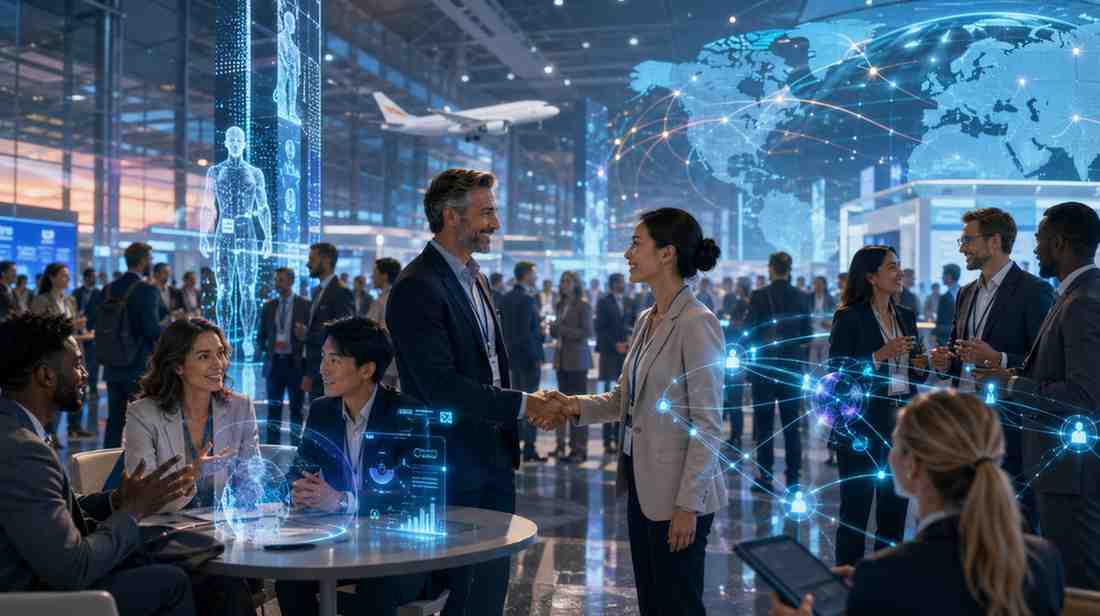
Artificial Intelligence is transforming every industry at an unprecedented speed. It is changing how we search for information, communicate, analyze data, and make business decisions. As AI becomes more capable, some predict that business travel, exhibitions, conventions, and face-to-face meetings will gradually become less necessary.
I believe the opposite will happen.
The more AI develops, the more valuable genuine human interaction becomes. Rather than replacing physical meetings, AI will become the greatest catalyst for expanding meaningful in-person business exchanges.
AI is exceptionally good at processing information. It can summarize reports, translate languages instantly, recommend business partners, analyze markets, and automate countless administrative tasks. These capabilities dramatically improve efficiency. However, business has never been built on information alone.
Trust is built between people.
Major investment decisions, strategic partnerships, government cooperation, and long-term business relationships are ultimately established through personal interaction. A handshake, a factory visit, a candid conversation over dinner, or an unscripted discussion during an exhibition often creates confidence that no virtual meeting or AI-generated report can replicate.
As AI makes information universally accessible, information itself becomes less scarce. What becomes increasingly valuable is authentic human experience.
This is precisely why the future of the MICE industry is brighter than ever.
Artificial intelligence will make exhibitions and conventions significantly more productive. Instead of replacing events, AI will improve every stage of the participant journey. It can intelligently match buyers with sellers, investors with entrepreneurs, and government officials with industry leaders based on highly relevant interests and objectives.
Instead of spending hours searching for the right people, participants will arrive with carefully curated meeting schedules. Every face-to-face conversation will become more purposeful and more likely to generate tangible business outcomes.
AI will also reduce operational burdens. Registration, customer service, multilingual communication, personalized recommendations, logistics planning, and post-event follow-up can all be enhanced through AI. Organizers will be able to devote more resources to designing exceptional experiences and creating stronger networking opportunities.
Business tourism will likewise become even more important.
As AI enables companies to identify overseas opportunities more easily, organizations will increasingly seek to verify those opportunities through site visits, investment missions, technical inspections, and international exhibitions. Companies may discover opportunities digitally, but they will continue to validate them physically.
In this new era, physical meetings become the place where digital intelligence turns into real-world decisions.
The same principle applies to governments. International cooperation is built not only on policies and documents but also on relationships. Cultural understanding, mutual respect, and personal trust cannot be automated. Diplomatic engagement, investment promotion, and public-private collaboration will continue to depend on people meeting people.
For the MICE industry, this presents an extraordinary opportunity.
We should no longer describe AI as a competitor to physical events. Instead, we should recognize it as the technology that makes physical events more intelligent, more efficient, and more impactful.
The future belongs to a hybrid model in which AI handles information while humans build relationships.
In that future, exhibitions become smarter. Conventions become more productive. Business tourism becomes more strategic. And face-to-face interactions become more valuable than ever before.
AI is not the end of human meetings.
It is the beginning of a new era in which every meeting matters more.
 About the Author: Phil (H.P.) Chung is the CEO and Managing Director of KINEXIN Convention Management, the operating company for India’s Yashobhoomi (IICC) in New Delhi. With over 20 years of experience at Korea’s KINTEX, he specialises in MICE industry management, international trade show development, and venue operations. He is also the General Director of KINTEX. His focus has been to establish Yashobhoomi as a major global hub for trade shows and investment in India. Phil has been involved with the MICE industry, creating, managing, and operating large-scale venues, and fostering international partnerships. He has been instrumental in securing major international events at Yashobhoomi, including Semicon, Power Gen, and other trade shows.