JNU Conference Maps New Wave in Language Research: AI, Translation Tech, Visual Culture and Interdisciplinary Studies
JNU Hosts IIIrd International Young Researchers’ Conference on Recent Trends in Language Research.

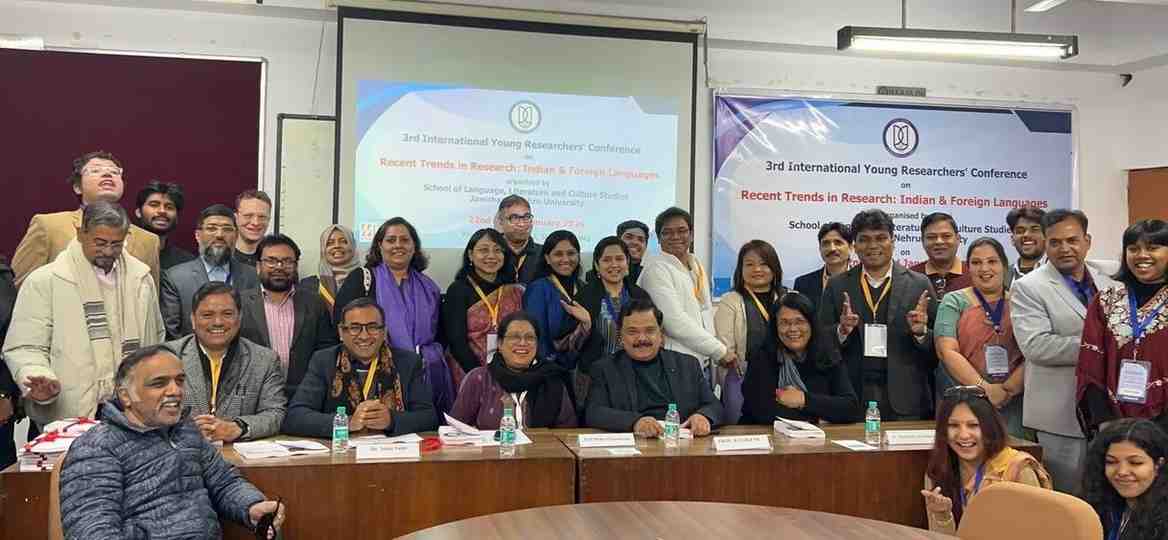
New Delhi, India: The School of Language, Literature and Culture Studies (SLL&CS), Jawaharlal Nehru University (JNU), successfully organised the IIIrd International Young Researchers’ Conference (IYRC)–2026 on the theme “Recent Trends in Research: Indian and Foreign Languages” on January 22–23, 2026, at the JNU campus. The conference brought together young scholars and academics from across India and abroad to discuss emerging directions in language, literature, culture and translation studies, with a strong emphasis on interdisciplinarity and the role of new technologies.
The inaugural session was held on January 22, marking the formal commencement of the two-day academic gathering. Initiated three years ago, the IYRC was conceived as an inclusive scholarly platform where early-career researchers could exchange ideas and share research experiences across the various Centres of the School. Over time, what began as a modest initiative expanded into a vibrant national-level forum with a steadily rising number of participants from across the country.
The conference aimed to encourage young researchers to engage critically with contemporary research trends, explore innovative perspectives in Language Studies, Literature, Cultural Studies and Translation Studies, highlight emerging tools and technologies reshaping language learning, and foster meaningful academic dialogue across Indian and foreign languages.
In her welcome address, Prof. Shoba Sivasankaran, Dean of the School and Director of the conference, reminded participants of Rabindranath Tagore’s words: “The highest education is that which does not merely give us information but makes our life in harmony with all existence.” She underlined how language and culture remain central to the harmony between knowledge systems and lived realities, and reaffirmed the conference’s purpose of nurturing young scholars across the School of Languages.
Delivering the inaugural address, Prof. Ravikesh, Registrar, JNU, highlighted the conference’s strong attention to interdisciplinarity and the importance of new research emerging at the intersections of disciplines. He cited growing dialogues such as literature and psychology, linguistics and technology, folklore and performance studies, visual culture and politics, and language pedagogy and digital tools, noting that global research trends increasingly demonstrated porous disciplinary boundaries. He also observed that the diversity of languages and regions represented in the conference—including Indian, European, East Asian, African and comparative frameworks—reinforced the inherently global, dialogic nature of linguistic and cultural studies, even as they remained rooted in local histories and contexts.
Dr. Satyanshu Srivastava, the conference coordinator, said this was the first time that representatives from all Centres—covering all languages taught at JNU—had jointly participated in and co-organised the event, making it a truly collaborative academic initiative within the School.
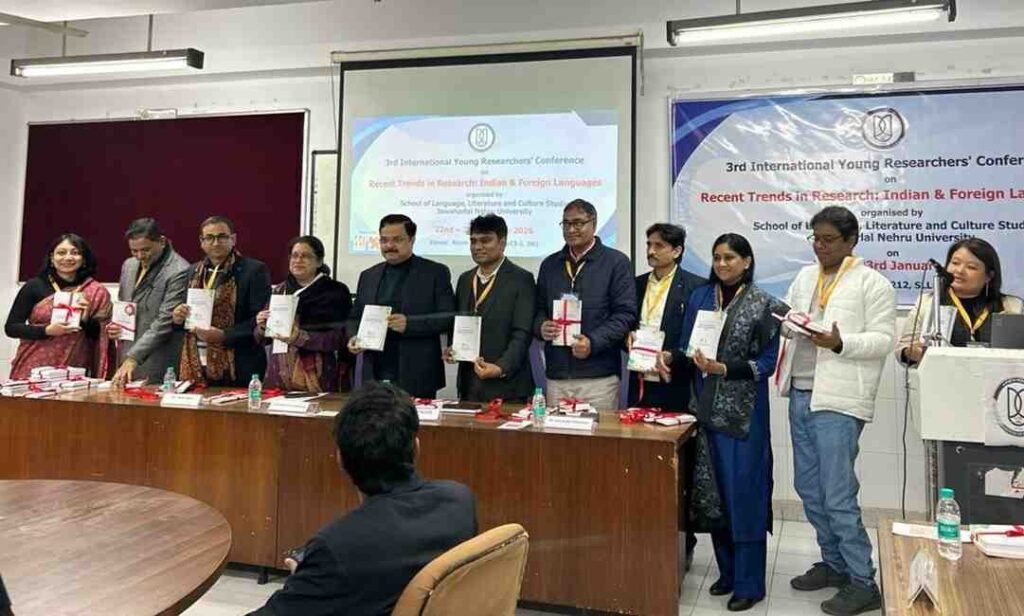
A key highlight of the inaugural session was the release of the edited book from the previous conference. Prof. Ravikesh, along with members of the Organising Committee, also released the IYRC 2026 Abstract Book, reflecting the conference’s growing academic outreach and national footprint. According to the organisers, nearly 350 abstracts were received from over 25 states across India, along with submissions from countries including the USA, UK, Japan, Russia and Korea. After a rigorous review process, 126 abstracts were selected for presentation.
The academic programme was structured into 18 sessions spread across the two days, with 12 sessions held offline and 6 sessions conducted online, enabling a wider international and national participation. In total, over 250 participants attended the conference, strengthening its position as a significant annual platform for young researchers. The conference was supported by Manak Publications and VK Global Publications.
The deliberations throughout the event reaffirmed the importance of such platforms for advancing scholarship in Indian and foreign languages and for sustaining intellectual exchange across borders. The School reiterated its commitment to continuing the IYRC as an annual academic event, encouraging emerging scholars to question, reflect and contribute meaningfully to knowledge production in the field of languages, literature and culture studies.