Korean Govt’ First Korea Education Centre Opens in New Delhi
47 Korea Education Centres across 22 countries now include India; New Delhi facility to boost Korean language learning, teacher support and student recruitment under Korea’s ‘Study Korea 300K’ global strategy.

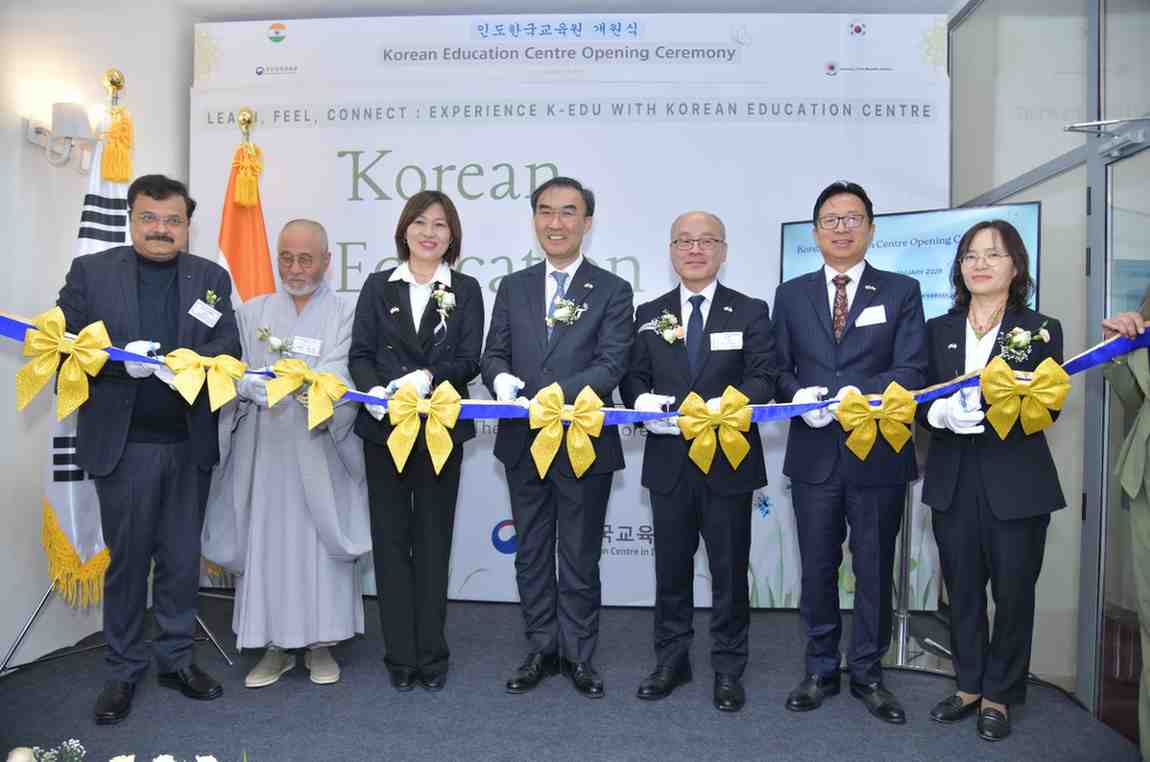
New Delhi, India – In a major milestone for India–Korea people-to-people ties and education diplomacy, the Republic of Korea officially opened the Korea Education Centre (KEC) in New Delhi on January 15, 2026, marking the first-ever Korea Education Centre in India. The centre has been set up to promote Korean language education, support identity learning among overseas Koreans, and expand academic cooperation, while also acting as a public platform to attract Indian students to Korea.
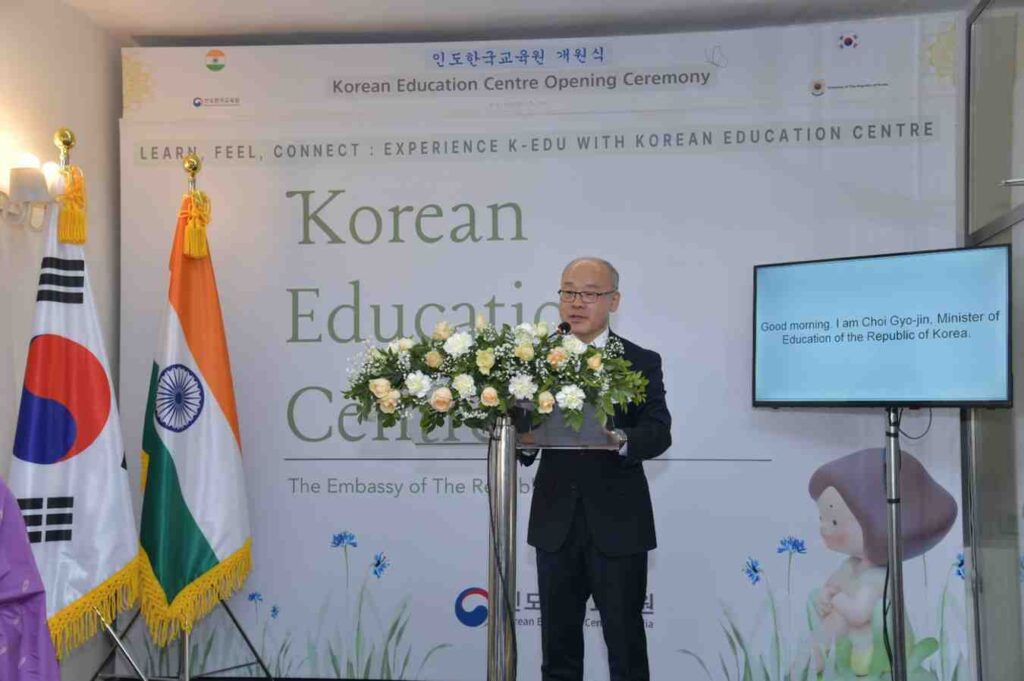
In his message, Choi Gyo-jin
The development places India within Korea’s expanding global network of Korea Education Centres—47 centres operating in 22 countries, a system that began with its first centre in Japan in the 1960s and has steadily grown as Korea’s educational outreach widened.
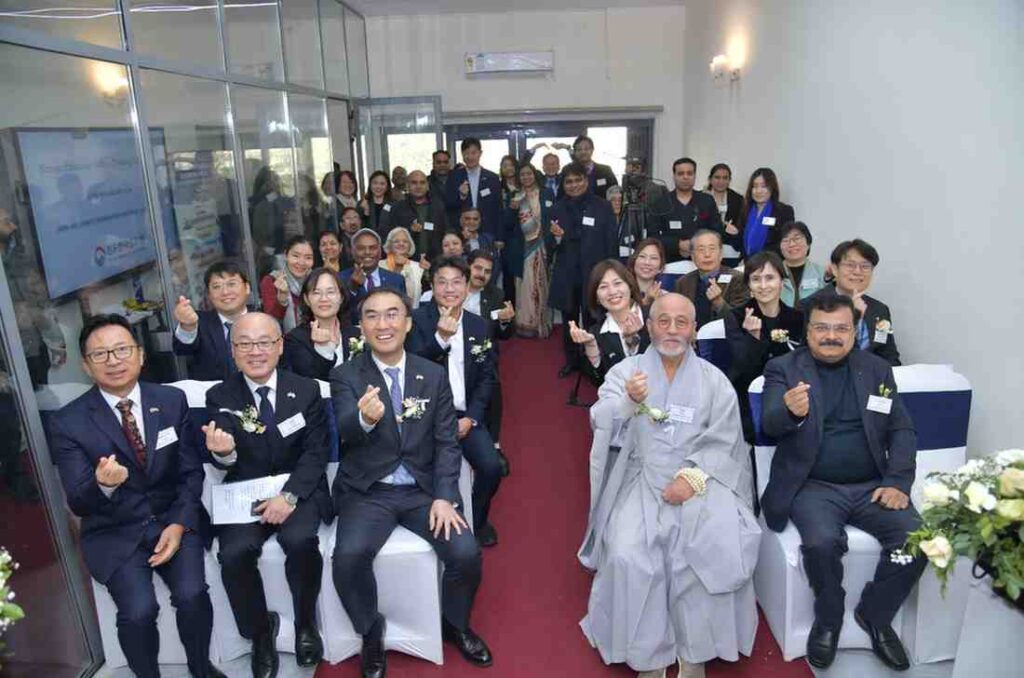
A delegation from the Ministry of Education, including Seol Sehun, Director General of Planning and Coordination, along with Lee Seong Ho, Ambassador of The Republic of Korea to India, Including Ravikesh, Registrar of Jawaharlal Nehru University, and Lee Kwang-Il, Chairman of the Korean Association in India, and Park Euy Don, Southwest Asia Chief of Peaceful Unification Advisory Council (PUAC) attended the opening ceremony of the Korean Education Centre in India.
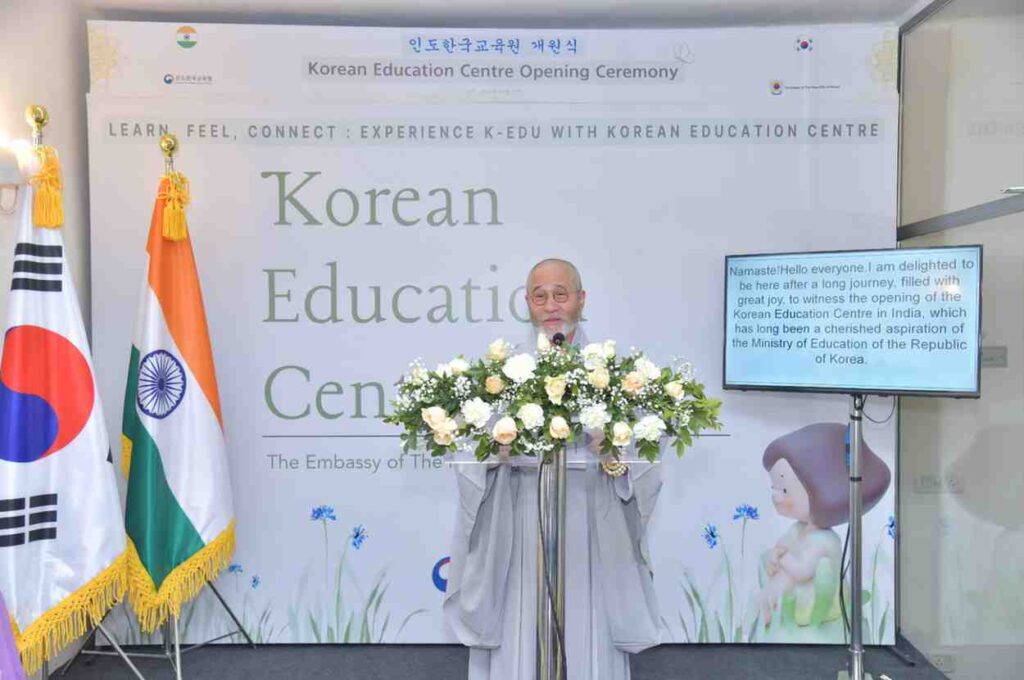
In his inaugural address, Choi Gyo-jin, Minister of Education of the Republic of Korea, framed the opening as a long-term investment in bilateral trust, stating that education does not yield immediate outcomes but fosters enduring cooperation over time.
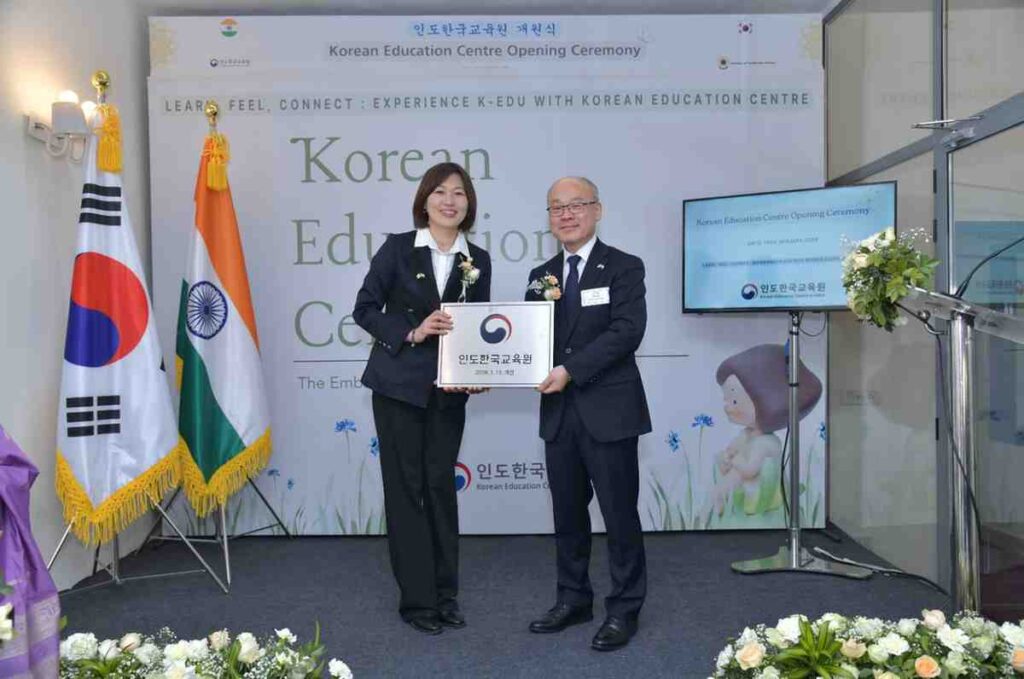
Choi Gyo-jin couldn’t join in person, and his speech was read by Seol, Sae Hun, Deputy Minister and Director General.
In his message, Choi Gyo-jin recalled the historical and cultural links between Korea and India—citing Rabindranath Tagore’s famous description of Korea as the “Lamp of the East”—and highlighted India’s support for Korea during the Korean War through medical aid and peace mediation. Emphasising India’s role as a pivotal partner, he said the New Delhi centre would support Korean language learning among the Korean community while expanding educational cooperation across India, and he pledged continued support to ensure the centre becomes a key hub for Korea–India educational cooperation under Korea’s global strategy.
Global comparison: where India fits in Korea’s worldwide KEC map: Globally, the Korea Education Centre network is most concentrated in Japan (15 centres), followed by North America & Latin America (13), Russia & CIS (7), Southeast Asia (6), and Europe & Oceania (6)—a distribution that reflects Korea’s diaspora presence and strategic education priorities.
India’s inclusion is particularly significant because the Ministry of Education has increasingly strengthened KECs not just as cultural-language institutions but also as recruitment and support platforms for international study in Korea. Under this strategy, Korea has designated 11 centres globally as key hubs for attracting international students, including Los Angeles, Osaka, Hanoi, Ho Chi Minh City, Tashkent, Almaty, Seattle, Mexico, Indonesia, and now India.
The Indian centre is aligned with Seoul’s high-profile “Study Korea 300K Project” launched in August 2023, which aims to transform Korea into a global education powerhouse by attracting 300,000 international students and supporting long-term settlement and integration of overseas students in Korea.
Lim Young-dam, Chairman of the International Korean Language Education Foundation, said the opening was a cherished aspiration of Korea’s education leadership and presented the centre as a timely response to the worldwide rise of Korean language demand under Hallyu. Noting that more than 250,000 middle and high school students worldwide are now learning Korean as a second foreign language, he underlined that systematic Korean instruction requires a structured curriculum, quality textbooks, and qualified teachers. He explained that since 2021 the Foundation and Korea’s Ministry of Education have jointly developed and distributed Korean language textbooks for overseas schools based on CEFR-aligned curricula, including country-specific editions in 10 countries. Looking ahead, he announced plans to develop India-specific Korean language textbooks by 2026, with distribution expected to begin in 2027, strengthening Korean language learning resources for Indian classrooms.
 India—now the world’s most populous nation—is an increasingly strategic partner in Korea’s global education outreach. The Ministry of Education noted that education cooperation between the two countries has expanded since the bilateral relationship was upgraded to a “special strategic partnership” in 2015.
Another factor shaping the centre’s timing is the continued rise of the Korean Wave (Hallyu) in India—boosting demand for Korean-language skills among youth who increasingly associate Korea with higher education, technology, culture, and career opportunities. The ministry also cited the presence of a sizeable overseas Korean community in India—about 15,000 people—who work across education, industry, culture, and research, and act as a bridge between the two countries.
Mandate: language, schools, scholarships and international education exchange
KEC New Delhi is an overseas educational institution established by Korea’s Minister of Education (in consultation with the Minister of Foreign Affairs) under the Overseas Koreans Education Act, with an expanded mandate shaped by globalisation.
Its functions include:
- Promoting the Korean language through lifelong education
- Identity education for the next generation of overseas Koreans
- Supporting the adoption of Korean language programmes in overseas schools
- Attracting international students
- Promoting international education exchanges
KEC India Director Ms Ko Ho-Jeong described the launch as more than the opening of an institution, calling it a new starting point for Indian students to engage with a broader world through the Korean language and education. He said the centre aims to go beyond teaching Korean and become a hub connecting people through education and culture, with special focus on supporting Korean language programmes so they can take root in local schools across India. Referring to student enthusiasm he has witnessed during school visits, he said Korean language education in India is increasingly tied to dreams, ambition and future opportunities—and the centre would work with Indian schools, universities and education authorities to expand access.
Calling the occasion historic, Lee Kwang-il, President of the Korean Association in India, said the opening of KEC in a country of 1.4 billion people signalled far more than the launch of an education facility—it marked a new beginning for mutual understanding and shared values between Koreans and Indians through language and culture. He said the centre would play a vital role in expanding systematic Korean-language education, strengthening understanding of Korean culture, and advancing educational cooperation and people-to-people exchanges. Highlighting the unprecedented interest in K-culture, K-food and K-pop among Indian youth, he said the centre could help India’s young generation build dreams and grow into future contributors to India–Korea friendship. The Korean Association, he added, would support the centre so it becomes a bridge between the Korean community and Indian society.
A new education gateway between the two countries:
By establishing a Korea Education Centre in New Delhi, Seoul has effectively added an institutional backbone to India’s rising Korean-language momentum—offering structure, continuity and government-backed credibility to a field that has largely been driven by private institutes, university departments and cultural interest until now.
With the Study Korea 300K strategy actively reshaping Korea’s global education engagement, the KEC in India is expected to play a dual role: strengthening language education within India and building reliable pathways for Indian students aspiring to study, train or pursue long-term opportunities in Korea.
As the centre begins operations, education observers see it as a strategic move that could deepen bilateral collaboration not only in language and culture but also in higher education mobility, teacher training frameworks, institutional exchanges, and future-ready global talent development between two of Asia’s most influential nations.