
Riding AI Chip Boom, S Korea Enters $1 Trillion Export Club
Becoming only the fourth country after the US, Germany and China to achieve the milestone, South Korea records unprecedented semiconductor shipments, with annual exports projected to reach $1.17 trillion.

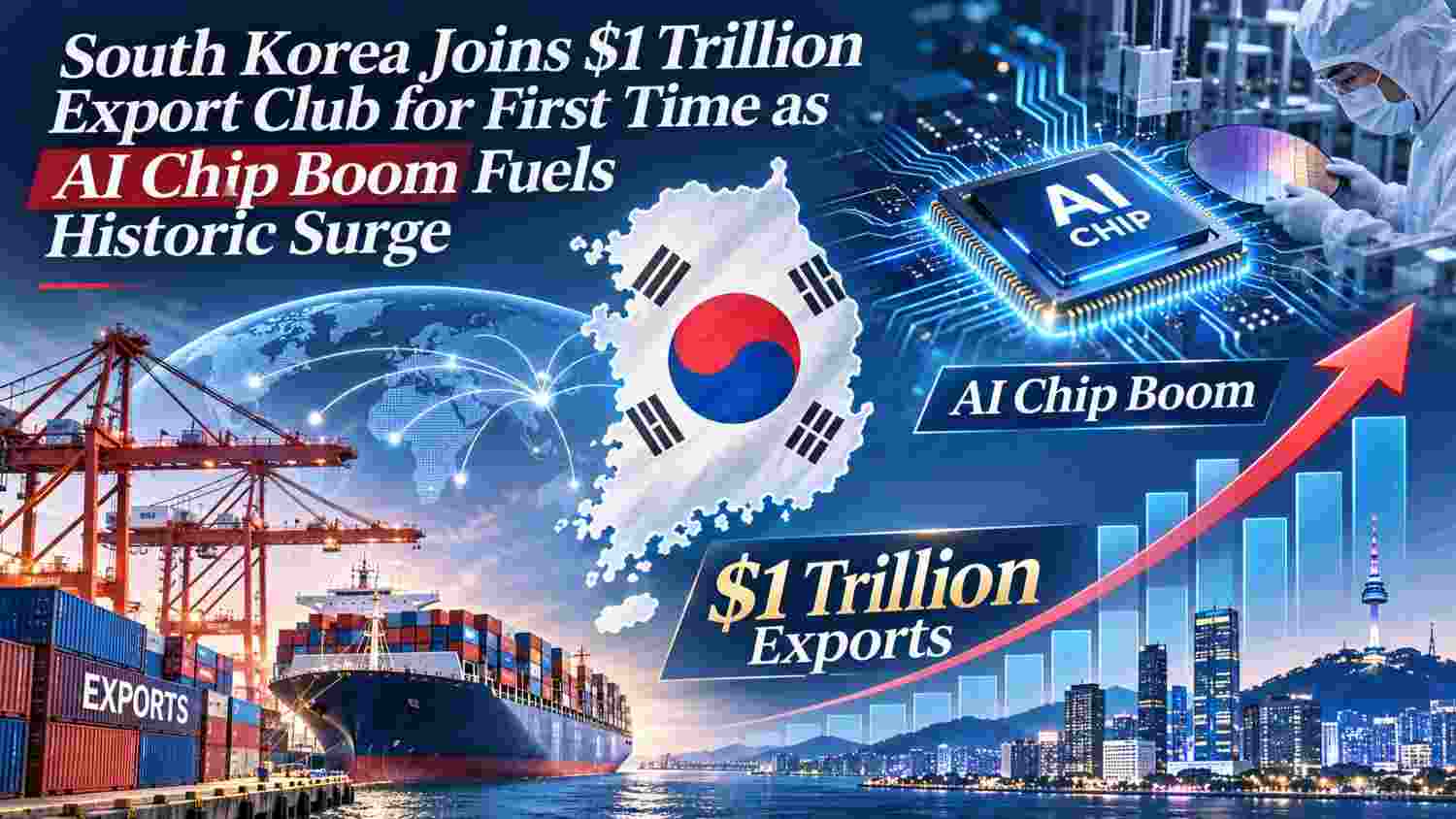
SEOUL | NOVEMBER 20, 2026: South Korea has achieved a historic economic milestone, surpassing US$1 trillion in annual exports for the first time, powered by an extraordinary surge in global demand for semiconductors, artificial intelligence (AI) infrastructure and advanced electronic components.
The landmark achievement, confirmed by South Korea’s Ministry of Trade, Industry and Resources on November 19, places the country in an exclusive group of just four nations to have exported goods worth more than $1 trillion within a single calendar year, alongside the United States, Germany and China.
It also makes South Korea the first new entrant into the trillion-dollar export club in 19 years, following Germany and the United States in 2006 and China in 2007.
According to the ministry, South Korea crossed the historic threshold at 2:09 pm local time on Thursday, November 19, more than a month before the end of 2026.
The achievement is particularly striking considering that the country’s annual exports exceeded $700 billion for the first time only last year, reaching $709.3 billion in 2025.
The government now projects that total exports could touch approximately $1.17 trillion by the end of 2026, representing an increase of around 65 per cent over the previous year’s record.
Semiconductors Power Unprecedented Growth: At the heart of this remarkable performance is South Korea’s globally competitive semiconductor industry, led by technology giants Samsung Electronics and SK hynix.
The worldwide expansion of artificial intelligence applications, cloud computing and large-scale data centres has triggered enormous demand for advanced memory chips, particularly high-bandwidth memory (HBM), DRAM and NAND flash memory.
South Korean manufacturers have emerged as major beneficiaries of this technology-driven investment cycle, supplying critical components used in AI servers, computing systems and next-generation digital infrastructure.
According to government figures, semiconductor exports surged by 193.1 per cent to $396.8 billion between January and October 2026, accounting for approximately 42.7 per cent of the country’s total overseas shipments during the period.
Higher global memory chip prices further boosted export revenues, reinforcing South Korea’s importance in the international technology supply chain.
Computer exports also registered exceptional growth, reaching $45.1 billion during the first ten months of the year.
Although semiconductors dominated the expansion, other industries contributed to the record performance.
Shipbuilding, petroleum products, display panels, cosmetics and pharmaceuticals recorded strong overseas demand, while exports excluding semiconductors increased by around 20 per cent.
South Korea’s cosmetics sector, buoyed by the worldwide popularity of K-beauty products, generated approximately $12.4 billion in exports during January–October, surpassing its previous annual record.
President Lee Hails Historic Achievement: South Korean President Lee Jae Myung welcomed the milestone as the culmination of decades of industrial development and the contributions of generations of Korean workers.
Acknowledging the country’s transformation from a developing economy dependent on labour-intensive manufacturing into a global technology powerhouse, Lee emphasised that the benefits of export growth must reach ordinary citizens.
“The gains from exports must, above all, improve people’s lives,” Lee said in a message on social media.
He also pledged to strengthen the competitiveness of established industries while promoting emerging sectors such as artificial intelligence and biotechnology.
The achievement reflects the remarkable evolution of South Korea’s export economy since the 1960s, when products such as wigs, textiles and other light manufactured goods formed an important part of its overseas trade.
Over subsequent decades, the country developed globally competitive industries in steel, shipbuilding, automobiles, electronics and, eventually, advanced semiconductors.
India Among Markets Supporting Export Growth: South Korea’s export boom has also been supported by increased demand across major overseas markets, including the United States, China, Japan and Southeast Asia.
Emerging destinations, including India and Latin America, have contributed to the expansion of Korean exports, highlighting the country’s increasingly diversified international commercial presence.
The development comes amid growing economic and industrial engagement between India and South Korea, particularly in electronics manufacturing, automobiles, advanced components and emerging technologies.
The sharp export growth has also strengthened South Korea’s external trade position.
During January–October 2026, the country registered a cumulative trade surplus of approximately $294.9 billion, more than three times its previous full-year record surplus of $95.2 billion in 2017.
Challenges Beyond the Chip Boom: Despite the extraordinary performance, South Korean policymakers and economists have cautioned against excessive dependence on the semiconductor industry.
With chips accounting for more than 40 percent of export earnings, any slowdown in global AI investment, correction in memory chip prices or disruption to technology supply chains could significantly affect the country’s future trade performance.
Rising protectionism, tariff uncertainties in major markets and intensifying competition from Chinese manufacturers remain additional challenges.
Government officials have acknowledged that the benefits of the export boom have not been distributed equally across all industries, as semiconductor manufacturing is relatively capital-intensive and generates fewer employment opportunities than several traditional manufacturing sectors.
Seoul is therefore seeking to develop additional export growth engines in pharmaceuticals, defence equipment, consumer products, advanced machinery and other high-value industries.
The ministry expects semiconductor demand linked to AI infrastructure investment to remain supportive through at least the third quarter of 2027, although the pace of export growth could moderate next year.
For South Korea, crossing the $1 trillion threshold is more than a statistical achievement. It marks another major chapter in its transformation into one of the world’s most technologically advanced and export-oriented economies, while presenting a new challenge: ensuring that extraordinary export earnings translate into sustainable and more widely shared economic prosperity.