Korean Biz Delegation Heads to Attend UP International Trade Show
Nearly two dozen Korean enterprises and sector specialists will explore Indian buyers, distributors and manufacturing partners at the UP International Trade Show in Greater Noida, which is starting on Friday.

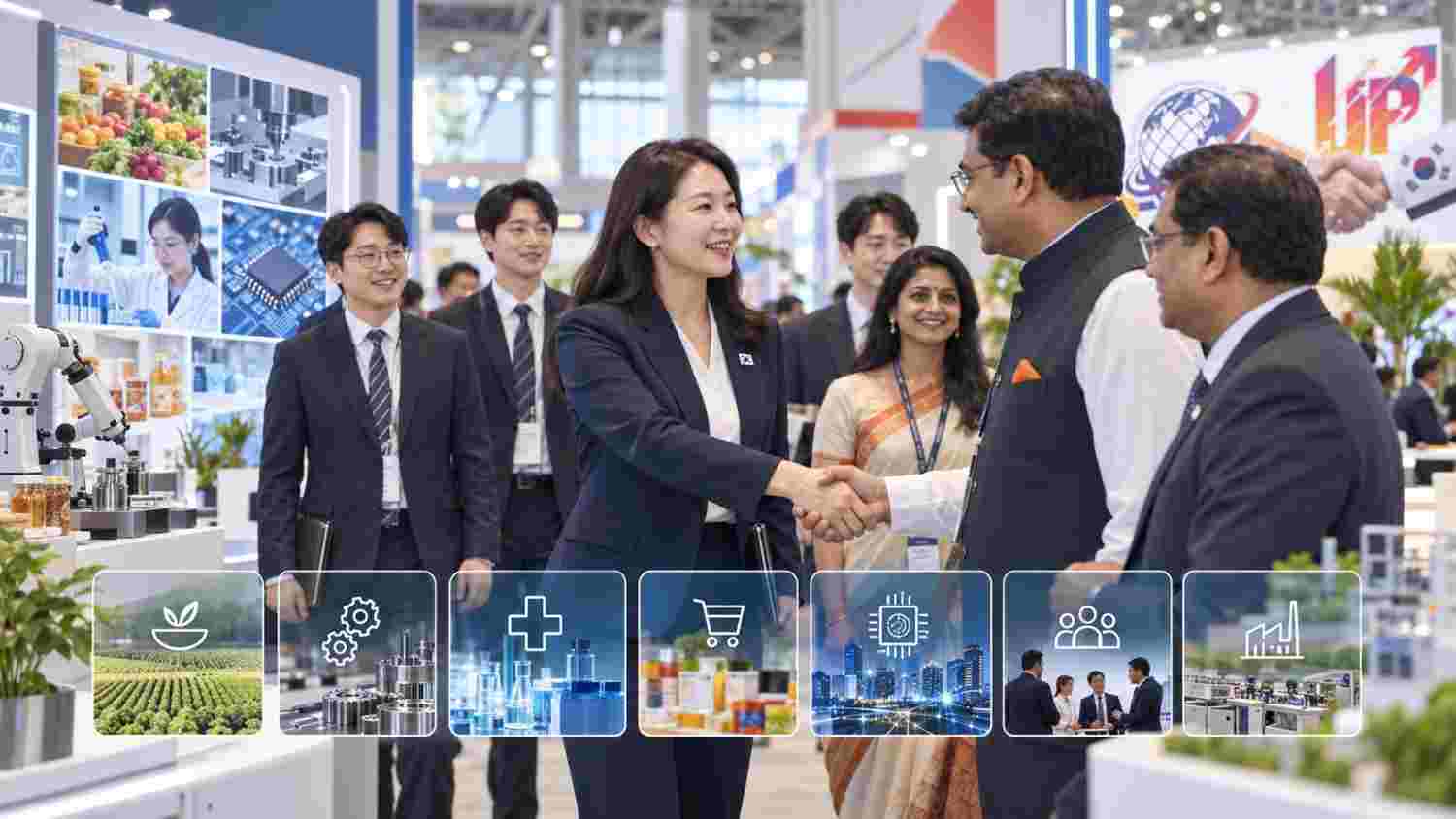
New Delhi: From bio-nano products, processed Korean berries and copper kitchenware to precision noodle-making machinery, smart imaging, industrial equipment and traditional embroidery, another diversified Korean business delegation is heading to India in search of buyers, distributors and long-term commercial partners.
The delegation, comprising representatives from nearly two dozen Korean enterprises and commercial sectors, will arrive in India on Thursday, September 24, ahead of the fourth UP International Trade Show at the India Expo Centre and Mart in Greater Noida.
Ms Helen Lee, also known as Yunsook Lee, Chairperson of Saehan Global Consulting, is leading the delegation and coordinating its business outreach in India.
The mission is expected to use the five-day trade show, scheduled from September 25 to 29, as a platform to understand the Indian market, interact with importers and distributors, identify opportunities for local partnerships and explore possible manufacturing and technology collaborations.
Jointly organised by the Government of Uttar Pradesh and India Exposition Mart Limited, UPITS 2026 aims to position Uttar Pradesh as a major sourcing and manufacturing destination. It will cover sectors ranging from agriculture, food processing, textiles and retail to electronics, healthcare, renewable energy, engineering, smart cities and industrial manufacturing.
The Korean delegation’s varied profile reflects the wide commercial scope of the exhibition. Instead of focusing on a single industry, the visiting group brings together consumer products, food and agriculture, advanced materials, machinery, professional services, art and lifestyle goods.
From Korean farms to Indian shelves: Food and agricultural products are expected to form one of the delegation’s most consumer-facing segments.
Among the participants is Lim Jeong-su, representing an agricultural enterprise working with omija, the bright red Korean berry traditionally known as the “five-flavour fruit.” Omija is consumed in Korea in the form of tea, beverages, syrups, extracts and wellness products.
Its combination of sweet, sour, bitter, salty and pungent notes gives it a distinctive place in Korean food culture. For India’s rapidly expanding market for functional beverages, premium teas and health-oriented food products, omija could offer opportunities in retail, hospitality and processed-food partnerships.
The delegation will also represent food-processing and precision-engineering capabilities connected with noodle and ramen manufacturing. Kwak Gwae-yeol and Hong Im-ju are associated with businesses offering machinery and technological solutions for producing noodles and related food products.
For Indian food manufacturers, such machinery could support automated production, consistent quality and the development of Korean-style instant or restaurant-grade noodles for the domestic market.
Their presence comes at a time when Korean food is becoming increasingly visible in Indian supermarkets, restaurants and online retail channels. The opportunity, therefore, is not restricted to importing finished products; it could extend to machinery sales, technical partnerships and localised food manufacturing.
Kitchenware, lifestyle products and wholesale trade: The delegation also includes businesses dealing in kitchen and household products, including copper kitchenware.
Copper utensils have a long tradition in both India and Korea, although their forms and uses differ. Korean manufacturers could find a receptive market among Indian consumers seeking premium cookware, tableware and decorative household products.
Other delegates are engaged in wholesale and lifestyle merchandise, bringing experience in supplying varied consumer goods through traditional markets and commercial distribution networks.
Such businesses may use the trade show to study Indian buying patterns, locate regional distributors and understand the price points required to serve India’s vast and highly segmented consumer market.
The mission also includes expertise in industrial products and general trading. These participants are expected to explore sourcing opportunities in Uttar Pradesh while simultaneously presenting Korean-made goods to Indian buyers.
Bio-nano products and smart visual solutions: At the technology end of the delegation is Kim Jong-gil, representing the bio-nano sector. While the group covers a broad product range, bio-nano capabilities could open discussions in areas such as healthcare, personal care, advanced materials and technology-enabled consumer products.
India’s large pharmaceutical, wellness and beauty markets offer possibilities for Korean businesses that can combine scientific research with commercially scalable applications.
Smart imaging and visual-presentation technology will form another area of interest, represented by Shin Woo-hoon. Such solutions can have applications in retail displays, events, advertising, entertainment, education and digital communication.
For Indian retailers and event businesses, technologies that make visual content more engaging could improve product presentation and customer interaction. The delegation is expected to use meetings at the fair to identify Indian firms capable of adapting and distributing such technologies locally.
Traditional craftsmanship alongside technology: The group is not confined to industrial and technology-driven products. Kim Jeong-ja, a Korean embroidery master associated with arts and cultural activities, will bring a traditional creative dimension to the mission.
Korean embroidery combines intricate needlework with designs inspired by nature, everyday life and cultural symbolism. Its presentation in India could create openings not only for product sales but also for cultural exhibitions, designer collaborations, fashion applications and exchanges with Indian craftspeople.
The inclusion of traditional craftsmanship alongside machinery and bio-nano products illustrates the delegation’s broader objective: to promote Korea not simply as a supplier of electronics and automobiles, but as a source of specialised products, creativity and small-enterprise innovation.
Services to support market entry: Professional services will also be an important part of the mission. The delegation includes expertise in international business consulting, legal services and market-entry support.
For Korean small and medium enterprises, India can present considerable opportunity but also unfamiliar regulations, distribution systems, business practices and regional differences. Saehan Global Consulting, under Helen Lee’s leadership, is expected to serve as the connecting platform between visiting businesses and prospective Indian partners.
Lee has positioned herself at the forefront of Korea–India commercial engagement by helping Korean businesses navigate the Indian market and build working relationships rather than limiting their visits to ceremonial meetings.
The legal and consulting specialists accompanying the delegation can assist companies in understanding contracts, compliance, incorporation, intellectual property, taxation and partner selection—areas that often determine whether an overseas market entry succeeds or stalls.
The UP International Trade Show is being promoted as a meeting ground for international buyers, domestic businesses and consumers. Its official focus sectors closely match the Korean delegation’s portfolio, particularly agriculture, food processing, healthcare, handcrafts, retail, engineering, electronics and manufacturing.
For the visiting companies, success will depend not merely on displaying products but on finding dependable Indian partners who can manage localisation, distribution and after-sales support.
For Indian businesses, the delegation offers access to Korean products and expertise beyond the familiar large corporate brands—including specialised machinery, regional agricultural goods, traditional crafts and technologies developed by smaller enterprises.
Led by Helen Lee, the mission will seek to convert that diversity into practical partnerships, making the Greater Noida trade show another bridge between Korean innovation and India’s enormous consumer and manufacturing markets