
West Asia crisis prompts India to fast-track energy diversification: FICCI
New report says the disruption is raising oil prices, weakening the rupee and straining key sectors, while also underlining the need for stronger energy security and supply-chain resilience

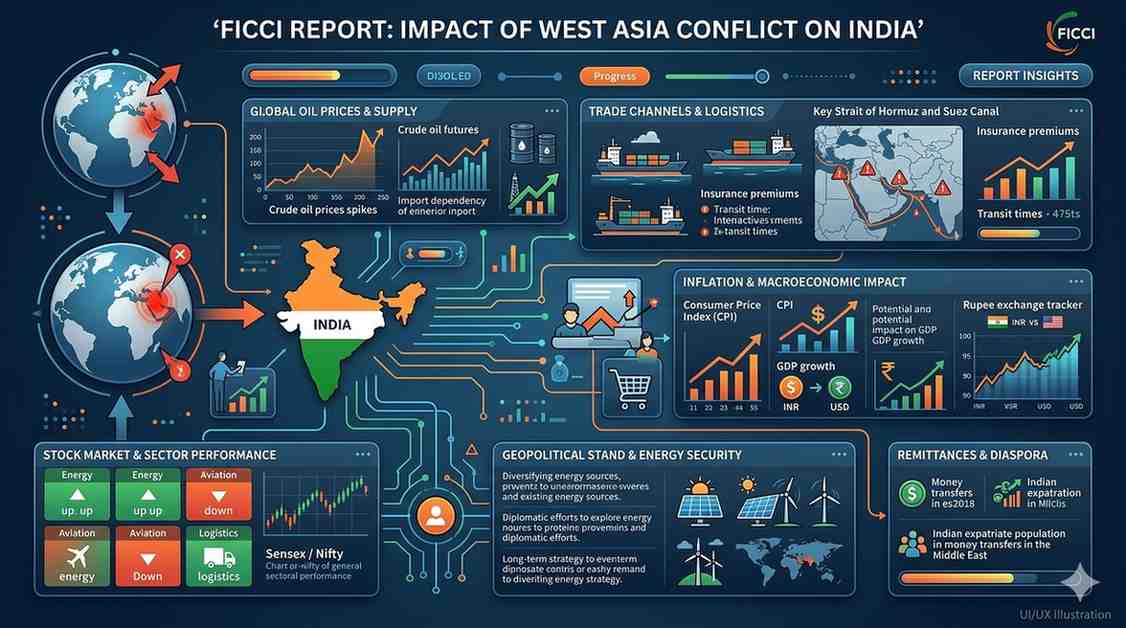
New Delhi: The West Asia conflict is emerging as both a near-term economic challenge and a strategic wake-up call for India, with a new FICCI report urging faster energy diversification, stronger supply-chain resilience and quicker movement towards domestic and renewable alternatives. The report says the crisis has already driven up crude prices, pressured the rupee, raised import and logistics costs, and exposed India’s dependence on Gulf-linked energy and commodity flows.
Titled West Asia Conflict: Implications for India and Imperatives for Industry and Government, the report says India is facing multiple headwinds from the disruption, including higher energy prices, costlier shipping, rising war-risk insurance and financial-market volatility. It identifies the Strait of Hormuz as the key pressure point, noting that the waterway carries around 20 per cent of global seaborne oil trade along with significant LNG and fertilizer flows. Traffic through Hormuz is estimated to be about 95 per cent below pre-conflict levels, sharply increasing freight and insurance costs.
The report says Brent crude rose from an average of about $71 a barrel on February 27 to $118 a barrel by March 31. During the same period, the rupee weakened to around Rs 93.5 against the US dollar on March 31, while India’s forex reserves fell from a record $728.5 billion in the week ended February 27 to $698.3 billion by March 20. According to FICCI, these pressures have created material downside risk for the government’s 7.0–7.4 per cent growth range, while Crisil has already lowered its FY27 GDP growth forecast from 7.3 per cent to 7.1 per cent.
Inflation concerns are also intensifying. Citing RBI research, the report says a 10 per cent rise in crude prices could add about 20 basis points to headline inflation. Financial markets have also reacted sharply, with the Indian stock market falling around 7.1 per cent in March and the volatility index jumping by more than 100 per cent since the conflict began.
FICCI says the disruption is now being transmitted rapidly through India’s manufacturing ecosystem because of its dependence on Gulf imports. Imported LNG accounts for about 53 per cent of marketed gas in India, and Asian LNG prices have already surged by roughly 80 per cent since the war began. LPG supplies have also been hit hard. In fertilizers, the report notes that 15 per cent of global ammonia trade and 21 per cent of global urea trade are linked to Hormuz, while India imports about 75 per cent of its ammonia from the Middle East. It adds that fertilizer prices could rise by 15–20 per cent, with prolonged disruption potentially increasing India’s fertilizer subsidy burden by Rs 20,000–25,000 crore.
The ripple effects are being felt across sectors. Packaging firms have reported more than a 50 per cent increase in prices of petrochemical derivatives such as plastics, laminates and polymers. Food-processing and FMCG companies are facing shortages in essential packaging materials, while shortages of butadiene, styrene, sulphur and caprolactam are affecting industries ranging from tyres and consumer electronics to nylon fabric and technical textiles. The report also flags helium as a critical vulnerability, saying disruptions in Qatar have taken roughly one-third of global helium supply off the market.
At the same time, FICCI frames the crisis as a moment for India to strengthen long-term resilience. The report outlines three possible scenarios, from a short disruption lasting up to three months to a prolonged crisis of over a year involving major disruption in the Strait of Hormuz. While the immediate impact is cost inflation, it says the larger policy priority should be to prevent deeper damage through industrial slowdown and weaker demand.
To that end, FICCI has called for coordinated action by both industry and government, including diversification of oil and gas sourcing, stronger strategic reserves, improved logistics resilience, greater localization of supply chains, and faster adoption of renewable and clean energy options. The report argues that, with timely intervention, India can not only cushion the current shock but also use the crisis to accelerate a more secure, self-reliant and future-ready economic framework.