
Japanese Entrepreneur Rides Horse to Beat Bengaluru Traffic Woes: Swaps Tech for Horsepower
Talendy founder Naotaka Nishiyama’s unconventional ride to work draws humour and applause online, while capturing his fascination with India’s adaptability and diversity

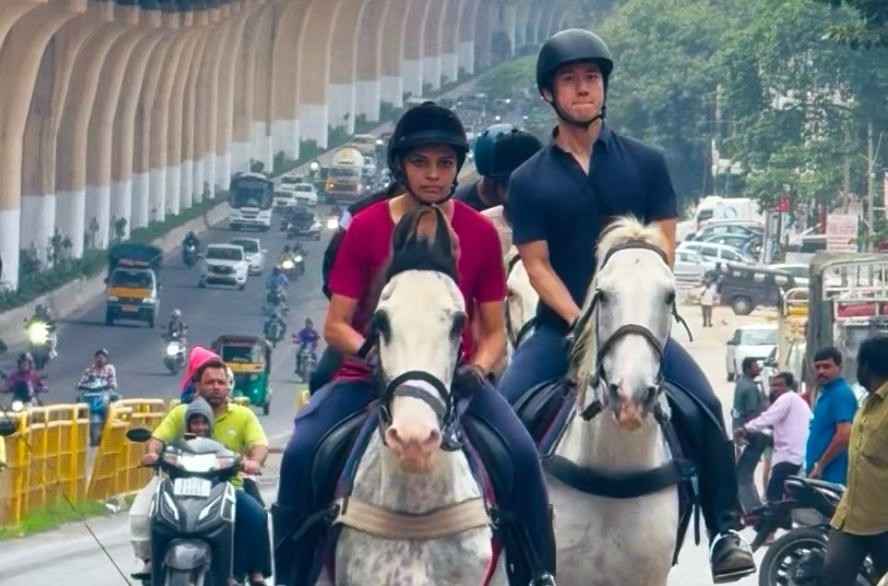
Bengaluru (India): For Japanese entrepreneur Naotaka Nishiyama, Bengaluru’s notorious traffic congestion called for an unconventional experiment—replacing mechanical horsepower with the real thing.
Nishiyama, who moved from Japan to Bengaluru in March 2024, shared a photograph of himself riding a white horse along a busy city road on his social media handle. With towering flyovers overhead and cars, autorickshaws, cows and dogs occupying the streets around him, the Japanese entrepreneur’s unusual “commute” presented a striking picture of life in India’s technology capital.
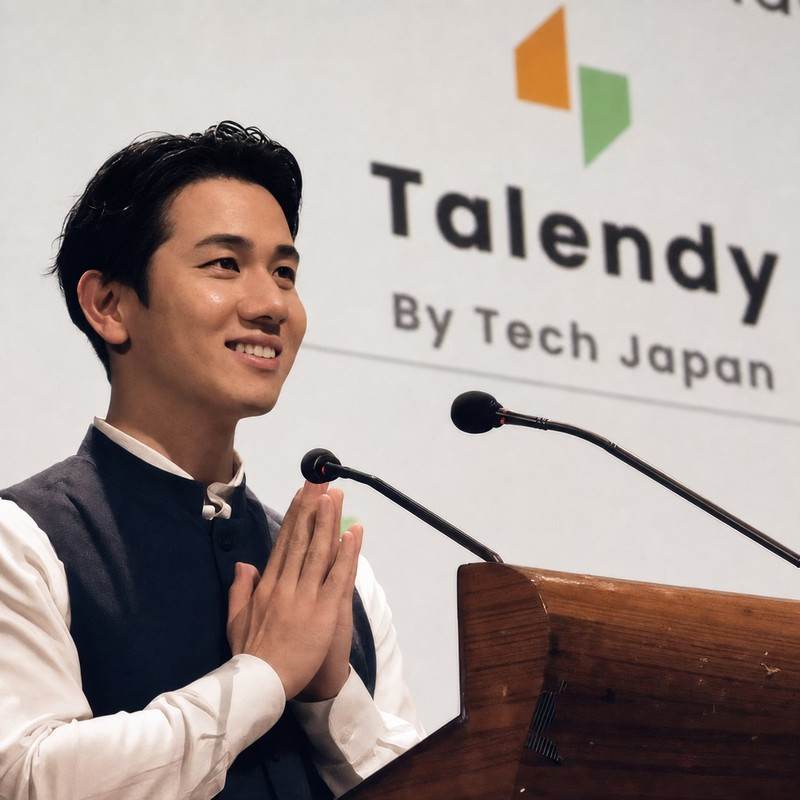 The founder and CEO of global HR technology company Talendy Holdings and former Head of Asia at Deloitte Tohmatsu Venture Support, said Bengaluru’s difficult traffic conditions had prompted him to try a new means of transportation. His post, however, was not merely a complaint about congestion. Instead, it became an affectionate reflection on the unpredictability, diversity and acceptance he has encountered during his time in India.
Nishiyama recalled feeling slightly nervous about how motorists and passersby might react to seeing a foreign entrepreneur riding a horse beneath a large flyover. His concerns quickly disappeared as drivers waved at him and autorickshaw operators greeted him with smiles.
To his surprise, he wrote, people appeared to accept a horse sharing the road with vehicles and resting animals as an entirely normal part of their daily surroundings.
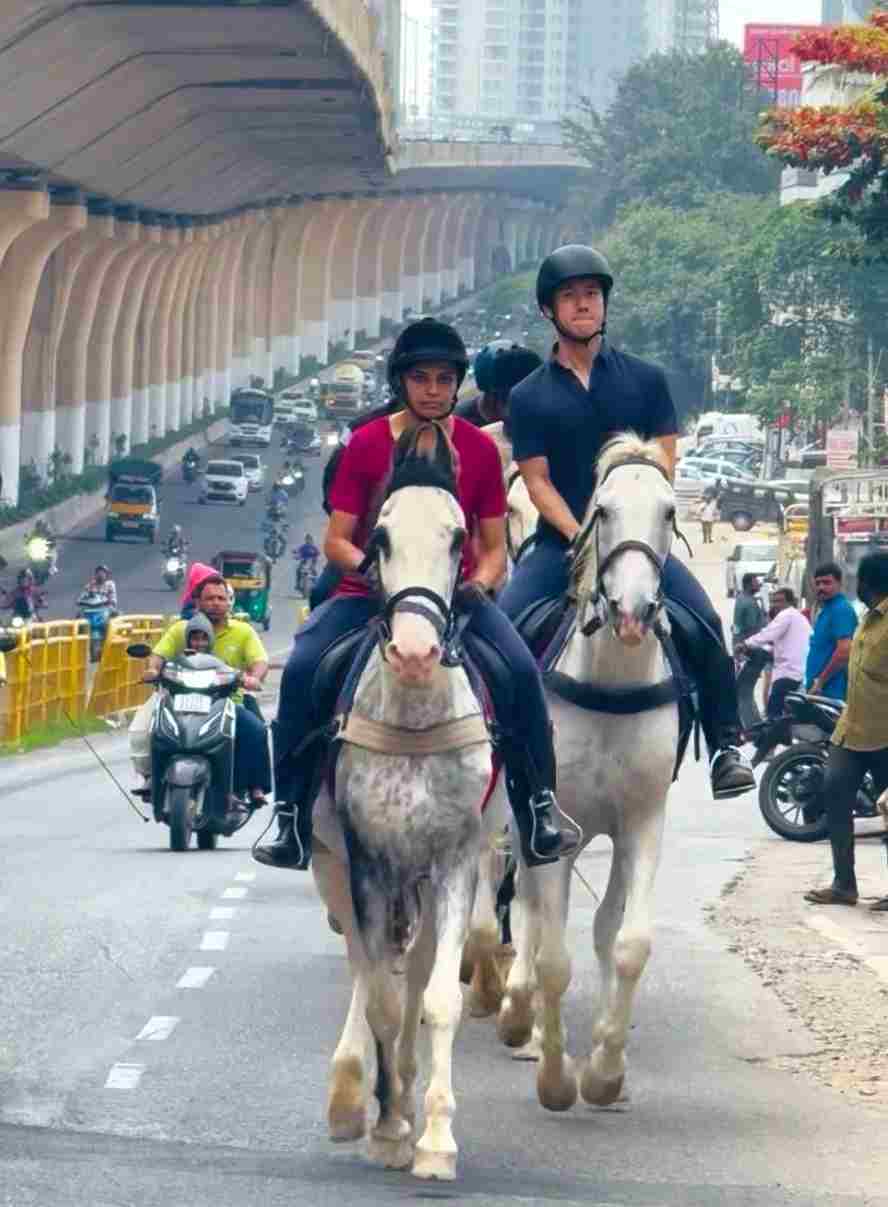 The experience, Nishiyama said, took his “India experience” to a new level and reminded him why he had grown to enjoy living in Bengaluru and India. The ride was undertaken safely along the roadside under the supervision of a professional horse-riding instructor, he clarified.
The scene also allowed Nishiyama to draw a humorous contrast between India’s modern technological ambitions and its colourful everyday realities. A day earlier, he had attended SEMICON India in Delhi, where discussions revolved around artificial intelligence, semiconductors and global business expansion.
Shortly afterwards, he found himself riding through Bengaluru on horseback and experiencing the city’s energy from an entirely different vantage point.
For Nishiyama, the rapid transition from high-rise offices and conversations about emerging technologies to a horse ride through a busy Indian street symbolised Bengaluru’s ability to accommodate seemingly contrasting worlds.
“It is a city that embraces and harmonises with diversity, not just cutting-edge technology,” he observed in his post.
He added that life in India was never dull and had repeatedly taught him the importance of adaptability, flexibility and welcoming the unexpected.
Social media responds with humour: The post quickly generated a series of light-hearted responses from Nishiyama’s large online community. His LinkedIn profile has more than 52,000 followers, giving the unusual ride considerable visibility.
Niharika Sharma, founder and procurement consultant at Corporate Legacies, joked that Bengaluru might have discovered the ultimate answer to its traffic problem—“literal horsepower”. She described a road shared by AI, semiconductors, autorickshaws, cattle, cars and horses as something possible “only in India”.
Nishiyama agreed, saying that this distinctive combination was part of what made India special.
Travel and corporate-events professional Jeevan Jagga took the joke further, suggesting that it might only be a matter of time before the horse resigned from Bengaluru’s “transport team” and relocated to Hyderabad, Kochi or Pune in search of a better work-life balance.
Nishiyama responded that if horses also began moving to other cities for improved work-life balance, Bengaluru’s traffic had truly met its match.
Software professional Narasimhan Murali remarked that only in India could someone move from discussing artificial intelligence and semiconductors to relying on horsepower without even changing the city.
Responding to him, Nishiyama described the seamless transition between global technology and local reality as “pure magic”.
Yatish Vyas proposed turning the idea into a transportation service for India’s tier-one cities and naming it “Neigh”. Nishiyama called it a potential “zero-emission unicorn startup” for Indian metropolitan centres.
Academician Anita Singh said Bengaluru’s traffic had made her consider using a road roller for her commute. Nishiyama quipped that such a vehicle might at least guarantee her the right of way.
Not all responses were humorous. One commenter used the post to criticise Bengaluru’s infrastructure and argue that the concentration of multiple economic sectors in the city had placed excessive pressure on its roads and civic systems.
Building professional bridges between India and Asia: Beyond his entertaining observations about India, Nishiyama is engaged in building professional and social connections across Asia.
His company, Talendy Holdings, is an HR technology startup that connects skilled professionals—particularly Indian technology talent—with employers in Japan, South Korea, Singapore and other international markets.
The company uses data-driven talent-matching systems and offers employer-of-record and global capability centre solutions to businesses expanding into India. It also seeks to provide continuing career support to technology professionals.
Nishiyama is also the founder of “giv”, a Japan-based non-monetary social platform. The initiative seeks to create exchanges rooted in gratitude rather than money, allowing people to give what they value and receive what they need. Its model emphasises trust, community, empathy and thank-you cards.
Before launching his ventures, Nishiyama served as Head of Asia at Deloitte Tohmatsu Venture Support. He has also worked with Japan’s Ministry of Economy, Trade and Industry, JETRO and international partners on cross-border innovation ecosystems.
His Bengaluru horse ride may have begun as a playful response to traffic, but it also captured the philosophy behind his work: adapting to unfamiliar conditions, connecting different worlds and finding possibilities in the unexpected.