
Japanese Women See Careers in India, but Safety Gaps Hold Employers Back
JCCII survey finds strong career motivation and rising satisfaction among Japanese women working in India, even as the proportion of surveyed companies employing them falls sharply.


New Delhi: Japanese women working in India are finding greater autonomy, professional growth and satisfaction in their careers, but inadequate healthcare, personal security, transport and welfare support continue to restrict their employment, according to a new survey by the Japan Chamber of Commerce and Industry in India.
The findings reveal a striking contradiction: Japanese women increasingly view India as a place of opportunity, yet many companies remain reluctant to employ or post them in the country because workplace and living-support systems have not kept pace.
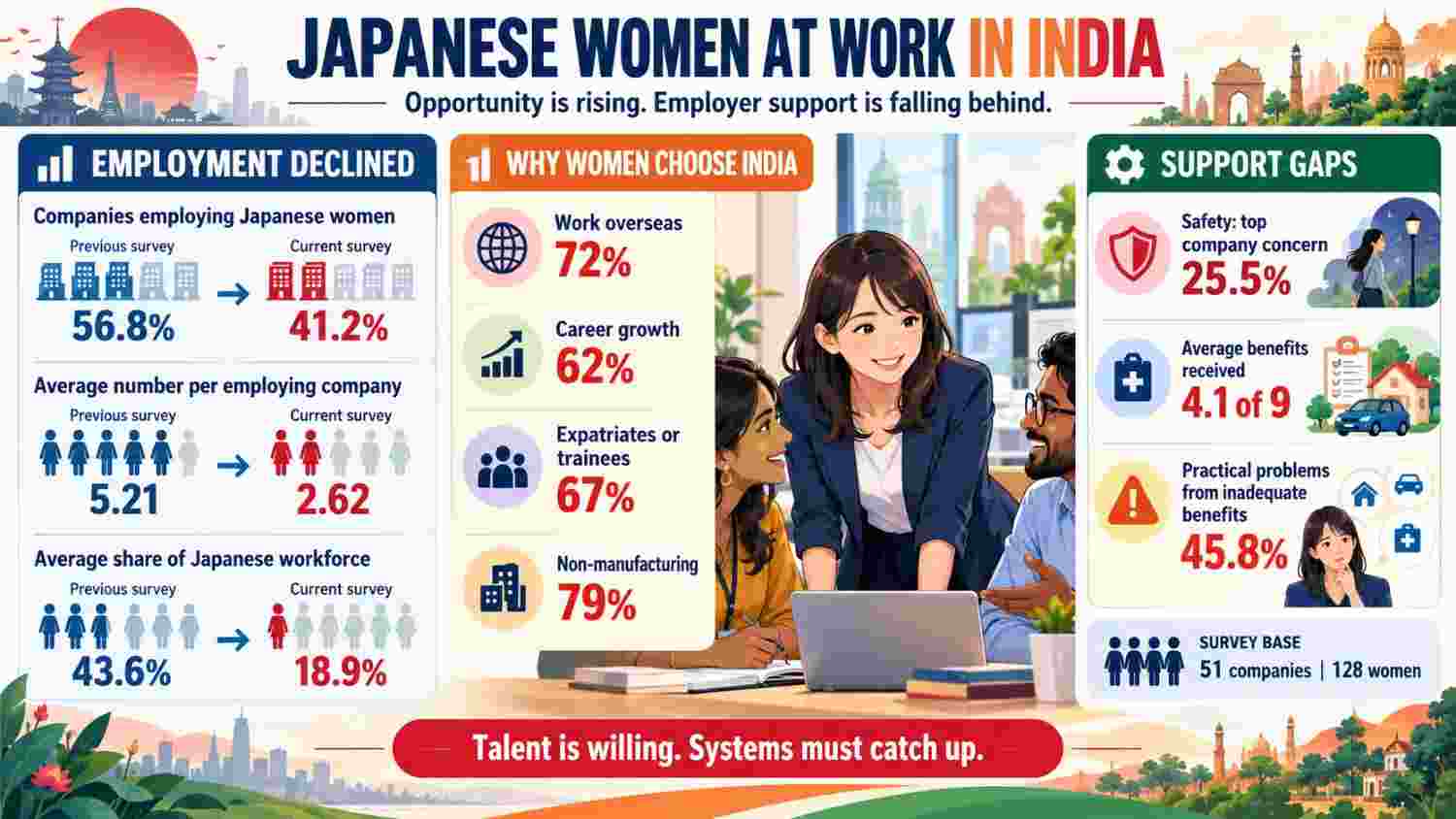
Only 41.2 per cent of the 51 surveyed companies employed at least one Japanese woman, meaning nearly six in 10 had none. That proportion fell from 56.8 per cent in the previous survey.
Among companies employing Japanese women, their average number fell from 5.21 to 2.62. Their average share of the Japanese workforce also dropped sharply, from 43.6 per cent to 18.9 per cent.
The report described this pattern as a movement towards the “minimisation” of employment rather than its maintenance or expansion.
 The report cautioned that direct year-on-year comparisons involving women respondents should be treated carefully because participation increased from 22 women in the previous survey to 128 this time.
Safety emerges as biggest corporate concern: Personal safety and security were identified as the largest obstacle to employing Japanese women, cited by 25.5 per cent of the surveyed companies.
Concerns involving pregnancy, childcare and other life stages also influenced corporate decisions. The findings suggest that the principal barrier is not a shortage of capable or interested candidates, but companies’ uncertainty over whether they can provide a sufficiently secure and supportive environment.
That distinction is important for Japanese businesses seeking growth in India. The report argues that employing women should not be treated as an exceptional arrangement requiring case-by-case improvisation. Safety protocols, secure housing, commuting arrangements, business-travel rules and flexible working systems should instead become part of standard corporate infrastructure.
Despite the decline in employment, companies that had hired Japanese women recognised clear advantages.
The most frequently identified benefit was the introduction of diverse perspectives and new ideas, followed by stronger relationships with clients and outside organisations and a more energetic workplace.
This represented a change from the previous survey, when client and external relations were seen as the leading advantage. Employers now appear increasingly conscious of the internal value that Japanese women bring through organisational diversity, innovation and competitiveness.
Of the 21 surveyed companies employing Japanese women, 10 relied exclusively on locally recruited employees, seven employed only expatriates, and four used a mixture of expatriate, locally hired or trainee arrangements.
Women see India as a career choice: The survey of individual women presents a more optimistic picture of working life in India.
About 67 per cent of respondents were expatriates or trainees, while roughly one-third were locally hired employees or entrepreneurs. More than half were based in Delhi-NCR, about a third worked in southern India, and 79 per cent were employed in non-manufacturing sectors.
Most had not arrived in India reluctantly. Seventy-two per cent said a desire to work overseas had influenced their decision, while 62 per cent cited career development. Both considerations ranked ahead of being assigned to India by their companies.
The figures challenge the assumption that Japanese women come to India primarily because of corporate transfers. For many, India represents a deliberate professional choice—a large and rapidly evolving market in which employees can acquire responsibility and experience that may be harder to obtain elsewhere.
Overall satisfaction was high, with autonomy, opportunities for personal growth, work-life balance and the quality of daily life contributing positively to respondents’ experiences.
The report’s analysis found autonomy to be a particularly strong direct driver of satisfaction. Its broader statistical assessment also underlined the importance of employee benefits and access to reliable information before relocation.
Overall satisfaction, career-related evaluation and work-life balance each improved by about eight percentage points from the previous survey, although the report advised caution because of the substantial difference in sample sizes.
Welfare gaps carry real consequences: The positive career experience, however, is accompanied by practical difficulties that can affect women’s health and ability to remain in India.
Across nine categories of employee support examined by the survey, respondents received an average of only 4.1 benefits. Approximately half expressed dissatisfaction with the support available, while 45.8 per cent said inadequate benefits had caused actual problems in their work or daily lives.
Medical care emerged as a particularly sensitive issue, including access to gynaecological services, adequate health insurance and reliable guidance about hospitals.
“Because I have no insurance, I hesitate to get tests or visit a hospital,” one anonymous respondent told the survey.
Another said uncertainty about seeking treatment sometimes allowed an illness to worsen until hospitalisation became necessary.
Secure transport was another recurring concern. One woman described being unable to find a taxi during the monsoon, becoming trapped in flooding and later suffering a neck injury in an autorickshaw accident.
Respondents also sought stronger housing assistance, company-provided transport or cars, home-leave support and practical help in navigating daily life.
The burden was not evenly distributed. Locally hired women reported greater anxiety about salaries, benefits and financial protection than expatriates, who are generally covered by more comprehensive corporate packages.
Women working in Delhi-NCR appeared to encounter a combination of strong professional opportunities and heavier pressures involving health and living conditions. Respondents in southern India more frequently reflected a pattern of stability and longer-term settlement.
The report identified locally employed women in Delhi-NCR as a group facing especially concentrated challenges.
Support systems could unlock a larger talent pool: The findings indicate that improving conditions for Japanese women could help companies address wider talent and leadership needs in India.
Rather than expecting employees to adapt individually to every difficulty, WING recommended building a dependable framework covering medical care, secure accommodation, transport, career development and access to trustworthy information before and after arrival.
It also called for career planning that does not disadvantage employees because they are locally recruited rather than transferred from Japan.
Better information could itself reduce anxiety. Clear advice on housing, hospitals, transportation, personal safety and employment conditions before relocation would allow women to make informed choices and avoid preventable problems.
WING is preparing guidelines for Japanese women working in India, covering travel preparation, accommodation, mobility, healthcare, safety and career development.
The larger message from the survey is that India does not lack Japanese women willing to work, lead and build careers in the country. What remains uneven is the institutional environment required to help them succeed and stay.
For companies, strengthening that environment may no longer be simply an employee-welfare measure. It could become a business strategy—one that widens access to talent, introduces different perspectives into management and makes India a more sustainable destination for Japanese professionals.