
Silicon to Solutions: Building India’s AI Infrastructure Backbone with Taiwan
Authored by: Vincent Lin, Director of Taipei World Trade Center Liaison Office in New Delhi

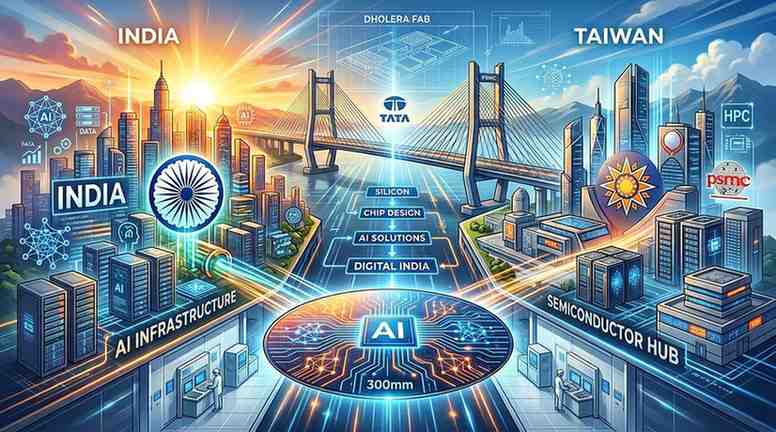
The global technology landscape is undergoing a structural shift driven by two powerful forces—artificial intelligence and the growing urgency for resilient semiconductor supply chains. In this evolving ecosystem, the partnership between India and Taiwan is emerging as a strategically important axis. Over the past decade, bilateral economic engagement between the two economies has expanded steadily, with trade volumes increasing and technology collaboration gaining momentum. As India accelerates its ambitions in artificial intelligence and digital infrastructure, Taiwan’s globally recognized expertise in semiconductors and hardware manufacturing positions it as a natural partner in building the country’s AI infrastructure backbone.
 Taiwan has long been the epicenter of the global semiconductor ecosystem, producing a significant share of the world’s advanced chips. As artificial intelligence adoption surges across industries, from healthcare and mobility to finance and manufacturing, the demand for high-performance computing hardware and specialized AI chips has increased dramatically. This has reinforced Taiwan’s role not just as a semiconductor manufacturing powerhouse but as a critical enabler of the global AI economy.
At the same time, India is witnessing the rapid emergence of artificial intelligence as a major economic and technological frontier. With one of the world’s largest digital user bases, a thriving startup ecosystem, and a strong developer community, India is uniquely positioned to become a global hub for AI innovation. Government initiatives such as the India AI Mission and continued investments in digital public infrastructure are further accelerating this transformation. However, scaling AI capabilities at a national level requires more than algorithms and software; it demands a robust underlying hardware and semiconductor ecosystem.
This is where the Indo-Taiwan partnership becomes particularly significant. The collaboration is gradually moving beyond exploratory engagement toward tangible industrial projects that bridge the gap between silicon manufacturing and AI-driven solutions. A landmark example is the partnership between Tata Electronics and Taiwan’s Powerchip Semiconductor Manufacturing Corporation (PSMC) to establish India’s first AI-enabled 300mm semiconductor fabrication facility in Dholera. By focusing on technology nodes ranging from 28nm to 110nm, the project targets the essential “workhorse” chips that power applications across power management, IoT devices, and automotive electronics, the foundational layers supporting AI-driven systems.
Beyond fabrication, cooperation is also expanding into the manufacturing of advanced computing infrastructure. The joint venture between Dixon Technologies and Taiwan’s Inventec reflects a shift toward producing high-value hardware in India, including AI servers and computing components. With its deep experience as a global original design manufacturer (ODM), Inventec brings critical design capabilities that can help strengthen India’s position as a reliable hub for IT infrastructure manufacturing.
Equally important is the development of talent and research ecosystems that can sustain long-term innovation. Academic collaborations between institutions such as IIT Gandhinagar and Taiwan’s National Yang Ming Chiao Tung University are fostering research in integrated circuit design, machine learning, and advanced manufacturing. These partnerships are building a cross-border talent corridor that will be essential to supporting the semiconductor and AI industries in the years ahead.
Policy initiatives are also reinforcing this momentum. Through the India Semiconductor Mission and broader digital economy programs, India is actively investing in supply chain resilience, research capabilities, and local manufacturing capacity. When combined with Taiwan’s unmatched hardware expertise and India’s scale, engineering talent, and rapidly expanding AI market, the partnership creates a powerful foundation for future innovation.
As AI becomes central to economic competitiveness, building resilient infrastructure will be critical. The India–Taiwan collaboration represents a pragmatic and forward-looking approach, one that moves beyond chips alone to create an integrated ecosystem spanning silicon, systems, and solutions. In doing so, it lays the groundwork for a more resilient and globally relevant AI infrastructure backbone for India.