India’s Holika Dahan and Korea’s Daeboreum Fall on Same Day in 2026, Linking Two ‘Full Moon’ Traditions
March 3 coincidence spotlights shared themes of fire rituals, renewal, community prayers, and a symbolic reset for the year ahead.

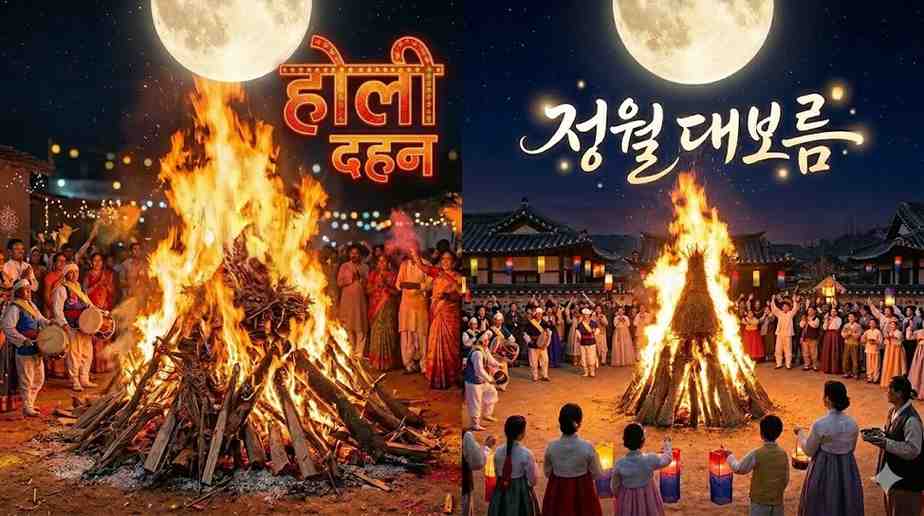
New Delhi, March 3, 2026: In a rare and culturally resonant overlap, India’s Holika Dahan and Korea’s Jeongwol Daeboreum—both anchored in the first major full-moon moment of the season—are being observed on the same date: March 3, 2026, prompting fresh interest in how two ancient traditions, separated by geography and language, converge in spirit.
Both festivals land on the same date, and reveal a striking shared vocabulary: the full moon above, the fire below, and a community in between—seeking protection, health, and a better year.
In India, Holika Dahan is marked by community bonfires on the eve of Holi, symbolising the victory of good over evil and the burning away of negativity. This year, the festival timing drew extra attention because the Purnima (full moon) tithi spans from March 2 evening to March 3 evening, with many advisories pointing to March 3 as the principal observance.
In Korea, Jeongwol Daeboreum—literally the “Great Full Moon of the first lunar month”—welcomes the year’s first full moon with folk rituals meant to invite health, good fortune, and a good harvest. In 2026, several official city calendars list Daeboreum events on March 3, including fire and moon-viewing programmes.
 Why does the same date matter? Both festivals are fundamentally “threshold” occasions—moments when communities gather to mark a transition:
- From winter to spring (seasonal renewal)
- From uncertainty to protection (ritual purification)
- From individual life to community life (shared celebration)
Holika Dahan does this through bonfire worship and symbolic cleansing, while Daeboreum does it through full-moon rites and folk practices that aim to “set” the year’s luck, health, and harvest prospects.
The strongest similarities between Holika Dahan and Daeboreum
1) Fire as a purifier and a community anchor: At the heart of Holika Dahan is the public bonfire, around which families and neighbourhoods gather, offer prayers, and perform rituals associated with protection and renewal. Daeboreum, too, is widely associated with fire traditions—including community fire festivals and programmes—reflecting the belief that light and warmth help drive away misfortune while welcoming abundance.
2) A full-moon logic: timing that follows the sky: Holika Dahan is tied to Phalguna Purnima, while Daeboreum is tied to the first full moon of the lunar year. Both traditions treat the moon as a kind of calendar of meaning, guiding the “right” time for ritual action.
3) “Good year” prayers: health, prosperity, and protection: Holika Dahan’s symbolism centres on triumph over destructive forces and a cleansing of the old to make way for joy (Holi).
Daeboreum rituals, in their traditional framing, are strongly linked to health and fortune for the months ahead—an annual “reset” that asks nature and society for stability.
4) Folk culture meets modern celebration: Both festivals have deep folk roots but continue to evolve as living traditions. Korea’s Daeboreum events now often blend hands-on cultural programmes with public celebrations, while Holika Dahan—followed by Holi—has expanded into one of India’s most visible public festivals.
Indo–Korea context: a timely cultural bridge: The March 3 coincidence arrives at a time when India–Korea people-to-people links are growing through education, diaspora communities, cultural festivals, and the wider popularity of Korean culture in India. The shared date offers cultural groups, schools, and community organisations in Indian cities with Korean presence—especially Delhi-NCR, Chennai, Bengaluru, Pune, and Hyderabad—an easy narrative bridge: different origins, similar human hopes.
In 2026, even practical festival planning has had to factor the lunar calendar more closely, with multiple reports in India highlighting how astronomical factors shaped Holika Dahan timing discussions this year.