

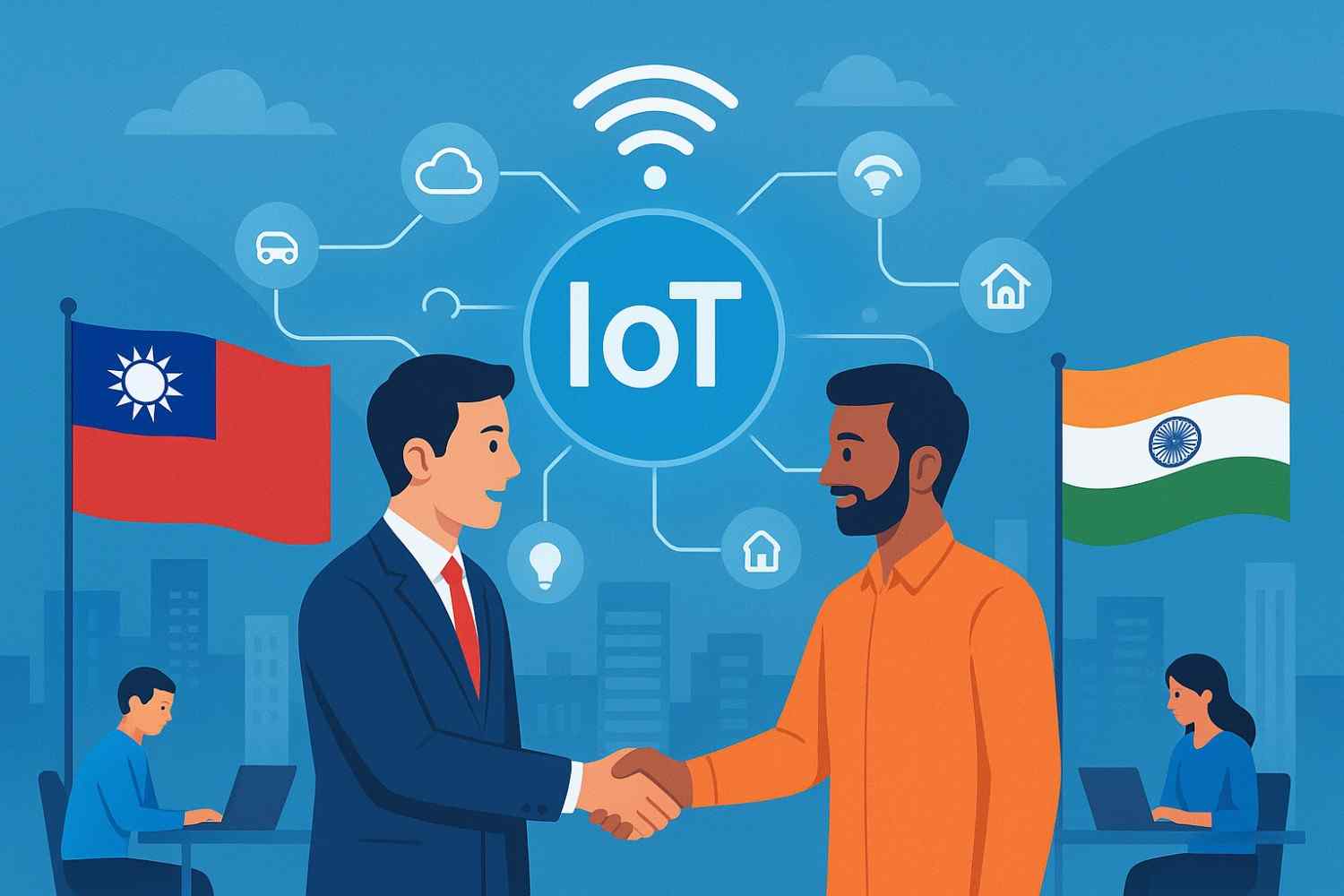
New Delhi, India, August 21, 2025 — The Internet of Things (IoT) has become one of the fastest-growing technological revolutions in India, reshaping industries, governance, and everyday life. From smart homes and intelligent healthcare systems to industrial automation and digital agriculture, IoT solutions are creating a wave of innovation across the country. At the heart of this transformation lies a powerful international collaboration, with Taiwanese research and development (R&D) playing a significant role. Taiwan, known globally for its leadership in semiconductor technology, smart devices, and advanced manufacturing, has become a key partner in India’s IoT growth story.
Taiwan’s expertise in hardware development forms the backbone of IoT ecosystems. While India has made substantial progress in software, cloud platforms, and data analytics, the challenge often lies in integrating these capabilities with robust, efficient hardware. Taiwanese firms bring decades of experience in microchips, sensors, and communication modules that are essential to IoT infrastructure. Their R&D centers, some of which are already established in Indian technology hubs, are bridging this gap by providing cost-effective, scalable solutions tailored to Indian conditions.
The Indian market poses unique challenges that demand localized innovations. For instance, IoT applications in rural agriculture require durable sensors that can withstand extreme weather, operate on low power, and transmit data in areas with limited connectivity. Taiwanese R&D teams, in collaboration with Indian engineers, have been instrumental in creating such context-specific devices. This partnership has not only accelerated product development but has also reduced dependency on imports by encouraging local manufacturing and assembly under India’s “Make in India” initiative.
Another area where Taiwanese R&D has had a profound impact is in industrial IoT (IIoT). India’s manufacturing sector, especially small and medium enterprises (SMEs), is embracing automation to enhance productivity and reduce costs. Taiwanese companies, with their long history of working with global supply chains, provide advanced sensor systems, robotics integration, and predictive maintenance tools that help Indian industries modernize. Their contributions go beyond supplying technology—they also share expertise through training, workshops, and collaborative research programs with Indian institutions.
The healthcare sector in India has also benefitted from this partnership. IoT-enabled devices such as remote patient monitoring systems, smart wearables, and telemedicine platforms are becoming more widespread. Taiwanese firms, with their strong capabilities in precision electronics and biomedical devices, are co-developing solutions that cater to India’s large and diverse population. These innovations are particularly relevant in rural and underserved areas, where access to doctors and hospitals remains limited. By making healthcare smarter and more accessible, Taiwanese R&D is directly contributing to improving the quality of life in India.
Smart cities are another key domain where Taiwanese contributions are shaping India’s IoT revolution. India’s ambitious Smart Cities Mission relies heavily on technologies such as smart traffic management, energy-efficient grids, and intelligent surveillance systems. Taiwan’s advancements in sensors, energy management, and 5G-enabled IoT devices provide a strong technological base for these projects. Collaborative pilot projects between Indian municipal authorities and Taiwanese R&D teams are helping create more sustainable, secure, and efficient urban environments.
Beyond technology transfer, the partnership also enhances India’s innovation ecosystem. Taiwanese companies are setting up R&D centers, incubators, and joint labs in collaboration with Indian universities. This creates opportunities for knowledge sharing, talent development, and cross-border research. Young Indian engineers gain exposure to global best practices, while Taiwanese firms benefit from India’s large pool of software talent and data analytics expertise. This synergy is gradually creating a self-sustaining cycle of innovation in the IoT space.
Furthermore, the geopolitical dimension of this collaboration cannot be overlooked. With global supply chains undergoing realignment and India seeking to strengthen its electronics manufacturing base, Taiwan has emerged as a natural partner. Both nations share complementary strengths—Taiwan in hardware R&D and India in software and services. Together, they can create globally competitive IoT solutions that serve not only their domestic markets but also the broader Asia-Pacific and global economies.
The road ahead promises even deeper collaboration. As 5G networks roll out across India and AI-powered IoT applications gain traction, the demand for advanced sensors, semiconductors, and edge computing devices will surge. Taiwanese R&D is well-positioned to meet these needs, while Indian companies provide a massive testbed for real-world applications. This partnership, if nurtured further, could position India as a global hub for IoT innovation, with Taiwan as its indispensable technology ally.
In conclusion, the role of Taiwanese R&D in India’s IoT revolution goes far beyond supplying hardware—it represents a partnership of innovation, adaptation, and mutual growth. By combining Taiwan’s hardware expertise with India’s software capabilities and vast market potential, the two nations are jointly laying the foundation for a smarter, more connected future. The collaboration stands as a model of how international R&D cooperation can accelerate technological revolutions while addressing local needs and global opportunities.