Consider India as a ‘scale-up base’ for global expansion of Korean tech: Dr. Abraham Lee
At Seoul deep-tech conference, Atomy India CEO calls India an essential strategic partner for Korean firms in semiconductors, AI and biotech, while urging a more practical cooperation framework between the two countries.

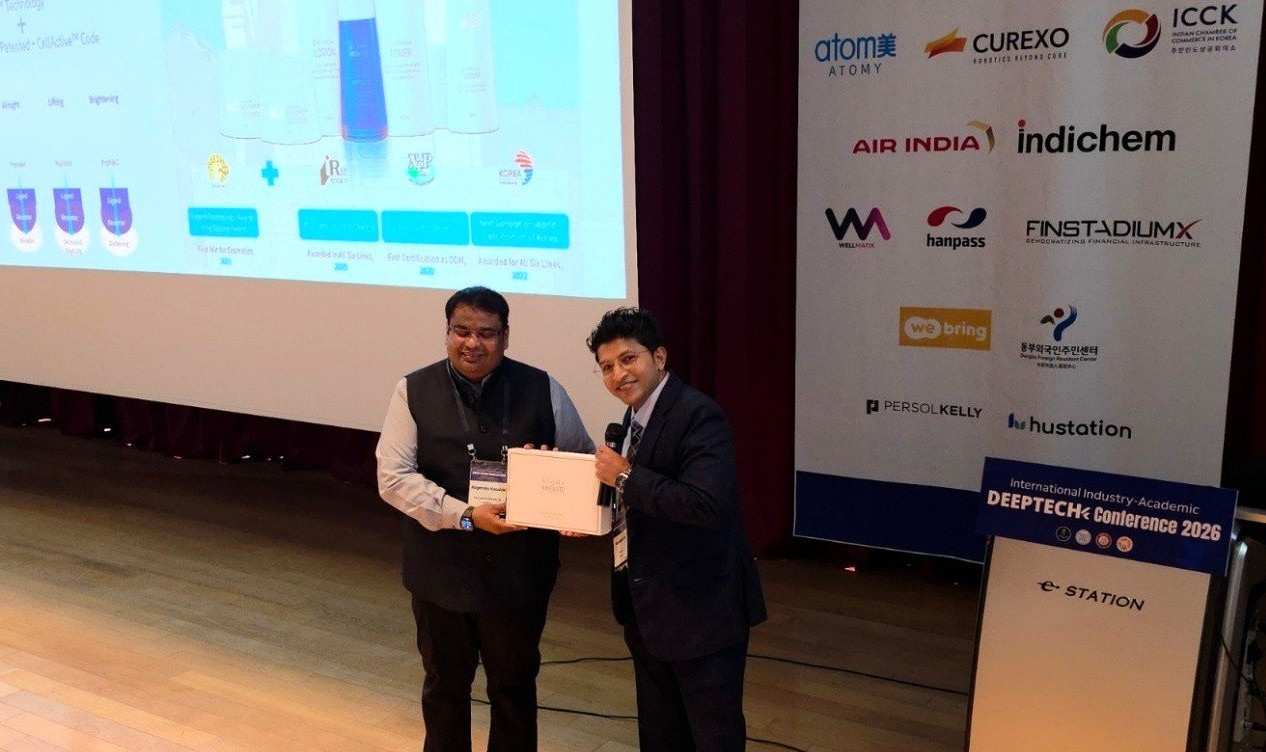
Seoul, South Korea: It is high time that India be considered as the natural “scale-up base” for the global expansion of Korean technology, as a closer Korea-India partnership in semiconductors, artificial intelligence, biotechnology and advanced infrastructure could create a powerful new growth axis in the changing global supply chain.
MD & CEO of Atomy India Dr. Abraham Lee said this while delivering a keynote address at the 2026 Industry-Academic DeepTech Conference in Seoul, recently, making a strong case for a new Korea-India technology partnership built on complementary strengths. He said India’s engineering talent, vast market and rapid industrial growth, combined with Korea’s technology and manufacturing strengths, made bilateral cooperation not merely desirable but strategically essential.
Dr. Lee said South Korea’s manufacturing and commercialization capabilities, when combined with India’s engineering talent and vast domestic market, could create a new axis of competition in the global supply chain at a time when the international technology race was increasingly being shaped by the United States and China.
The conference was organised to explore a fresh model of bilateral technology cooperation by linking South Korea’s advanced industrial strengths with India’s scale, talent pool and market potential. Industry and academic experts from both countries discussed collaboration in deep-tech sectors such as semiconductors, artificial intelligence and biotechnology.
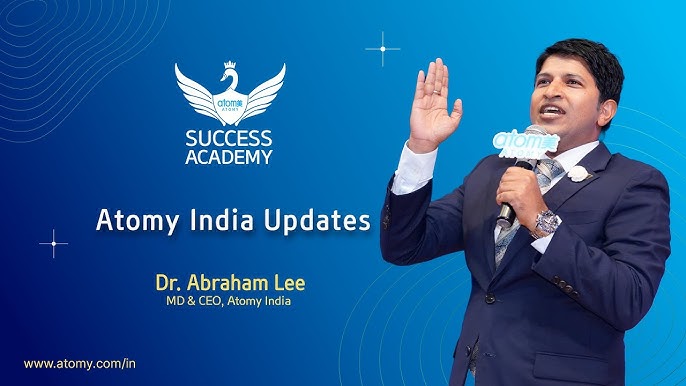
In his keynote speech, Dr. Lee proposed several specific areas for future cooperation. These included joint development of semiconductor lithography equipment, collaboration on green hydrogen and battery energy storage systems, building intelligent transportation systems and digital-twin-based infrastructure, and joint research in AI-driven biomedical technologies. He argued that such initiatives could move bilateral ties beyond discussion and toward practical industrial outcomes.
Dr. Lee, who is currently the MD & CEO of Atomy India and a Director of the Direct Selling Association of India, brought to the discussion an unusual mix of academic, industrial and cross-cultural experience. A Ph.D. in Structural Biochemistry at KAIST and a master’s degree holder from IIT Kharagpur, he has also served as former chairman of the Indian Association in Korea, former global manager at LG Life Sciences, and co-chairman of the MSME task force of FICCI. He is fluent in six languages, including Korean, English, Hindi and Bengali.
Widely seen as a Korea-friendly scientist and business leader who understands both countries’ technology ecosystems, Dr. Lee has also been recognised for building Atomy India into an example of how a Korean business model can be adapted successfully for the Indian market. He said the combination of Korean technology and India’s market size had the potential to shape global standards and stressed that cooperation between the two countries was “not an option, but an essential strategy.”
He also underlined the need for a more structured support system from government and industry to help Korean companies expand in India. According to him, the real barriers to entry for Korean firms were securing local manpower, bearing initial investment costs and achieving market settlement. Unless all three were addressed together, he suggested, the chances of failure remained high.
The conference also showcased practical case studies and research findings. These included AI-based brain tumour prediction models, protein design technology and rehabilitation robotics, as well as collaboration projects linked to digital transformation infrastructure and energy technology. Organisers said the event was significant because it moved beyond theoretical discussion and pointed toward joint research, industrial application and commercialisation.
Officials associated with the event believed the conference marked an important starting point for more substantive Korea-India cooperation, especially as global supply chains were being restructured and countries sought new technology partners. For Korean companies, the idea of using India as a strategic base appeared to be gaining sharper shape and practical relevance.
In a subsequent interview with the media outlet, Dr. Lee said his decision to choose Korea after completing his master’s at IIT Kharagpur shaped the course of his career. He recalled that his years at KAIST taught him not only technical competence but also a culture of speed, execution and teamwork, while his stint at LG Life Sciences helped him understand how technology could be translated into market success.
Reflecting on Atomy India, he said the venture grew by localising Korean technology-based products while building a two-way supply chain connecting Indian production and resources to global markets. Reiterating his keynote message, he said Korea-India cooperation in semiconductors, AI and biotechnology had become a strategic necessity, with India offering the critical advantages of talent, market size and growth. He added that support mechanisms were being prepared to assist Korean firms with manpower, funding and market entry, and said his long-term goal was to help create a shared growth structure through which Korea and India could together set new global standards in technology and industry.