
Japanese Learners to Test Fluency, Original Thinking at MOSAI’s 38th North Zone Speech Contest
The competition in New Delhi will select junior and senior winners for the All India Japanese Language Speech Contest; institutions must submit nominations and speeches by October 5.

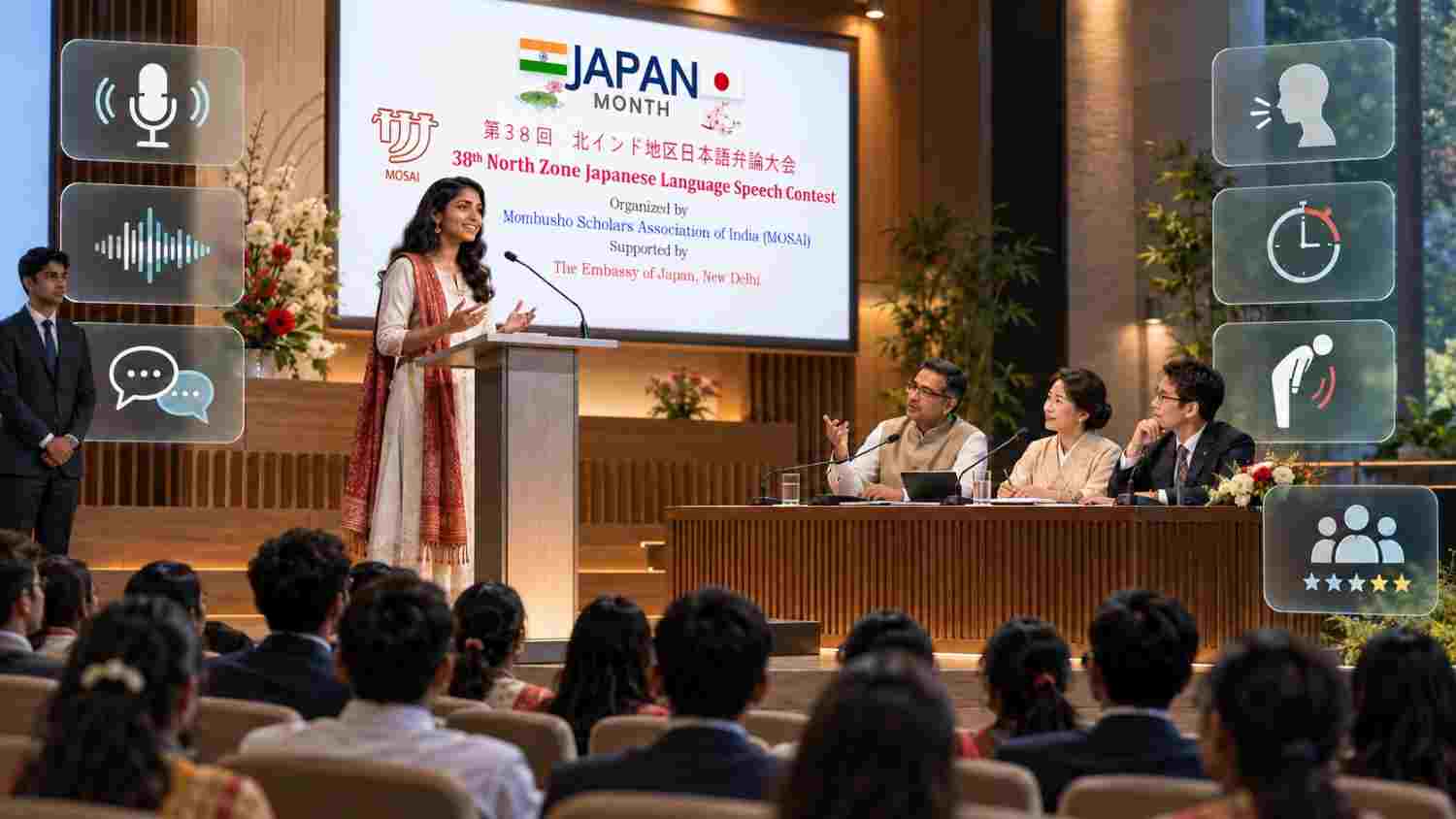
New Delhi: Japanese-language students from across northern India will have an opportunity to demonstrate far more than memorised vocabulary when they take the stage at the 38th North Zone Japanese Language Speech Contest in New Delhi on October 24.
The competition will test participants’ ability to express original thoughts and personal experiences spontaneously in Japanese, respond to questions from language experts, and communicate with the pronunciation, intonation, and etiquette associated with Japanese public speaking.
Organised by the Mombusho Scholars Association of India (MOSAI), with support from the Embassy of Japan in New Delhi, the contest will be held at the Mount Carmel School auditorium, A-21, Anand Niketan. Registration will begin at 2 p.m., followed by the inaugural session at 2.30 p.m.
Jinichi Kadowaki, Minister and Deputy Chief of Mission at the Embassy of Japan in New Delhi, will be the chief guest and deliver the inaugural address. MOSAI President Dr Ashok Jain will welcome the participants, teachers, jury members and guests.
The annual contest aims to encourage Japanese-language education in India while giving learners a platform to use the language creatively and confidently outside the classroom.
Unlike an examination centred on written answers or rehearsed grammar, the competition requires students to communicate their own ideas naturally. MOSAI’s contest guidelines specifically state that it is not a memory test based on the reproduction of a written speech.
Each speech must be completed within four minutes and will be followed by a two-minute question-and-answer session. Questions will relate to the speech topic and will be calibrated to the participant’s Japanese level.
The questioning round will allow language experts to assess whether contestants understand what they have presented and can communicate spontaneously rather than simply repeat memorised material.
Two categories for different learning levels: The competition will be conducted in junior and senior categories. Japanese-language institutions may nominate up to three students in each category from among those currently enrolled.
The junior category is open to students who have completed up to 600 hours of Japanese-language study. For the contest generally, candidates must not have studied Japanese for more than 1,500 hours or five years.
Eligible participants should ordinarily be between 18 and 35 years of age, although the rules permit a six-month relaxation at the lower and upper age limits in specially recommended cases.
Candidates must be formally enrolled in an institution in India that teaches Japanese and nominated by that institution. Regular Japanese-language teachers, Japanese nationals and students who have studied in Japan for more than three months are not eligible. A candidate is also ineligible if either parent is a native Japanese speaker.
Students who have previously secured first place in the same category cannot compete in it again. A junior-category winner may, however, participate at the senior level after the prescribed interval.
Eligible nominating bodies include Japanese departments, colleges and centres affiliated with recognised universities, as well as registered companies, societies, trusts and organisations that teach the language.
Originality, delivery and cultural etiquette to matter: Contestants may choose their subjects, but speeches on religion and politics are prohibited. The organisers have encouraged participants to select themes rooted in their experiences and individual thinking, using grammar, vocabulary and expressions appropriate to their level.
Participants will be assessed across five principal areas—content, delivery, grammar and vocabulary, etiquette and manner, and responses during the question-and-answer session. Each component carries 10 points.
Content should be logically structured and display personal reflection. Delivery should be fluent and expressive, and grammar and vocabulary should match the contestant’s category (junior or senior)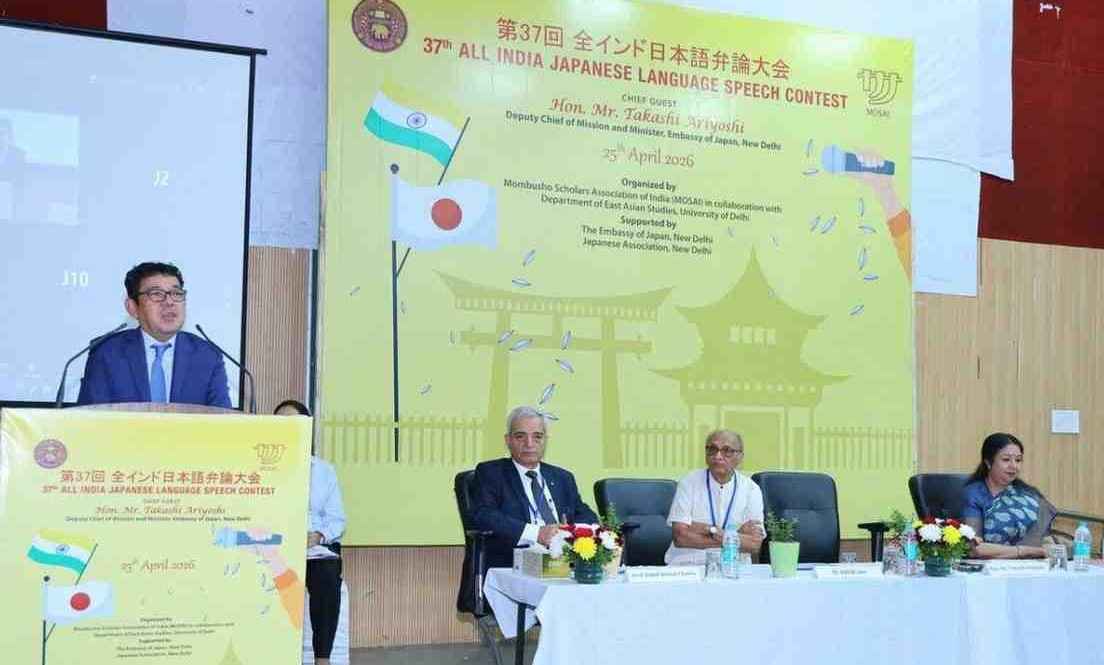 .
.
Judges will also observe pronunciation, pauses, emphasis, gestures and other elements of speaking etiquette. Reading or consulting a written manuscript will attract negative marks, as will exceeding the four-minute time limit.
To preserve anonymity during judging, participants must not disclose their names, the names of their institutions or the cities where they are studying Japanese. Copying a speech delivered previously or sourced from written or electronic material can lead to disqualification.
Prof Ashok Kumar Chawla, the programme coordinator, and Dr Sushma Manda will brief the jury before the contest. Ms Himani will compere the programme and explain the rules and regulations to the participants.
Junior-category speeches are scheduled between 3 p.m. and 4.30 p.m., followed by a short break. Senior contestants will speak from 4.40 p.m. to 5.30 p.m. The concluding session will include the jury chairman’s observations, the announcement of results, the presentation of certificates, and the distribution of prizes.
Kadowaki will present prizes to the winners, while Dr Jain will distribute participation certificates. Dr Sushma Manda will deliver the vote of thanks.
All contestants will receive certificates, while the first-, second- and third-place winners in both categories will receive special prizes. The three leading contestants from each category will also become eligible to represent the North Zone at the All India Japanese Language Speech Contest.
The national competition traces its origins to 1985 and is preceded by regional contests in the North, South, East and West zones. MOSAI conducts the North Zone contest, while partner organisations coordinate the other regional rounds.
Institutions must submit completed nomination and individual application forms, together with contestants’ speeches in Word format, by October 5, 2026. Applications must be routed through the Japanese-language institutions where students are currently enrolled; individual students cannot enter independently.
The contest will ultimately measure not only how much Japanese the students have learnt, but whether they can use it to think, communicate and respond confidently before an audience—the skills that turn classroom learning into genuine command of a language.