Taiwan, India Institutionalise Public Finance Cooperation as Bilateral Trade Hits Record $12.5 Billion
New agreement expands fiscal engagement into taxation, customs, treasury affairs, infrastructure and international finance as the two sides seek stronger supply-chain and investment partnerships

Bengaluru: Taiwan and India signed a Memorandum of Understanding (MoU) on Public Finance Cooperation in Bengaluru on Friday, August 28, establishing a regular institutional mechanism for exchanging fiscal knowledge and expertise between the two sides.
The agreement was signed by Mumin Chen, Representative of the Taipei Economic and Cultural Center (TECC) in India, and Ninad S. Deshpande, Director General of the India-Taipei Association (ITA), according to a statement issued by Taiwan’s Ministry of Finance.
The MoU strengthens the existing public finance cooperation between Taiwan and India and provides a structured platform for bilateral exchanges. It is expected to support closer coordination among officials and professionals working across a range of fiscal and financial fields.
“The MOF further explained that the MOU takes effect on the date of signature (i.e., August 28, 2026), which will establish a systematic mechanism for bilateral fiscal exchange and be beneficial to further deepening exchanges and cooperation,” the release said.
The new arrangement builds on agreements signed by Taiwan and India in 2011 covering the avoidance of double taxation and mutual assistance in customs matters. It expands their collaboration into taxation, customs administration, treasury affairs, national property management, infrastructure projects and international financial cooperation.
Highlighting the practical mechanisms through which the agreement would be implemented, the release added, “Going forward, both sides will deepen professional exchanges and experience sharing through bilateral meetings, seminars, participation in training programs, and mutual consultations.”
The public finance agreement came amid a broader expansion of economic and institutional ties between India and Taiwan, supported by growing commercial engagement and investment in strategically important sectors.
Taiwanese companies have played a significant role in strengthening India’s electronics manufacturing ecosystem. Foxconn, one of the world’s largest electronics manufacturers and a key supplier to Apple, has substantially expanded its Indian operations in recent years. The company’s growing presence reflects the wider interest among Taiwanese businesses in India’s manufacturing capacity, consumer market and policy incentives.
Formal economic engagement between India and Taiwan dates back to 1995, when the two sides established representative offices. India set up the India-Taipei Association in Taipei, while Taiwan established the Taipei Economic and Cultural Center in New Delhi.
Bilateral trade reached a record USD 12.514 billion in 2025, rising 17.95 per cent from USD 10.609 billion in 2024, according to data released by TECC in India. India was Taiwan’s 15th-largest trading partner during 2025.
Taiwan’s exports to India increased 16.74 per cent to USD 9.212 billion, making India its 11th-largest export market. Imports from India rose even faster, increasing 21.46 per cent to USD 3.302 billion, with India emerging as Taiwan’s 21st-largest source of imports.
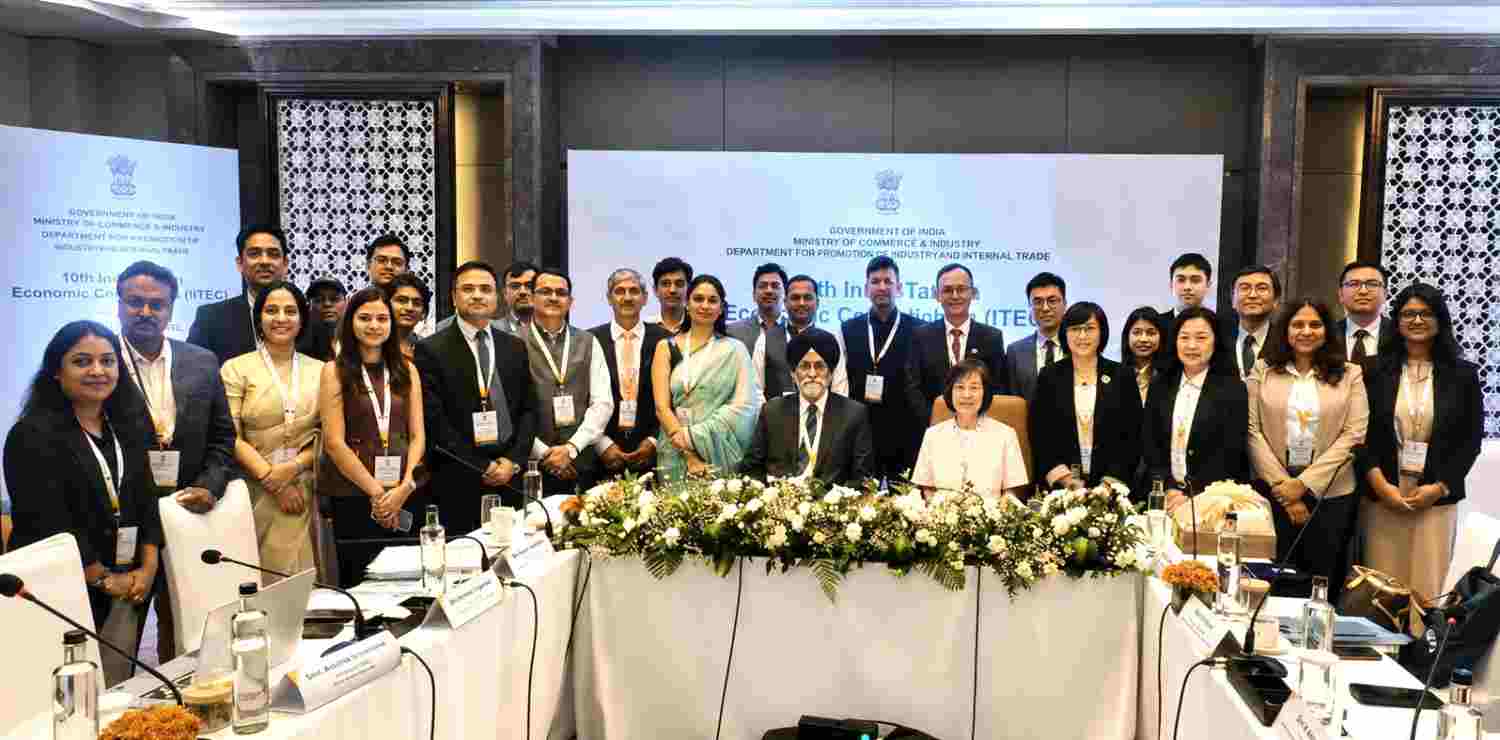
The signing took place on the same day as the 19th Taiwan-India Economic Consultation, held in Bengaluru on August 28. The consultation featured detailed exchanges on global trade developments, supply-chain resilience, investment strategies and talent cultivation.
The meeting was jointly convened by Cynthia Kiang, Taiwan’s Deputy Minister of Economic Affairs, and Amardeep Singh Bhatia, Secretary of India’s Department for Promotion of Industry and Internal Trade.
Kiang commended the Indian government’s Make in India and Digital India initiatives, which seek to attract global investment at a time of geopolitical uncertainty and the restructuring of international supply chains.
Drawing attention to Taiwan’s established strengths in semiconductors, information and communications technology and advanced manufacturing, Kiang expressed hope that Taiwan and India would expand their supply-chain partnership and make greater use of their complementary capabilities.
Bhatia said the Indian government had actively pursued policy reforms and infrastructure development in recent years to improve the country’s business environment and make it more attractive to foreign investors. He expressed hope that Taiwan and India would continue strengthening cooperation across emerging areas.
He also welcomed the scheduled resumption of direct flights between Taipei and New Delhi in December 2026, saying the restored air connection could generate additional trade and investment opportunities.
According to Taiwan’s Ministry of Economic Affairs, the two sides also concluded two MoUs covering financial and financial technology cooperation during the economic consultation. They also extended an existing agreement on cooperation in intellectual property rights.
The economic consultation followed a series of high-level engagements involving officials and corporate representatives from both sides. On August 27, Kiang and Bhatia participated in the fifth Taiwan-India CEOs Roundtable, where discussions focused on India’s investment environment and taxation-related issues.
The two officials also attended the India-Taiwan Industrial Collaboration Summit, which brought together more than 200 business representatives from Taiwan and India. The summit concentrated on sectors with considerable potential for bilateral collaboration, including smart electronics, green and smart technologies, and smart automotive components.
Taken together, the public finance agreement, financial and fintech MoUs, intellectual property cooperation and industry-level discussions reflect an effort to give Taiwan-India economic engagement a broader institutional foundation.
The developments also show that the relationship is expanding beyond trade in goods into regulatory cooperation, investment facilitation, talent development, resilient supply chains and knowledge-sharing. With bilateral commerce already at a record level and direct air connectivity set to return, the latest agreements could help translate the two economies’ complementary strengths into deeper and more diversified cooperation.