
Beyond AI Fearmongering, Toward the True Evolution of Industry
By Phil Chung, CEO, KINEXIN Convention Management, Operator of Yashobhoomi (India International Convention & Expo Centre), New Delhi

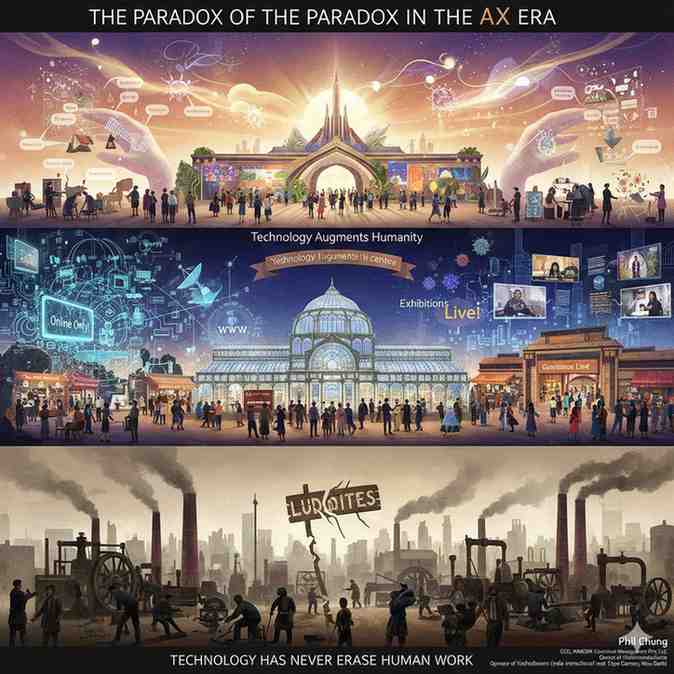
The Paradox of the Paradox in the AX Era: When we look at today’s debates surrounding rapidly advancing technologies—AI, robotics, semiconductors, crypto, quantum computing—a familiar pattern emerges.
“Jobs will disappear.” “Humans will no longer need to work.” “Physical interaction is over.”
This apocalyptic narrative is not new. In fact, it is remarkably repetitive.
Having worked across AI-driven industries, advanced technology sectors, and the global MICE (Meetings, Incentives, Conferences, Exhibitions) industry in Korea, the United States, and India, I have repeatedly observed that these fears are disconnected from historical reality.
From the Industrial Revolution to the dot-com bubble, from SARS to COVID-19—every era of technological transition has begun with the declaration that “this time, it’s the end.”
History tells a very different story.
From the Industrial Revolution to the World Expo: During the 18th-century Industrial Revolution, spinning machines and steam engines were seen as harbingers of mass unemployment. The Luddite movement destroyed machines in the belief that technology would eradicate human labor.
What actually happened? While certain tasks disappeared, entirely new industries emerged—manufacturing, logistics, engineering, distribution, marketing—on a scale previously unimaginable. Advances in steam power and transportation did not shrink economies; they expanded them exponentially.
If air quality had been measured in industrial-era London using today’s AQI standards, the numbers might have been catastrophic. Yet no serious historian would argue that industrialization made humanity poorer in opportunity or employment.
On the contrary, it created factory workers, technicians, engineers, inventors, writers, planners, and laid the foundation for modern industries, including the MICE sector in which I work today.
A defining moment was the Great Exhibition of 1851, held at London’s Crystal Palace. Nations gathered to showcase innovation, exchange ideas, and compete for technological leadership. The modern exhibition and convention format was born not despite industrialization, but because of it.
The Dot-Com Era, SARS, and the Myth of “The End of Offline”: Fast forward to the late 1990s and early 2000s. During the dot-com boom—and later the SARS pandemic—a similar argument resurfaced: offline interaction would fade, exhibitions would decline, and teleconferencing would replace physical gatherings.
At the time, I was working in marketing at a software company in New York. Major newspapers, Silicon Valley commentators, and technology firms confidently predicted the obsolescence of face-to-face business.
We now know how wrong that assumption was. Offline interaction did not disappear. Instead, it fused with online platforms, catalyzing explosive growth in commerce, advertising, media, and content industries.
The same illusion reappeared during COVID-19:
“Conferences are over.”
“Everything will move to Zoom.”
“The metaverse will replace reality.”
Yet one of the fastest-recovering global industries post-pandemic was the exhibition and convention sector. Informa, the world’s largest exhibition group, saw its stock collapse during COVID—only to rebound to historic highs in the following years.
In Korea, KINTEX—the largest shareholder of KINEXIN, which I currently lead—expanded its global footprint, while Messe Esang, a major Korean exhibition organizer and co-investor, successfully listed on KOSDAQ.
These are not signs of an industry in decline.
AI, Creativity, and the Illusion of Replacement
We now face the same fears in the era of AI transformation (AX).
Does AI replace creativity?
When companies embraced Google-centric SEO, traditional marketing did not die. Instead, new roles emerged—data analysts, content strategists, performance marketers.
Today’s AIO (AI Optimization) follows the same trajectory. Algorithms may suggest keywords and timing, but brand identity, narrative coherence, and cultural sensitivity remain human responsibilities.
Design tells a similar story. Generative AI can produce countless visual drafts, but determining what is meaningful, sustainable, and commercially viable still depends on professional designers’ judgment and experience.
Literature is no exception. AI can generate poetry, but transforming words into literature requires a poet’s sensitivity to nuance, silence, and the emotional undercurrents of an era.
Technology expands the doorway of creation—but humans still decide what walks through it.
The Exhibition & Convention Industry: The Oldest “Future Industry”
Few industries have been declared obsolete as often as exhibitions and conventions.
From television to the internet, from the metaverse to VR and mixed reality, predictions of replacement have been constant—often from technocratic perspectives dismissing physical gatherings as inefficient.
Yet this industry’s roots stretch back thousands of years—to ancient trade fairs, religious assemblies, and even marketplaces described in the Old Testament.
Human civilization has never advanced at scale without people meeting in person.
Crucially, the MICE industry has never resisted technology. It absorbs it. Digital transformation has enabled data-driven exhibitions, global participation, and hybrid formats.
VR and metaverse technologies are not substitutes for reality; they are tools to better understand and augment it.
AI Creates Redefinition, Not Unemployment: AI will eliminate repetitive, inefficient tasks. That is undeniable. But the result is not human idleness. Just as the internet expanded the volume and complexity of information we manage, AI will enable us to solve more complex problems and assume more diverse roles.
Every technological leap is accompanied by the claim, “This time is different.”
History has never validated that claim.
The real threat to future generations is not technology, but a lack of imagination.
I firmly reject the notion that AI, robotics, crypto, or quantum computing will make humanity redundant. The danger lies not in technology itself, but in failing to see it as an extension of human capability.
As the exhibition and convention industry has repeatedly demonstrated, industries do not vanish—they evolve, becoming more integrated, more multidimensional, and ultimately more human-centric.
History has always moved this way.
This time is no different.
What we are witnessing is not the end of work—but the arrival of a richer era, filled with greater tools, deeper content, and far more to create.
 About the Author: Phil Chung is the CEO and Managing Director of KINEXIN Convention Management, the operating company for India’s Yashobhoomi (IICC) in New Delhi. With over 20 years of experience at Korea’s KINTEX, he specializes in MICE industry management, international tradeshow development, and venue operations. He is also the General Director of KINTEX. His focus has been to establish Yashobhoomi as a major global hub for trade shows and investment in India. Phil has been involved with the MICE industry, creating, managing, and operating large-scale venues, and fostering international partnerships. He has been instrumental in securing major international events at the Yashobhoomi venue, including Semicon, Power Gen, and other trade shows.